
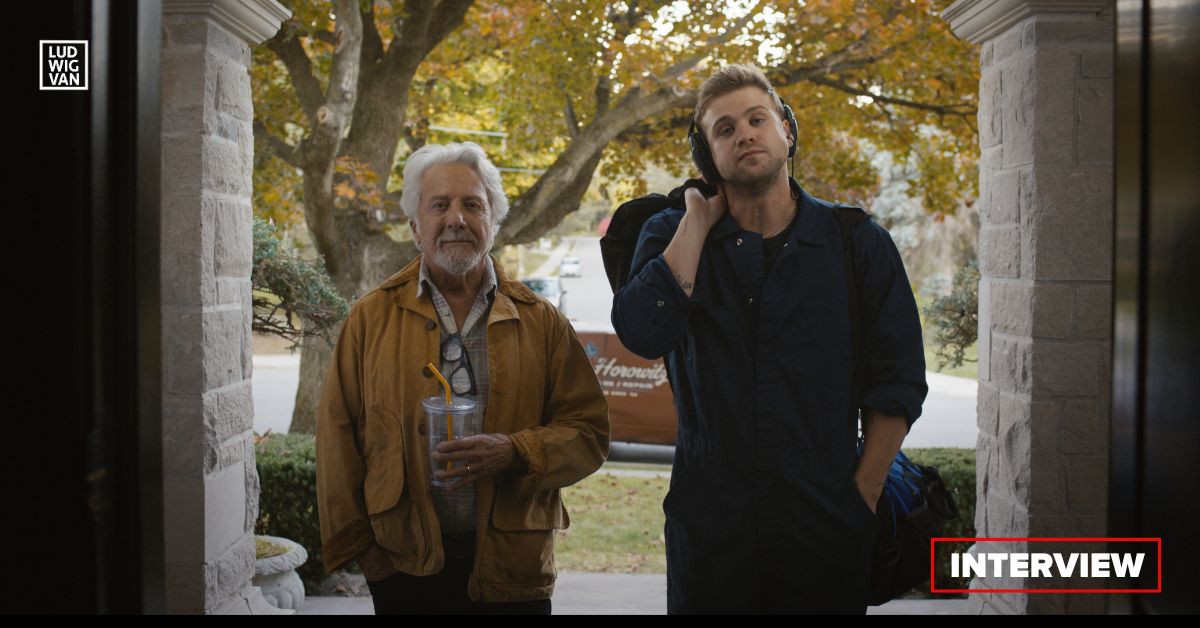
Documentarian Daniel Roher makes his feature debut with Tuner, a film that is part crime caper, part romance, with a strong underlying thread about the nature of music, art, and the artist. The film made its Canadian premiere at the Toronto International Film Festival in 2025.
Roher’s documentary credits include Once Were Brothers: Robbie Robertson and the Band, which opened the Toronto International Film Festival in 2019, and Navalny, for which the director won the Academy Award for Best Documentary Feature Film in 2023.
Tuner composer Will Bates was born in London, and we asked him about his work on the movie.
The Movie
Leo Woodall (The White Lotus, One Day), plays Niki White — once a virtuoso pianist, now a piano tuner. He lives with a condition called hyperacusis, where a person’s hearing is hyper-acute to the point of causing discomfort and even pain, and as he grew into his teenage years, it made music making unbearable. He constantly wears ear phones to block out the everyday noise.
Now and then, sound designer Johnnie Burn lets us hear the world the way Niki hears it without them in all its crazy highs, lows, and distortion. It’s disorienting, to say the least.
On the bright side, it makes him an excellent piano tuner.
That’s what he’s doing as the film opens, in a partnership with his uncle Harry Horowitz (Dustin Hoffman), an old jazz cat who’s been keeping New York’s pianos playing harmoniously for decades.
Dustin Hoffman adds much of the humour to the movie’s opening, both alone and in his banter with screen wife Marla, played by Tovah Feldshuh. He’s perfected the lovable old curmudgeon with a nice edge and sense of authenticity. Woodall also shines in the centre of the film, convincing as someone whose dream has gone awry, and is left drifting in its wake.
Casual abuse by their clients, who ask for everything from help fixing toilets to coming late at night in order to work in client are par for the course. It’s on one such occasion, working late, that Niki stumbles on to a couple of safecrackers, and a realization: what amounts to an auditory disability in everyday life becomes an unusual gift for hearing the tumblers as they settle into place while illegally opening a safe.
Plot
“Tuning a piano’s about creating harmony out of chaos.”
In some ways, and without giving away too much, the plot is a little predictable. Niki is reluctant to get involved, despite his obvious advantage, but then Dustin Hoffman’s Harry Horowitz falls ill, and money is short…
It’s part crime caper movie, with scenes that depict both the highs and the lows of robbing the rich of their safes. Lior Raz plays the charismatic, yet dangerous, head of the thieves Niki stumbles upon.
But, along the way, Niki also meets Ruthie, played by an appealing Havana Rose Liu. She’s a composition student, and she struggles with her latest work.
Their relationship opens up a romantic side to the story, but also a discussion of art and the artist. Who is he, Niki wonders, if he can no longer be a virtuoso? Does he have to spend the rest of his life spinning his wheels? To its credit, the movie offers no easy answers to those existential questions.
During the course of the story, Ruthie plays some of her composition, contemporary music actually written by Marius de Vries, who also served as the executive music producer for the film.
Will Bates: The Interview
Will Bates composed the movie soundtrack. Bates has composed scores for a wide range of filmmakers that include Paramount+’s NCIS: Tony & Ziva, which just premiered on September 4, Netflix’s mini-series Devil in Ohio; and the Golden Globe and Emmy-nominated Netflix mini-series Unbelievable to name only a few.
Bates is also a solo artist and multi-instrumentalist with his own post-punk band The Rinse, and has recorded and toured internationally. He’s primarily a saxophonist, and as such, he’s collaborated with a range of artists. He’s also a producer and composer.
The soundtrack for Tuner ranges from contemporary jazz to tense electro and neoclassical passages.
Bates appreciates that the film gave me the chance to write in a range of styles from action-oriented to romantic. “I mean, it’s a very emotional story between Nicki and Ruthie,” he says. “A lot of the music that’s on camera is needed to emphasize the technical expertise of the characters.”
Niki’s story, and his relationship to music, is something Bates can empathize with. “It’s very much something that I can relate to. I feel like my identity as a human being is so connected to what I do.”
The scene where Niki confronts his feelings about his situation is a poignant one. “That frame resonated with me — what would happen if you couldn’t express yourself in that way?” he says.
He’s been involved with music since he was a child. “I started life as a saxophone player, and I started as something of a child prodigy,” he says. An accident that injured his fingers changed the trajectory of his plans.
“It was something I thought about when I worked on this film.”
The musical excerpts sometimes act as something of a counterpoint to the action on screen. “Daniel was quite clear […] it should be a balance to what is seen on screen,” he explains. It acts to flesh out the underside of the action on screen.
“How can we get under the hood of these characters?” While the virtuosity of characters like Niki and Ruthie is in evidence, the music adds emotional underpinning. “We need to develop some subconscious themes.” He put music to the subtext, in other words.
Building the Score
“We wanted to throw a lot at the page,” Will says. “I build big, intricate pieces. And then I find myself taking a sledge hammer to all that,” he continues. “How can I say the same thing with less? That was certainly the case with this movie.”
Once he’s pared it back, something emerges. “To me, that’s melody,” he says.
As a film score, it’s always about how to enhance the story.
“In the end, we have to realize we’re in the service of story. It’s not about us,” he explains. He tries to express what isn’t necessarily said out loud in the dialogue. When it comes to Niki and Ruthie’s story, it was about building a connection between them from the outset.
“It’s obviously in their performance, and I’m really there to amplify what’s on screen.”
Marius de Vries hired outside consultants to train both actors to be able to play his music on screen. That part of the film was already done when Bates came on board.
“It was a useful thing for me to be able to contrast and work against.”
Film maker Daniel Roher wanted the movie score to have a separate composer, a different voice.
“Obviously, there’s a lot of jazz in this movie,” he states. Roher wanted the score to include something of a nod to that aspect of the story, but also offer a contrast.
“What would it sound like if Bill Evans had access to modular synths?” he wondered. Roher loved the idea.
He got creative with instrumentation, including a vintage East German tuning device. “It has different switches for different pitches,” he explains. “It’s very wonky, and makes these kinds of strange tones. I used that to build chords.” He enjoyed being able to use an instrument he’d collected some time ago. “What a perfect place to use this weird instrument that I’ve had for a while,” he continues. “I have a strange habit of collecting odd electronic instruments.”
Roher was clear on one point: he wanted the movie score Bates wrote to contrast the orchestral music that the characters were playing in the story. It had to offer a different sound world.
“That was definitely part of the fun of this project, was to incorporate those strange sounds and then add the more familiar elements.”
Other pieces in his instrument collection also proved handy. Bates had been going to estate sales with his wife, and once they knew what he did, he was offered free pianos. “I took them all,” he laughs. “I became the guardian of these pianos.”
His wife, an artist, has deconstructed a few with the use of hammers, and he’s retained the harp from one of them. He used it for the scenes where Niki is cracking a safe.
“The percussive sounds are me banging on the piano harp.”
Tuner will screen at the Zurich Film Festival on September 30, and then the Vancouver Film Festival on October 11. Look for it to hit a screening service sometime in the near future.
Fun fact: Herbie Hancock makes a cameo appearance in this film where music and musicality play a role of their own.
Are you looking to promote an event? Have a news tip? Need to know the best events happening this weekend? Send us a note.
#LUDWIGVAN
Get the daily arts news straight to your inbox.
Sign up for the Ludwig Van Toronto e-Blast! — local classical music and opera news straight to your inbox HERE.

- PREVIEW | Classical Guitarist Alexandra Whittingham Makes Toronto & Ontario Debuts - March 13, 2026
- PREVIEW | Soundstreams Presents Quatuor Bozzini: With Strings Attached - March 13, 2026
- INTERVIEW | Award-Winning Librettist & Against The Grain AD Royce Vavrek Talks About Canuck Cantatas - March 13, 2026