
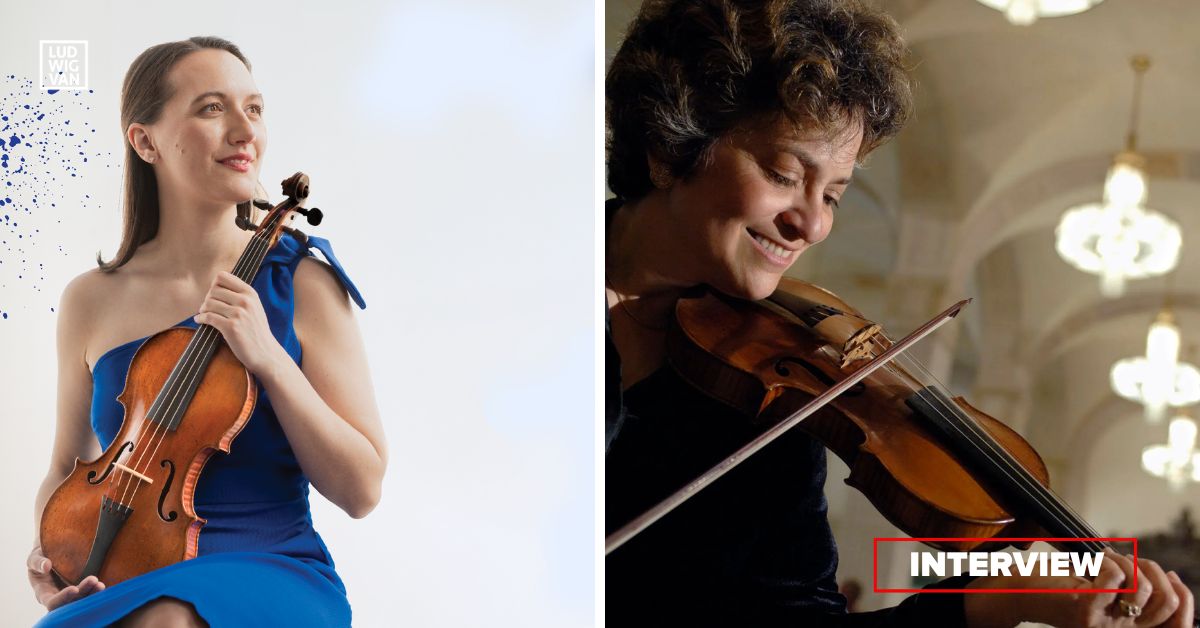
Violinist Yolanda Bruno usually performs on a Venetian instrument made by master craftsman Domenico Montagnana in 1737 (on loan from Groupe Canimex). But, it’s another Venetian violin, and its former owner, who is the focus of her upcoming release, Dear Jeanne.
Canadian-American Baroque violinist Jeanne Lamon led Toronto’s Tafelmusik for 33 years, performing on a 1759 Santo Serafin Baroque violin that she’d purchased years ago.
She was also a teacher and mentor to Bruno, who recorded the album on Jeanne’s Santo Serafin. Dear Jeanne will be released live on September 3, with a release concert and a documentary film screening.
We talked to Bruno about the violin, the music, the film, and Jeanne Lamon.
Jeanne Lamon
The late Jeanne Lamon was born in Queens, New York in 1949, and she would later say that her fascination with the Baroque era stemmed form her mother’s own love of Bach. Her name at birth was Jean Susan Lamon.
Jeanne wanted to play the violin from the age of three, a wish that was granted when she was seven. She first studied the instrument formally at the Westchester Conservatory of Music, and went on to attend Boston’s Brandeis University, where she earned a Bachelor of Music. She continued her studies in the Netherlands privately when Herman Krebbers, who was the concertmaster of the Concertgebouw Orchestra in Amsterdam. That’s where she first heard a Baroque concert, and shortly afterwards, she replaced her violin with a Baroque instrument.
After her studies, she launched her career in the US, teaching at Smith College in Massachusetts, and performing as a soloist and with various ensembles and orchestras. She became the first violinist to win the Erwin Bodky Award for Excellence in the Performance of Early Music in 1974.
Among her many performances during that period were two as a guest musician with Toronto’s Tafelmusik Baroque Orchestra in the late 1970s. In 1981, she was invited to become Tafelmusik’s Music Director.
Since women were rare in positions of musical leadership (then as now), Lamon changed her name from Jean to Jeanne to avoid confusion over the fact that Jean is a male name in the French language.
She moved to Toronto in 1981, and became a Canadian citizen in 1988. She led Tafelmusik for 33 years until her resignation after the 2013/14 season.
During her tenure, Tafelmusik became an internationally recognized Baroque music ensemble. The ensemble toured the world, and recorded several highly regarded albums. Lamon also performed as a soloist, and recorded her own albums.
Her invaluable contributions to Canadian classical music were recognized by multiple awards and honours, including the Muriel Sherrin Award presented by the Toronto Arts Council Foundation. She was made was appointed a Member of the Order of Canada on July 13, 2000, and a Member of the Order of Ontario in 2014.
After stepping down from Tafelmusik, she lived on Vancouver Island with her partner of 43 years, Christine Mahler, (also former cellist with Tafelmusik). Jeanne died of cancer in 2021.
Yolanda Bruno
Violinist Yolanda Bruno is a native of Ottawa. Her talent has been recognized by several awards and competition wins, including Grand Prizes at the Montreal Symphony Orchestra Competition and the inaugural Isabel Overton Bader Violin Competition. She received the Canada Council for the Arts’ Virginia Parker Prize — the nation’s highest honour for young musicians.
Yolanda has performed as a soloist with the Montreal Symphony, Toronto Symphony, Orchestra of the Americas, and London Mozart Players, and her career includes a range of genres and styles, including everything from performing for the Queen at Buckingham Palace to recording with Australian heavy metal band Parkway Drive.
Yolanda served as Concertmaster at the Kingston Symphony Orchestra and Associate Concertmaster at the Toronto Symphony Orchestra. She teaches chamber music at The Glenn Gould School.
J.S. Bach Sonata Sonata No. 3 in C Major, Largo, performed on the Jeanne Lamon 1759 Santo Serafin Baroque violin, recorded at the Isabel Bader Centre for the Performing Arts (Kingston, ON, Canada):
Yolanda Bruno: The Interview
The album, and the film, focus on Jeanne’s violin.
“Her instrument was made in Venice in 1759,” Bruno explains. “It’s really a one of a kind instrument. What makes it quite remarkable is that it’s set up as a Baroque instrument.”
As she relates, that’s a modification that Lamon initiated herself in the 1990s. Typically, Baroque instruments are modernized by adjusting the angle of the neck and bridge in order to project sound more loudly, in keeping with modern concert hall dynamics. During the European Baroque period, performances were often in church with acoustics determined by the architecture, or a smaller, domestic setting.
“The vast majority of antique instruments that we see today, their necks have been adjusted.”
It is believed that Jeanne bought the instrument from Sotheby’s in New York in the late 1980s.
“She was probably the only woman in the room,” Yolanda laughs.
Lamon had only a few minutes to make up her mind whether or not the instrument was for her. She’d been interested in another, similar violin by the same maker which had come up for auction earlier, but the bidding had gone beyond her budget.
She made her choice, and outbid all the other violinists and collectors at the auction. Lamon knew already that she wanted to restore it to its original Baroque specs, and that process took about a year.
“Tafelmusik was just at the beginning of their international careers,” Yolanda points out.
Jeanne made her investment in the instrument, and she performed on it for all of Tafelmusik’s award-winning recordings.
“When she picked it up, she said it just felt like a hand in a glove,” Bruno recalls.
After Jeanne passed away in 2021, her partner Christine Mahler planned on donating the instrument to the Canada Canada Council for the Arts Musical Instrument Bank. It would represent the first violin with an authentic Baroque configuration in the Instrument Bank. The violin has since been donated on loan to historical violinist Naomi Dumas, under the condition that it retain its Baroque configuration.
While she was involved in doing the considerable paperwork involved for the donation, however, Christine asked Yolanda if she’d like to play the violin.
“You get really intimately close to someone when you’re playing their instrument,” Bruno says.
The Album
The idea for the album came to her as she performed on the Serafin, but Bruno realized she had to secure funding. That came through on a last minute grant application.
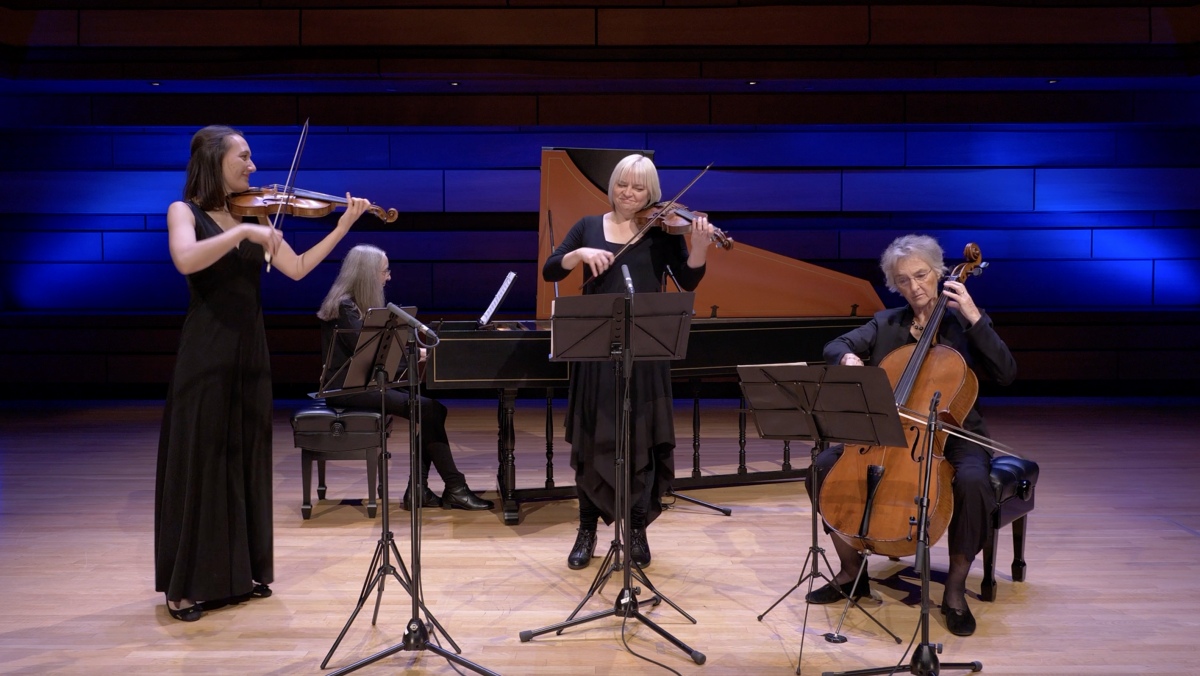
As a tribute to both Jeanne and her violin, the centrepiece of the album is Jeanne’s string trio arrangement of Bach’s iconic Ciaccona or Chaconne. The Chaconne, originally written for solo violin, is part of the Partita No. 2 for Violin in D minor, essentially a collection of shorter pieces.
“In the end, I recorded it at the Isabel Bader Centre in Kingston,” Bruno says. The trio was rounded out by violinist Julia Wedman, Christina Mahler, and Tafelmusik harpsichordist Charlotte Nediger.
Lamon originally wanted to perform the Chaconne as a trio with Yolanda and Christina in Kingston. That was scheduled just after the pandemic hit.
“Of course that got cancelled. We recorded that in the specific hall where that recital was supposed to happen.”
The recording took place in 2022, during the same week that a tribute to Lamon was staged at the Kingston venue. It was an emotional performance.
“We tied everything to Jeanne in some way,” she says. That includes adding French Baroque music to the album — Jeanne’s favourite genre.
“It’s spiritual,” Yolanda says, “it’s also very dynamic.”
There’s a new work on the album as well. “I commissioned a piece by Toronto based cellist and composer Beth Silver,” Bruno says.
Jeanne’s family was originally from The Netherlands, where they worked in the diamond cutting industry. Her father, wanting to get out of the family business, took a year off, and went to America in about 1938. The family had a Jewish background, and once WWII broke out, he tried to get his family members to join him.
“He urged his family to come to America.”
Unfortunately, most did not make the trip, and Lamon’s father lost a large part of his family to the Holocaust.
“I approached Beth and said, can we find something from the era, and something that will honour Jeanne’s family history?”
Silver found a seder poem from a 17th century prayer book and worked to adapt it into a piece for violin. “She’s made it into something a little more folk-like,” Yolanda says. “It’s a lovely solo violin piece,” she adds.
“And then the big fireworks of this album is Vivaldi’s La Folia.”
Vivaldi’s La Folia, also a chaconne, is a set of 20 variations on an ancient Portuguese folk tune of the same name (which means “madness”). Written in 1705, it connects with the era and also the geography of Lamon’s violin. Bruno points out that it’s probable that Vivaldi himself played a Serafin violin.
A Film About An Antique Violin
“I know nothing about this violin before Jeanne played it,” Bruno says. “It’s been named the Jeanne Lamon Serafin.”
A documentary film screening is part of the September 3 launch event.
“A big part of the launch event is a documentary film that we made about the instrument.”
Bruno produced the film, titled The Immortal Serafin. Robert DiVito directs, and it was developed by Bruno’s partner, musician Michael Bridge.
The documentary incorporates interviews with leading Canadian violin antiquarian and restorer Ric Heinl, violin restorer and former member of Tafelmusik Jaak Livoya, who helped Jeanne to acquire the violin in the late 1980s, and Ottie Lockey, the Managing Director of Tafelmusik for 19 years.
Bruno also performs and speaks about the violin, and larger issues, in the film. She says she wants to underscore the instrument’s age, and its survival over nearly 300 years.
“How does that relate to how we look at and consume today?” she asks. For Serafin, it was a good business move that would give him a marketable reputation for quality. “You took time to make something of quality, and it was meant to last a long time.”
As she points out, it’s endured for almost three centuries because people were convinced it was worth taking care of. The woods it was made of were carefully selected from trees that were more than 100 years old at the time. The ebony that’s used for the fingerboard, due to its hardness, comes from Madagascar, and is now an endangered material.
“We’re quite literally holding on to a piece of history.” The conditions that existed on the planet back then are gone forever. “Holding this antique instrument […] it not just sounds great,” she says, “it’s part of our shared human history.”
“Where will this violin be 300 years from now?”
Album Release & Events
The album launch event includes performances by Yolanda Bruno, Julia Wedman, and Christina Mahler, along with the screening of The Immortal Serafin documentary.
Album launch and film premiere: September 3, 2025 at Trinity St. Paul’s
- The performance is free, but tickets should be reserved in advance [HERE].
The album launches online on September 10 from your favourite streaming service.
Are you looking to promote an event? Have a news tip? Need to know the best events happening this weekend? Send us a note.
#LUDWIGVAN
Get the daily arts news straight to your inbox.
Sign up for the Ludwig Van Toronto e-Blast! — local classical music and opera news straight to your inbox HERE.

- PREVIEW | Classical Guitarist Alexandra Whittingham Makes Toronto & Ontario Debuts - March 13, 2026
- PREVIEW | Soundstreams Presents Quatuor Bozzini: With Strings Attached - March 13, 2026
- INTERVIEW | Award-Winning Librettist & Against The Grain AD Royce Vavrek Talks About Canuck Cantatas - March 13, 2026