
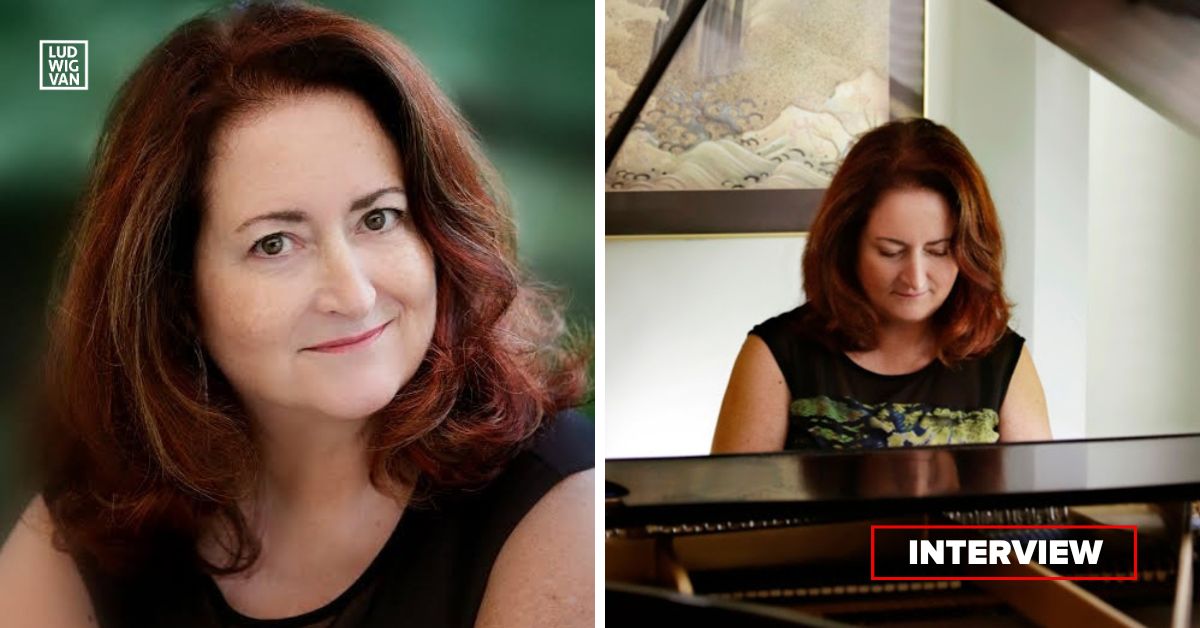
Classical music practice can take many forms. For some, it’s a career as an orchestral musician. For others, it’s the pursuit of original music.
Based today in Ottawa, Huguette Lavigne grew up with three Canadian cultures — Franco Ontarian, Québécois, and English. She studied music at McGill University and l’Université de Montréal, and since graduation, has composed more than 60 original piano works.
Her latest album, Let Go, Fly Far, was recently released, and includes 11 tracks.
“I sat at my piano in Ottawa — a hot smoky summer followed by fall, then a cold long winter, and let my hands wander…” says the composer in a statement.
We spoke to her about her music, which blends elements of contemporary classical, new age, modern jazz, and Indian classical into the mix, and incorporates improvisation.
Huguette Lavigne: The Interview
“I grew up in a French Canadian musical family, in the sense we all played music. We couldn’t get together without playing music,” she says. For her, it sparked a desire to pursue it in study.
She credits early instructors for their influence.
“I had a fabulous first teacher,” she says. Her approach was unique, in that she didn’t have her young student practising scales. “I’m teaching you Mozart, you’ll have plenty of scales,” she would tell Huguette.
Lavigne lived in Cornwall, where studying classical music meant largely preparing for the Kiwanis competitions. She moved to Montréal at age 12, where her music instruction changed.
“Then I had to go to the Grey Nuns and learn theory,” she recalls. Even as a young child, she loved the greats of the classical canon, like Mozart and Bach. “I loved them,” she adds. Along with her music-friendly family, it’s where the passion for music first began. “I think I started playing at age three.”
Her family’s stories include that time they bought a piano from a widower in the neighbourhood, and, at age five or six, Huguette immediately sat down and began to play. With the piano at home, she began to write music not long after.
That’s not to say her determination to pursue music never wavered during her childhood years. “There were moments when I wanted to quit,” she says.
Improvisation In Classical Music
Huguette says the first time she improvised classical music was at a Kiwanis competition back in Cornwall, Ontario, as a child. She’d won the gold medal.
“There was a huge gala. Of course I had to play, and keep it fresh,” she said. However, there was a problem. “I wasn’t ready for the gala.”
She hadn’t thoroughly practiced the piece she was to play, a contemporary piece by a Canadian composer, and got through about the first half of it more or less on point. That’s as far as her memory went, however.
“I simply made up the rest,” she says. She reports that the performance got a big round of applause. “I thought they probably didn’t know it either,” she laughs. “I thought gee, that was fun.”
Her studies leaned into the repertoire found in Canadian conservatory piano books of the time.
“They had a variety of styles in there,” she says. “I loved Bach.”
Bach was also adept at improvisation. It’s an idea that is picking up more and more momentum across the realm of Western classical music.
“I think I’m not the only one,” Huguette says.
At McGill, she naturally studied harmony and theory. Improvisation wasn’t in the curriculum for classical music studies.
“I would come up with full pieces.” At first, they only existed in her imagination. She began to write her ideas down. “I decided to notate a few notes.” At the same tie, she resisted the idea of incorporating all the notation typical of a classical piece.
As such, she’s come up with her own style of notation. “The last ten years, all I do is jot down enough notes that I will remember it. It’s easy to go back to the variety of choices that I have for each piece.”
It keeps her approach fresh, and invites improvisation. “The improvisation never quits.”
On the album, she’s recorded 10 pieces that were practiced and presented as is. Improvisation takes risks, as she points out, that may not work out in the studio on second listen. But, staying true to her musical beliefs, the album includes two versions of her piece Last Waltz, one practiced, and one improvised.
She acknowledges that it’s an approach that works in context.
“I love what I do,” she says. Taking that love and creating something intended for others to read and play, though, requires a more meticulous approach, as does performance. “But I’d rather just compose and play the piano.”
Along with six releases, Lavigne’s body of work includes 11 videos.
Indian Classical Music
She was first introduced to Indian classical music by her husband and his traditions. Trips there to visit his family strengthened her interest.
“I just love the raga, the music,” she says. She is often inspired by Indian and Hindu mythology in her compositions, and connected with the large role that improvisation plays in classical Indian performance. In some of her own pieces, she uses an ostenato that she likens to Indian ragas.
Improvisation is an aspect that also crosses over into contemporary jazz. “[There’s] a lot of overlap,” Huguette says. “Jazz is living and breathing. For me, I need to move ahead.”
Jazz may be another direction for future work. She’s a fan of Laila Biali, who also blends both jazz and classical elements in her music in a way that sounds contemporary and fresh.
In the end, Lavigne calls her style adult contemporary, although it could also easily fall under neoclassical.
“I can write in every style.”
You can stream Huguette Lavigne’s album Let Go, Fly Far here.
Are you looking to promote an event? Have a news tip? Need to know the best events happening this weekend? Send us a note.
#LUDWIGVAN
Get the daily arts news straight to your inbox.
Sign up for the Ludwig Van Toronto e-Blast! — local classical music and opera news straight to your inbox HERE.

- PREVIEW | Classical Guitarist Alexandra Whittingham Makes Toronto & Ontario Debuts - March 13, 2026
- PREVIEW | Soundstreams Presents Quatuor Bozzini: With Strings Attached - March 13, 2026
- INTERVIEW | Award-Winning Librettist & Against The Grain AD Royce Vavrek Talks About Canuck Cantatas - March 13, 2026