
Shaw Festival 2025/Major Barbara by George Bernard Shaw, directed by Peter Hinton-Davis, Royal George Theatre, closes Oct. 5. Tickets here.
Peter Hinton-Davis is known to be a director of vision, and he has given the Shaw Festival a magnificent production of Major Barbara.
The program essay is unusual because it takes the form of an interview between writer Robert A. Gaines and Hinton-Davis. For point of reference, Prof. Gaines is a past president of the International Shaw Society.
Hinton-Davis’ Approach to the Play
In the program notes, we learn about the elements that underpin Hinton-Davis’s directorial vision.
With his design team, he created a set with a contemporary feel that would still work for a 1905-time frame but give the play a fresh feel (but more about that later).
He included specific aspects of both Christian symbolism and Shaw’s atheism, and that the play is both a drawing room comedy and a satire.
A major throughline is Barbara’s journey (and to some extent Cusin’s) from idealism to realism, although the ending is still ambiguous, and each audience member will see something different in the outcome.
And finally, an overarching theme is Shaw’s outrage at the poverty in Great Britain that led him to become a Fabian Socialist.
Gaine’s essay certainly makes for interesting reading, very intellectual, very academic, very informative for understanding Hinton-Davis’ approach to the play.
What Was Left Out
Curiously, there seems to be one detail that the program notes, either wittingly or unwittingly, have left out, and that is the sheer emotional impact of the play.
Simply put, Hinton-Davis has crafted an incredibly powerful interpretation that has a richness and depth I have never experienced before in any of the several productions of Major Barbara that I have attended.
The Double Casting
While there are other marvelous aspects to be mentioned, the glory of the Hinton-Davis’ vision is the second act that takes place in the Salvation Army shelter.
Only the three major characters, Barbara Undershaft, a major in the Salvation Army (Gabriella Sundar Singh), her Greek professor fiancé Adolphus Cusins (André Morin), and her arms manufacturer father Andrew Undershaft (Patrick Galligan), play themselves throughout.
What makes this production so very provocative is the double casting and the ramifications it presents by putting the drawing room in the slums. The other actors in Undershaft household also become the denizens of east end London.
This is not the first time this idea of double casting has been used.
In 2016, the Infinite Jest Theatre Company presented a Major Barbara with double casting in Los Angeles, but in that case, apparently, the actors deliberately hid themselves inside the second characters and only by reading the program would the audience have known that it was the same cast.
Not so here.
As the acts change, we see Stephen Undershaft (Taurian Teelucksingh) begin to undo his jacket to change his clothes to become Snobby Price. Hinton-Davis wants us to be aware of the double casting, and the contrasts of personalities that underlie the human condition.
The Double Characters
The determined mother Lady Britomart Undershaft, the daughter of an earl (Fiona Byrne) is Rummy Mitchens, an old lady pretending to be a “saved” prostitute. Her doctrinaire, dogmatic son Stephen is Snobby Price, a con artist and so-called “saved” mother-beater.
Sarah Undershaft, the youngest daughter (Lindsay Wu), is already engaged at just 19, and is the most traditional member of the family. She transforms into the young and caring Army worker Jenny Hill.
Her fiancé Charles Lomax (Sepehr Reybod), your typical upper-class twit found in so many drawing room comedies, becomes the threatening bully Bill Walker who strikes Jenny Hill for taking his woman away from him.
Morrison, Lady Britomart’s butler (Ron Kennell) plays another worker and is perhaps the only genuine person at the shelter. As Peter Shirley, he can’t get work because of his gray hair and has been driven to near starvation. The nobility of the working man?
On the outside, the class divide is clearly visible, but lines tend to blur when you look at them from the inside. Except for Morrison and perhaps Sarah, the rest of the drawing room personnel play questionable characters, and certainly a multitude of themes can be conjured up from that scenario.
Shaw’s Major Barbara
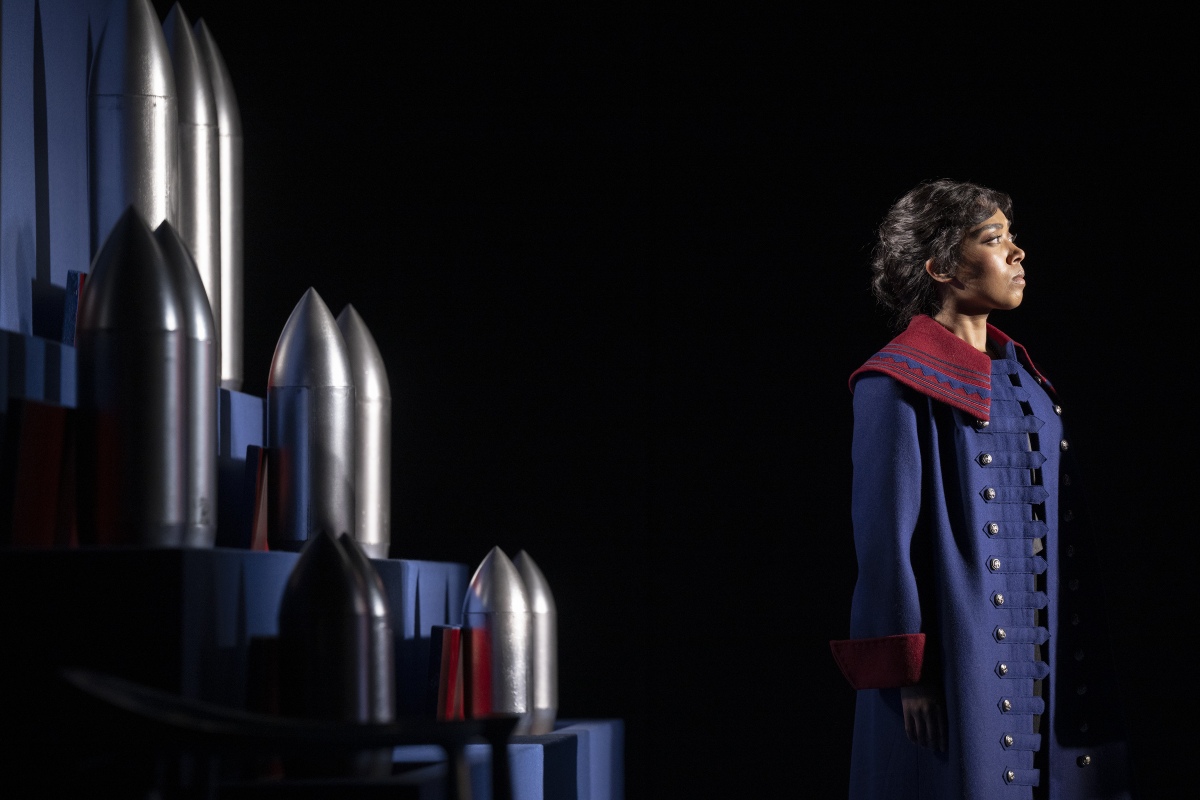
And then there is the idealistic Major Barbara herself.
Appalled when Commissioner Mrs. Baines (Patty Jamieson) accepts Undershaft’s £5000, and £1000 from a whiskey manufacturer which Barbara regards as tainted money, she removes her Army badge.
On a darkened stage with a spotlight only on her face, (courtesy of designer Bonnie Beecher), a grief-stricken Barbara cries out, “My God why hast thou forsaken me?”
In this heartbreaking moment, she is ridiculed by Bill Walker.
“What price salvation now?”
As everyone knows, Shaw had no time for sentiment. Remember, he wrote the epilogue at the end of Pygmalion to make sure everyone knew that Eliza Doolittle married Freddy, and didn’t end up with Henry Higgins as we all wanted her to do.
Similarly, Shaw has to move the third act past Barbara’s anguished crisis of faith by first presenting a clever philosophical battle for Barbara’s soul between Undershaft and Cusins, and then by Barbara bringing her idealism onto a more realistic plane, all through dialogue that is a witty Shavian wordplay of ideas.
Hinton-Davis’ Major Barbara: My Takeaway
In this production however, no matter how much bravado or moral clarity Barbara shows, she is damaged goods.
The Barbara that exited from act two was it broken young woman.
Hinton-Davis lets us know that Barbara can’t go from fierce warrior in act one, to the depths of despair in act two, to finding a new mission in life in act three, by jumping easily over the deep abyss of her crisis of faith.
That trauma can’t be erased that simply.
Shaw would have us believe that Barbara could desert the poor of London under the guise that she was doing them harm. That she is so mission driven that she can, with no trouble at all, move from saving souls at the Salvation Army to saving the souls of factory workers.
Shockingly, this would be more fulfilling, giving her even a selfish motivation.
Well Hinton-Davis certainly does not go along with Shaw, even though he allows his actors to have fun with the dialogue. The end of the production is so devastating because he does not let us forget the heartbreak that lies within. There is an underlying sadness in Sundar Singh’s performance.
The Set
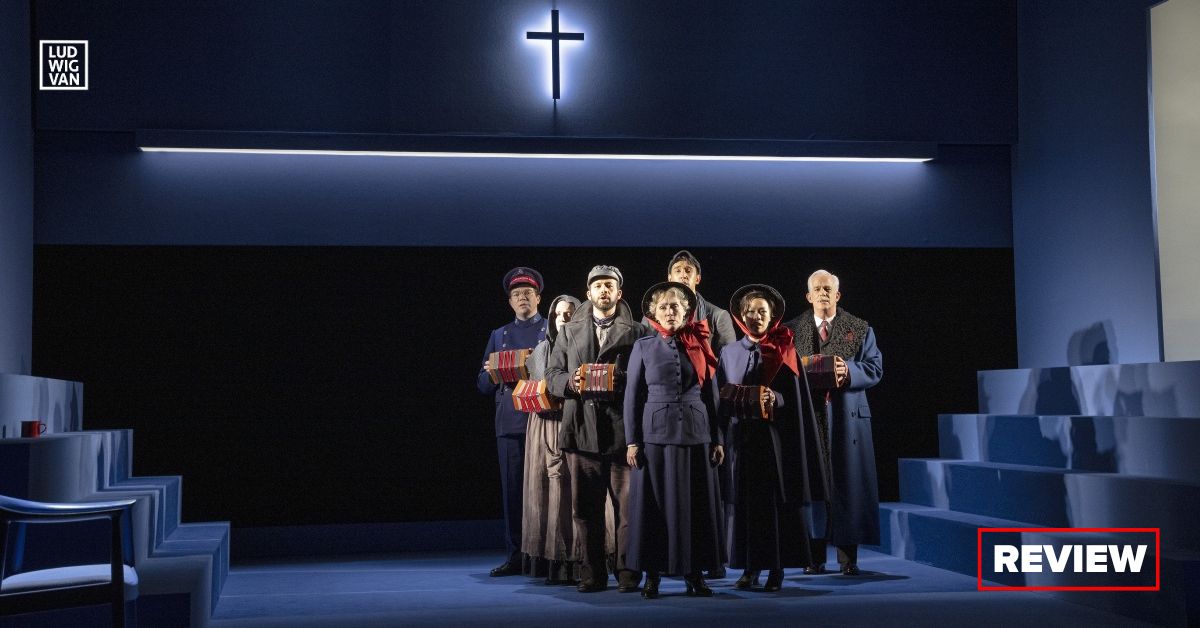
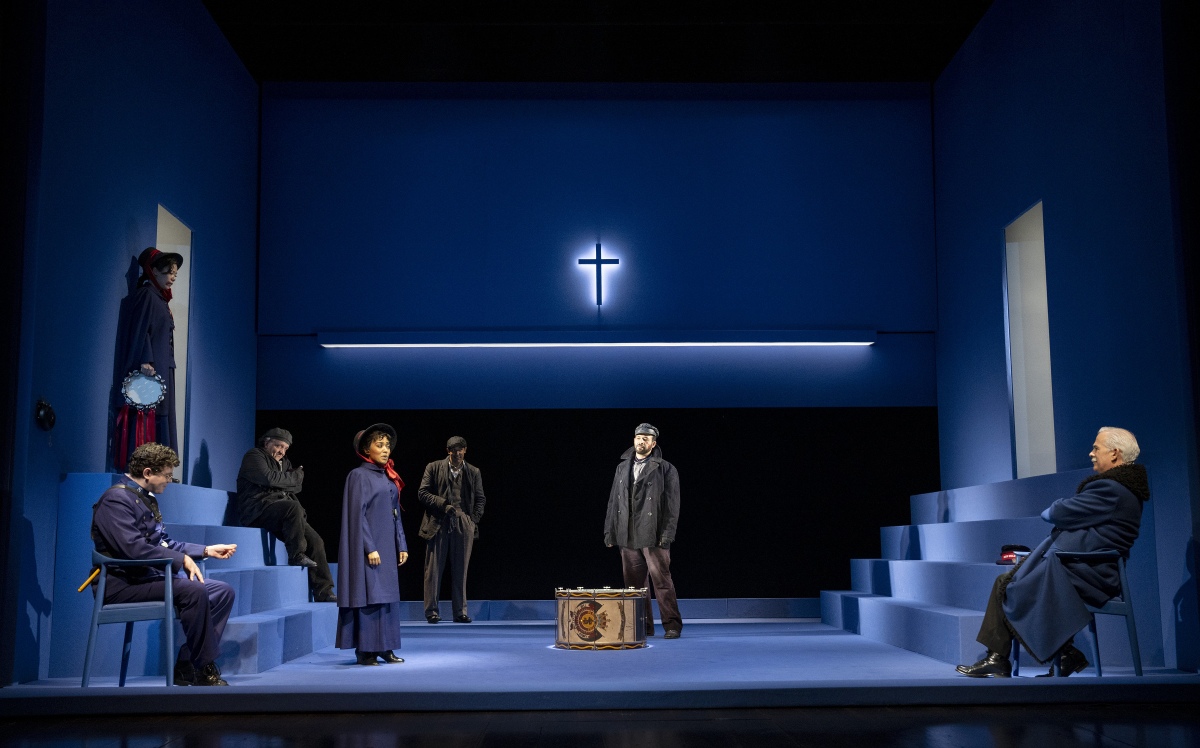
Gillian Gallow has designed a stark, stylized set resembling the adobe buildings one finds in the Middle East, conjuring up the Holy Land with a cross embedded above the roof.
There are two very steep staircases on either side of the stage, and the cast has to be mountain goats to negotiate them, but somehow it adds to the struggle of their characters. These stairs become quite symbolic as a result.
On the other hand, painting the set a rich blue colour gives a feeling of serenity that lies beneath the turmoil in the lives of the characters.
There are two chairs facing each other at the front of the stage where watchers sit. And yes, there are watchers, Jamieson and Kennell, who come and go. It is unsettling to see them there. They present an edgy feeling, but then we are dealing with uncomfortable topics.
Oddly, there is a curb that people have to step over to get to the front of the stage, and seeing the characters do their little hop is most peculiar. Nonetheless, it had to be put there for a reason. For example, Undershaft and Cusins do the maneuver before their contretemps. Is it leaving the world of the play to heighten reality?
Some aspects of the set are a puzzlement, but then Hinton-Davis always includes elements to be pondered.
The Music
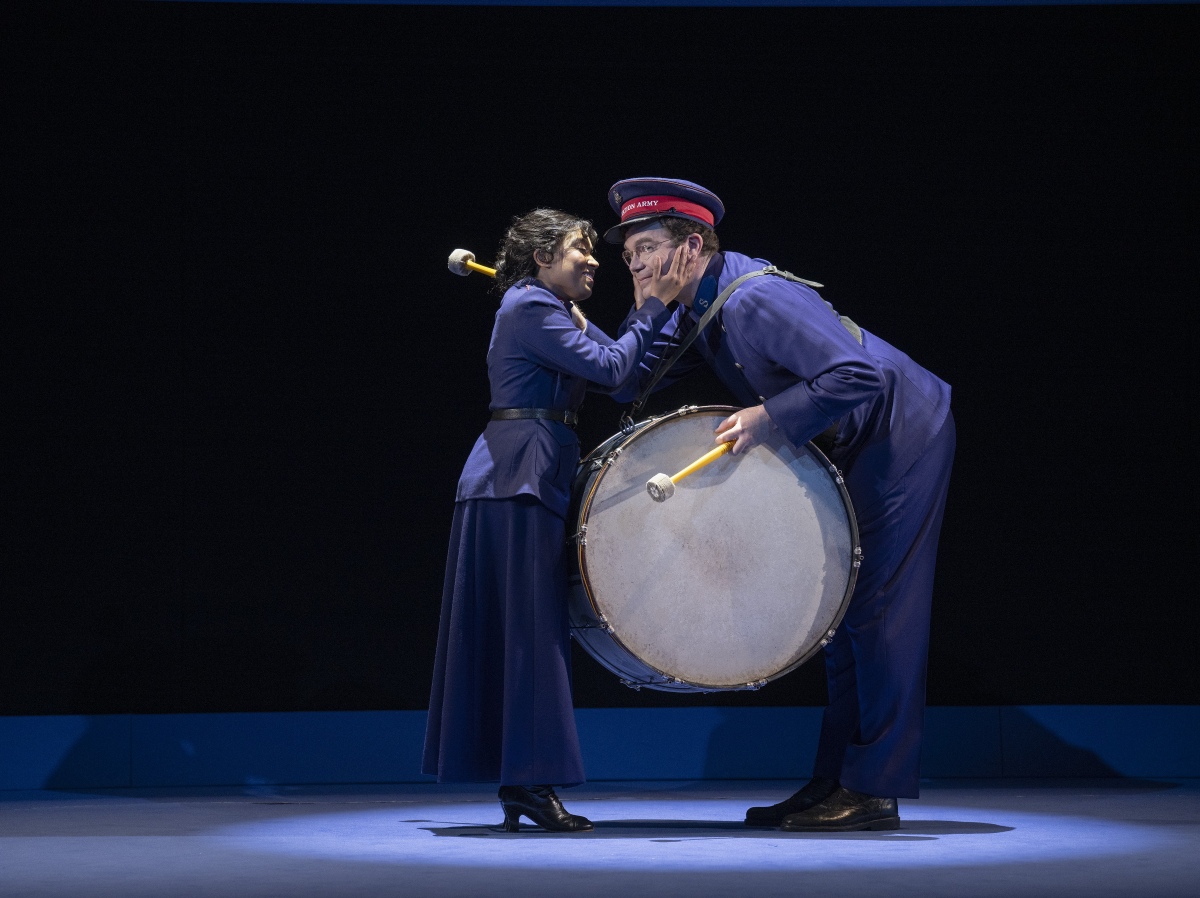
Music plays an important role throughout the production. On several occasions the entire cast stands together like a massed choir singing stirring hymns, with Jamison as the lead singer.
Composer Allen Cole has written equally stirring original music that is performed throughout. The music gives a very serious undertone to the play which adds to the emotional impact.
The Actors
That the actors in Major Barbara are a talented group, there can be no doubt given the particular demands of this production.
More to the point, they have formed a true ensemble, whether singing in their choir or performing their roles in the drawing room or in the Salvation Army shelter. You can feel the chemistry between them.
That united bond adds strength to Hinton-Davis’ vision that there is more to Major Barbara then Shavian wit and wisdom.
Endgame
The unsentimental Shaw would not be pleased by the effect that this Hinton-Davis production of Major Barbara had on me.
I was profoundly moved by what I felt was a powerful if downbeat ending.
Under the veneer of enthusiasm, Barbara will continue, but she will never be the same again.
Are you looking to promote an event? Have a news tip? Need to know the best events happening this weekend? Send us a note.
#LUDWIGVAN
Get the daily arts news straight to your inbox.
Sign up for the Ludwig Van Toronto e-Blast! — local classical music and opera news straight to your inbox HERE.


- SCRUTINY | Mirvish’s Shucked Is Loud, Brash & Unapologetically Corny - March 10, 2026
- SCRUTINY | The National Ballet of Canada Opens Winter Season with Classical Purity and Contemporary Power - March 2, 2026
- SCRUTINY | Mirvish’s Some Like It Hot Celebrates Broadway Glam Updated For 2026 - February 24, 2026