
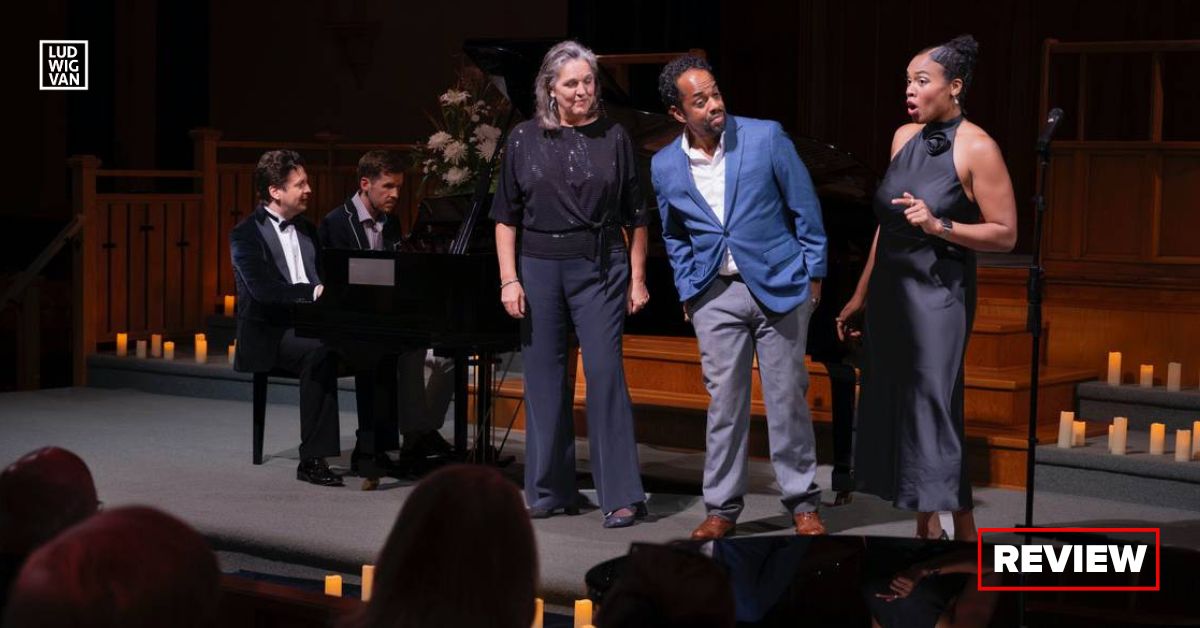
Collingwood Music Festival: Gershwin Gala. Artistic Director & pianist Daniel Vnukowski; soprano Adrianne Pieczonka, soprano Jonelle Sills; bass-baritone Justin Welch; pianist Steven Philcox. July 18, 2025, First Presbyterian Church, Collingwood.
“Are you a musician?” the woman next to me asked.
We were sitting in the first row of the balcony of the First Presbyterian Church waiting for the Gershwin Gala — the grand finale of this year’s Collingwood Music Festival — to begin.
“No,” I told her. “I’m a journalist. Do you play music?”
“I play with music,” she said, lightly chuckling. “I listen mostly. I fell in love with a piece of music and, at 90, I went out and bought a keyboard. I wonder how many candles there are.”
She was referring to the chancel below, which, in addition to a grand black piano and an ornate flower arrangement on a white column, was covered in faux candles glowing orange.
Later, during intermission, I tried to count the candles — approximately 190 — but before the show began proper I wanted to catch her name. “Jean Morton,” she said, sharing that she was born in Winnipeg, and lived all over Canada before deciding to retire in the South Georgian Bay.
I noticed, like me, Jean was wearing a lanyard, but hers read “Maestro Pass,” which grants all-access to every festival event that, this year, included masterclasses with the likes of pianist Angela Park, violinist Sharon Lee, composer Ian Cusson, and performances by Canadian Brass, the Elmer Iseler Singers, the Montréal Guitare Trio and the Payadora Tango Ensemble.
The Collingwood Music Festival was founded by its artistic director Daniel Vnukowski in 2019, but, in his opening remarks, he shared that it began as a dream in 2017 as a benefit concert during a snowstorm, which was attended by the late Marilyn Knowles, a local resident, music lover and fierce supporter whose donation made the evening’s performance possible.
“It does not end here,” Vnukowski said of the bitter-sweetness of the festival’s end, teasing there were events and programs in the works.
But, first a taste of the Great American Songbook and the music of “the one who bridged it all together”: composer George Gershwin.
ACT 1
Dressed in a crisp white shirt, black bowtie and black velour blazer, Vnukowski began with Three Preludes, which were first performed by Gershwin in 1926.
The first, Allegro ben ritmato e deciso, was playful, fast-paced and deceptively discordant, whereas the second, Andante con moto, was mournful and bluesy, allowing more subdued tones to come through and giving us a sense of Gershwin’s range. The third, Agitato, was a return to his punchy sensibility, where a conversation between the major and minor notes took place, evoking images of train sequences in silent films.
Vnukowski, an impassioned performer, seemed to dash off each prelude with ease, always concluding with such dramatic flair, setting the tone for the night.
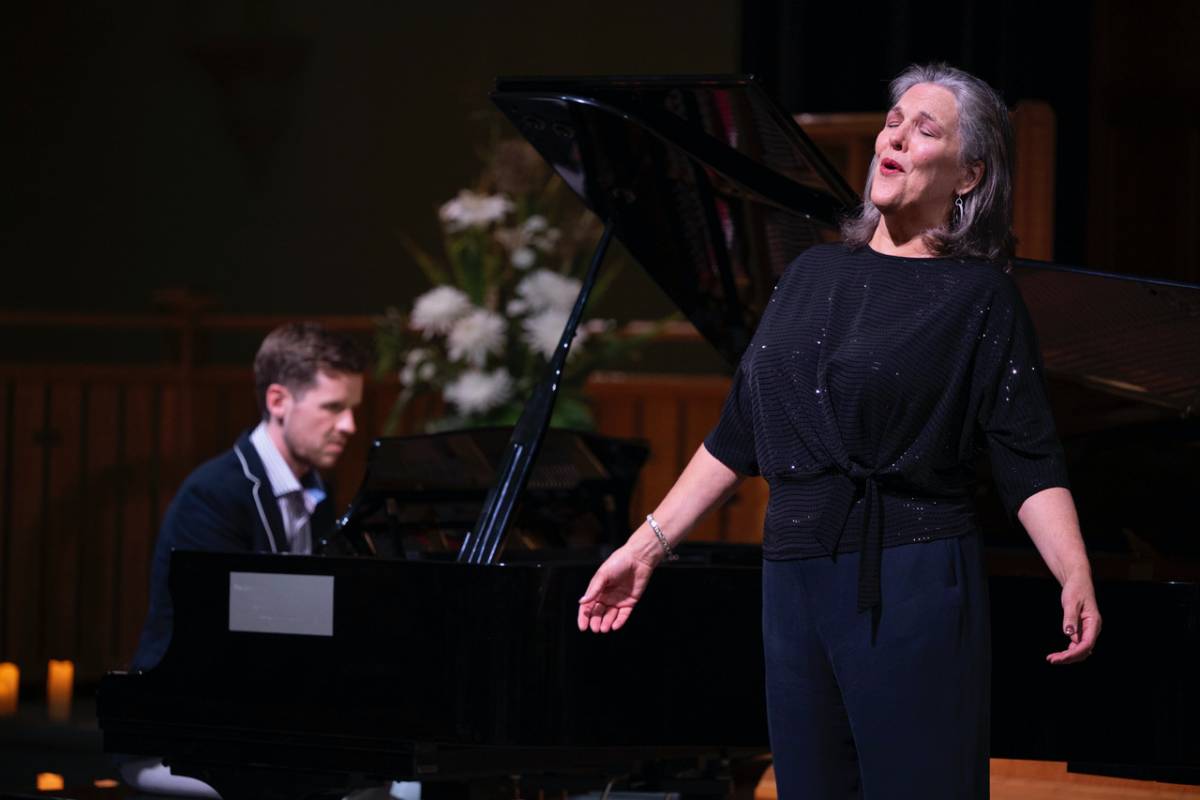
Following him onto the chancel was the dapper pianist Stéphane Mayer and the soprano Adrianne Pieczonka, who wore a bejewelled black top that glittered in the spotlight as she moved, performing the well-known I Got The Rhythm, Love Walked In, and Someone to Watch Over Me.
As each song progressed, it became clear that what Pieczonka, and by extension Gershwin, were interested in was using the music, and the voice, to articulate the vestiges of love: of love that has the power to change everything in one’s life.
“Forgot the gloom of the past/one look and I/had found my future at last,” she gracefully sang, as if from experience.
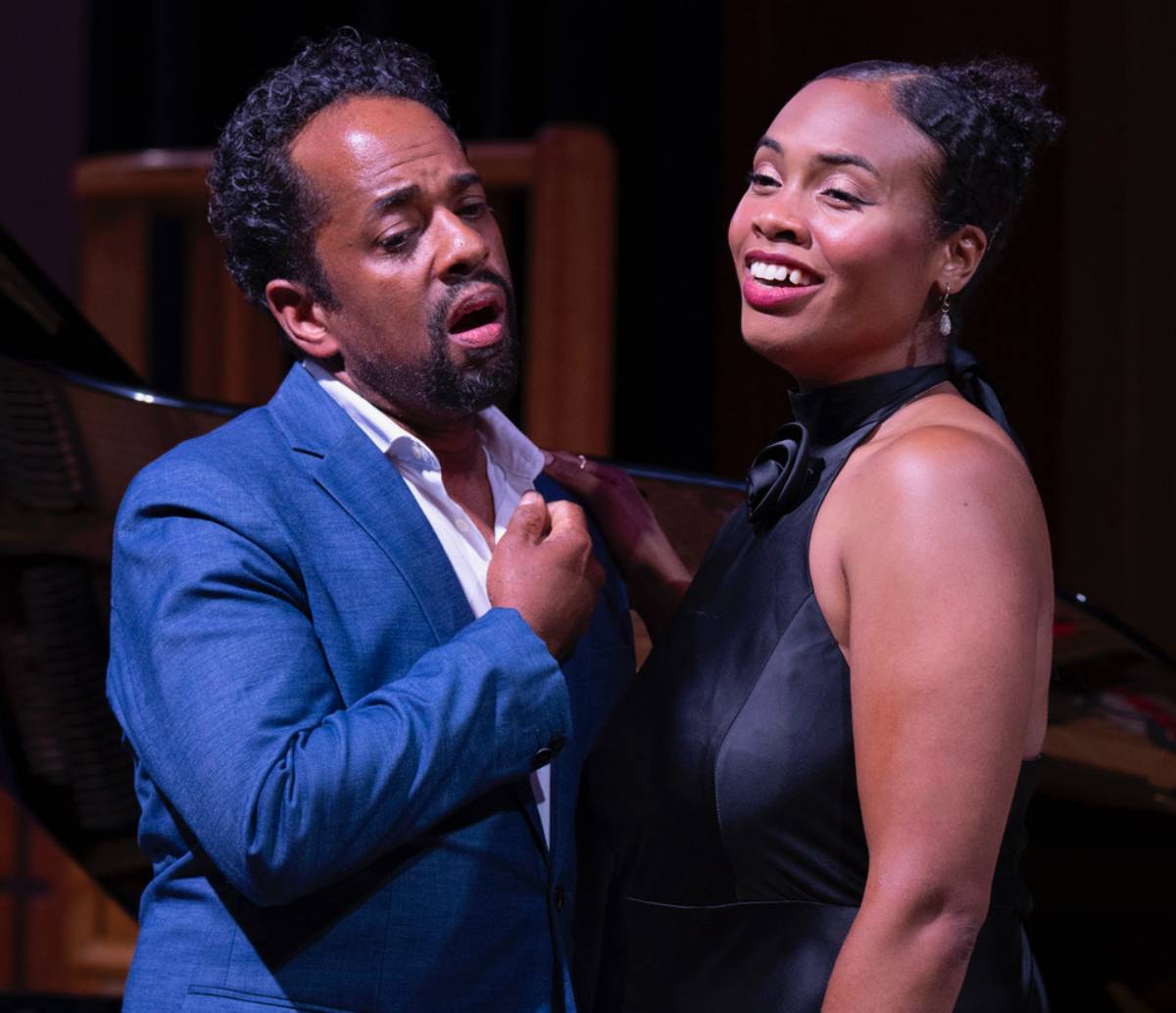
After her, the soprano Jonelle Sills, in an elegant, black, floor-length dress adorned with a black flower on top, arrived on the chancel to sing Embraceable You and The Man I Love.
As Mayer, who often bobbed his head or tapped his foot to the beat, played the opening chords, it was fascinating watching Sills prepare to perform as she smiled widely and looked out at the audience, as though settling into a character and absorbing our anticipation so she could unleash the force of her voice, which she proceeded to do, balancing the operatic and Broadway styles in such a way that she was able to make the songs her own.
Her voice reached the high ceilings and sent a shiver up my spine.
The bass-baritone Justin Welsh, then, had the duty to bring us back down to the earth, to reminding us of the importance of memories in his rendition of They Can’t Take That Away From Me, which was made popular by Fred Astaire.
“The way you wear your hat/the way you sip your tea,” he lusciously sang, “The way you sing off key/the way you haunt my dreams.” In this list of images drawn up by the attentive lover, we see how the gestures we consciously and unconsciously produce in daily life can impact those around us, to become something to be catalogued and privately cherished.
Prefacing the controversial, yet highly successful, reputation of Swanee, Welsh had us hanging onto every word, reveling in the pleasures of his timbre.
Before intermission, Vnukowski returned to the stage and said he forgot to ask us if we wanted to hear Rhapsody in Blue now or later.
My seat-mate, Jean, was, along with most of the audience, in favour of now.
It is important to note here that one of the challenges placed on bringing Gershwin’s music to life was the decision to perform, in Vnukowski’s words, “a purely acoustic” version, meaning that the grand, jazzy sensations from the Rhapsody would only be communicated through the piano.
This is not the Leonard Bernstein version.
But, with the church’s ceiling bathed in blue light, with his athletic musicianship on full display, with full submission to the music, Vnukowski managed to evoke the original spirit of this masterpiece.
He possessed enough passion to conjure up an orchestra out of a piano.
Jean was the first one up for the standing ovation.
ACT 2
During intermission I remained in my pew and observed the audience members — which included the soprano Ambur Braid — who all seemed to know each other and were chatting away.
It reminded me of a line I read from the Collingwood Music Festival’s statement of intent:
“Research has shown the social, physical and cognitive benefits of hosting a music festival in its community, enhancing people’s moods and nurturing a sense of belonging.”
Coming from Toronto, where we are spoiled with the riches of culture from all sectors, I could see the way that bringing music into these regions, and fostering the potential of future generations, was vital, and could see how it enlivened the community.
The second act closely followed the format of the first.
There was Vnukowski playing Walking The Dog and Rialto Ripples, transporting us to a lounge in New York in the 1930s, and Pieczonka returning to sing — cleanly, crisply — of love in Isn’t it a Pity and Love is Here To Stay, where she broke away from the song sheet to offer wisdom.
“The older I get, the faster the world turns,” she said. “We need to hold onto love — the only concrete thing.”
When she sang By Strauss, settling into the Germanic role, she finally seemed unrestrained.
There was Welsh and Sills, who took turns appearing on the chancel to sing excerpts from Porgy and Bess, one of two opera’s Gershwin composed before his early death in 1937.
Welsh charmed the audience with I’ve Got Plenty of Nothin and It Ain’t Necessarily So, encouraging the participate in a call and response that took us out of our complacent spectatorship. But, once again, it was Sills, who gave her spin on Summertime and the devastating My Man’s Gone Now — with its piecing cry — that made the evening unforgettable.
Every critic keeps an inventory of gestures from the performances they see and when Sills allowed the over-wealth of emotions of the end of the song to overcome her and choose to fall back into the curve of the piano with the final note, I’d found another one to add to it.
She conveyed the drama of the opera and the character onto the chancel — an excerpt turned event.
After Welsh and Sills came together for a touching duet of Bess, You Is My Woman Now, and Vnukowski returned for a brief improvisation on Gershwin (à la Earl Wild), all of the performers appeared on the chancel to reprise I Got The Rhythm as the final number.
“Who could ask for anything more?” they all sang.
It was the perfect note to close the season — feeling full of love, music and inspiration.
As I made my way down the stairs, noticing that a few members of the audience were holding seat cushions, a woman snapped her fingers and asked us all if we “got the rhythm.”
I didn’t answer her then, but I will now: I do indeed.
By Nirris Nagendrarajah for Ludwig-Van.com
Are you looking to promote an event? Have a news tip? Need to know the best events happening this weekend? Send us a note.
#LUDWIGVAN
Get the daily arts news straight to your inbox.
Sign up for the Ludwig Van Toronto e-Blast! — local classical music and opera news straight to your inbox HERE.

- CLASSICAL CHARTZ | The Top Ten Classical Music Albums For The Week Of March 9 To 15 2026 - March 9, 2026
- SCRUTINY/INTERVIEW | The Leonkoro Quartet’s Premiere Performance Delights Music Toronto Audience - March 9, 2026
- INTERVIEW | Violinist— And Now Filmmaker — Lara St. John Talks About Dear Lara - March 2, 2026