

At this year’s Toronto Fringe Festival, historical figures from the past are resurrected — not only to haunt, but to inspire a trio of creative souls.
In Songs By A Wannabe, Siranoush and Divine Monster, these figures become vessels for their creator’s loneliness, ambition and constant pursuit of self-invention.
Whether it’s an impersonator of the Spice Girls’ Geri Halliwell, the iconic Armenian actress Siranoush, or the ghost of the great Sara Bernhardt, these shows, created by women, demonstrate the way the past can infuse itself into the present.
These three shows contend with what it means to make art in the shadows of legends.
SONGS BY A WANNABE
WANNABE/Creator: Barbara (Babz) Johnston
Soulpepper Theatre’s Michael Young Theatre
In 1998, the entertainer Geri Halliwell quit the Spice Girls, the best-selling British pop group in which she was known as “Ginger Spice” on account of her signature red hair.
In Songs By A Wannabe, a 75-minute, one-woman musical created by and starring Babz Johnston, Halliwell’s sudden departure is a seismic cultural event on par with 9/11.
“When you pretend to be someone else,” Johnston — who spent over a decade travelling the world in a tribute band — sings, “You get to be a bigger, braver version of yourself.”
For this wannabe, a celebrity like Halliwell enables her to be a star.
Directed by Mitchell Cushman, Songs By A Wannabe takes place in a green room in Ferndale, Michigan. The stage (modestly designed by Eric Andrews) features a clothing rack with flamboyant outfits, a vanity devoid of a mirror, and a backstage door producing sounds every time its opened.
When the nearby presence of another, more successful tribute band threatens the future of her career, Johnston begins to reminisces about her storied past in catchy, dramatic show-tunes (co-written by Anika Johnson and Suzy Wilde) that display her range as an engrossing performer.
On opening night, despite the missing lighting cues, overloud sound (designed by James Evidente) or forgotten lines, Johnston carried on like a professional whose eminence no force could dim. With her ability to seamlessly slip in and out voices and characters, to transport the audience to the places that she speaks of and the emotional core of those memories, Johnston is living proof each of us contain multitudes.
“I don’t know who I want to be,” she forlornly sings — but, in the meantime, while she figures it out, there is a sequinned leotard and a ginger wig with her name on it that amplifies her innate charm, and spice.
- Continues to July 13; tickets and info [HERE].

SIRANOUSH
CorpOluz Theatre/Writer & Performer Lara Arabian
Soulpepper Theatre’s Tank House Theatre
I was surprised to find how similar Siranoush —an 80-minute, one-woman show written and performed by Lara Arabian — is to Songs By a Wannabe, both part of Fringe’s Next Stage Series. The staging, for instance, is almost identical: a clothing rack with flamboyant outfits, a table above which hangs a lightbulb, and screen on which images (designed by Avideh Saadatpajouh) and sounds (designed by Armen Bazarian and Shane Miersch) are projected.
Like Johnston, Arabian is also inclined to use dolls, both Armenian ones and Barbies, to assume voices and become various characters, but here that transformation also occurs corporeally; her body often convulses as she embodies and disembodies Siranoush, the legendary Armenian actress whose unprecedented life inspires Arabian’s search of a self.
Directed and co-created by Carla Melo, and based on Arabian’s real life experiences, Siranoush tracks Arabian’s journey from a Canadian-born Armenian child to an adult who finds herself in Armenia, a sense of not belonging plaguing her every step of the way.
“The only way I am myself is to pretend to be someone else,” she says.
From her initial encounter with a framed portrait of Siranoush in an art gallery, through the characters that she played, including Marguerite in Alexander Dumas’ The Lady of the Camellias and Hamlet in Shakespeare’s Hamlet, Arabian tactfully explores this elusive woman the archives have not preserved, but that her empathetic imagination can.
As Arabian interacted with the audience, handing over her passport to be stamped or an egg to be thrown at a window (evoking the scene of protest at the Belarusian Embassy in 2024), I was stunned most by the assuredness with which she assumed her responsibility as a storyteller.
“Adapt or perish,” she concludes: “But never forget your past.”
If not Siranoush, I won’t be forgetting Arabian anytime soon.
- Continues to July 13; tickets and more info [HERE].
DIVINE MONSTER
Bernhardt Productions/Playwright: Elena Kaufman
Soulpepper Theatre’s RBC Finance Studio
After the performance of Siranoush, Arabian addressed the audience and suggested that we consider watching Divine Monster, which was about the ghost of Sarah Bernhardt.
“When Siranoush was called the Armenian Sarah Bernhardt,” Arabian said, “Siranoush paused and said, Sara Bernhardt is the French Siranoush.” I decided to heed her advice.
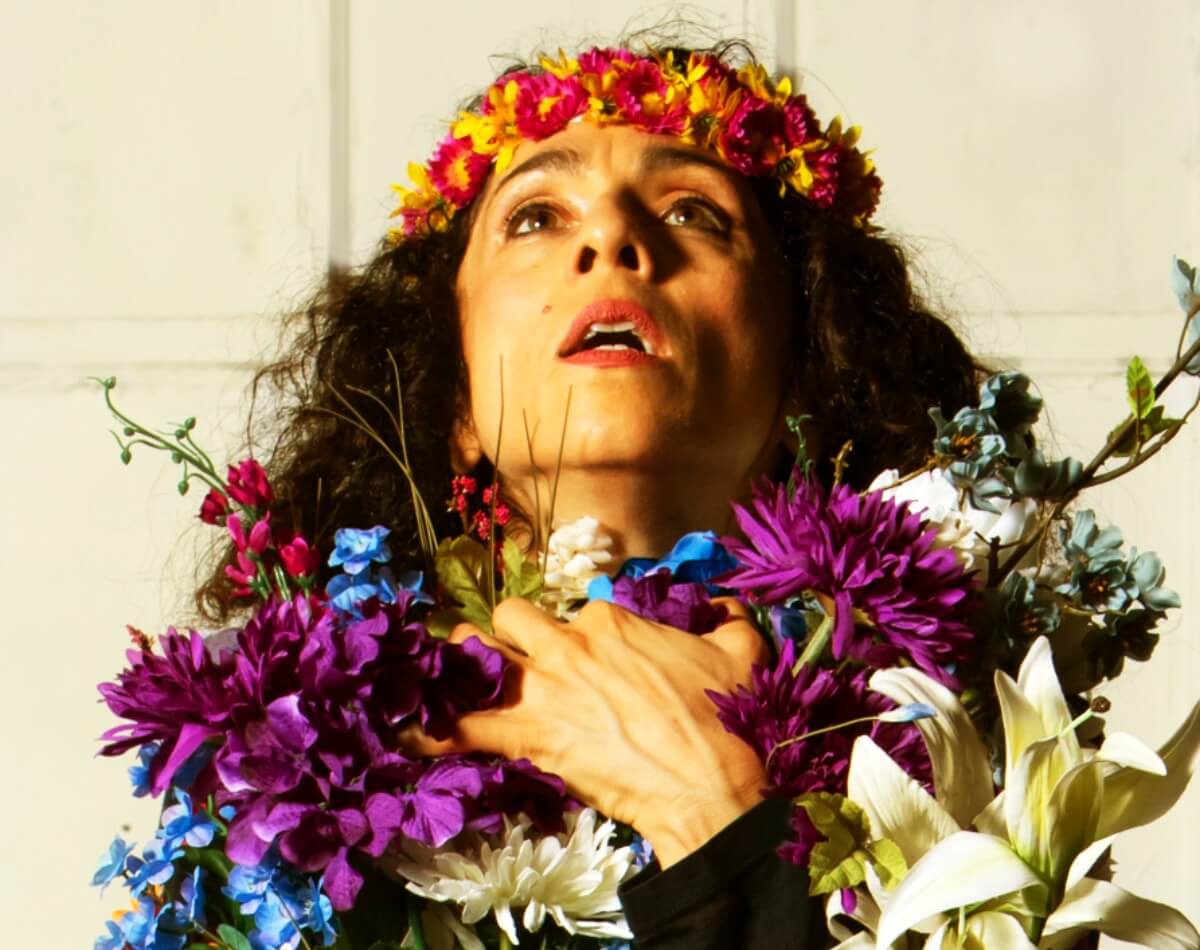
In Divine Monster, directed by Mary Dwyer and written by Elena Kaufman, Sarah Bernhardt (Bonnie Anderson, who oozes haughty exquisiteness) roams the Père Lachaise Cemetery with her shape-shifting companion (an amiable Greg Campbell) looking for a host. She happens upon Martha (Hope Goudsward), a lesbian musician who stokes the flames of a recent heartbreak with liquor.
The play, which runs 55 minutes, is concerned with second chances, and in depicting the divide between the 19th and 21st centuries, which is most pronounced in its costume design. This finds Anderson and Campbell clad in mute yet ornate ensembles and Goudsward donned in solid colours (production designed by Debra Hale), and in its juggling of high and low subject matter.
In one scene, for instance, Martha explains to Sarah what Facebook is, and, in another, Sarah introduces Martha to Oscar Wilde, who says, “The mystery of love is greater than the mystery of death.” The only mystery in Divine Monster is if Martha will be convinced to be haunted by a genius, and what will happen when she does, though, regrettably, the latter never occurs, since the show is uninterested in dramatizing the experience beyond their interaction.
When the two women almost kiss, or the light of the blood moon drowns the stage in rouge, there are promises of what this play — whose material amounts to extended first act — would look like if it were further developed. In the end, I wondered if Martha was worth Bernhardt’s inspiration.
But I suppose greatness anoints the mediocre too.
- Continues until July 12; tickets and more info [HERE].
By Nirris Nagendrarajah for Ludwig-Van
Are you looking to promote an event? Have a news tip? Need to know the best events happening this weekend? Send us a note.
#LUDWIGVAN
Get the daily arts news straight to your inbox.
Sign up for the Ludwig Van Toronto e-Blast! — local classical music and opera news straight to your inbox HERE.


- CLASSICAL CHARTZ | The Top Ten Classical Music Albums For The Week Of December 8 To 14 - December 9, 2025
- CLASSICAL CHARTZ | The Top Ten Classical Music Albums For The Week Of December 1 To 7 - December 2, 2025
- SCRUTINY | Alex Pauk’s Esprit Orchestra Creates A Luminous Concert Of Sound - December 2, 2025