
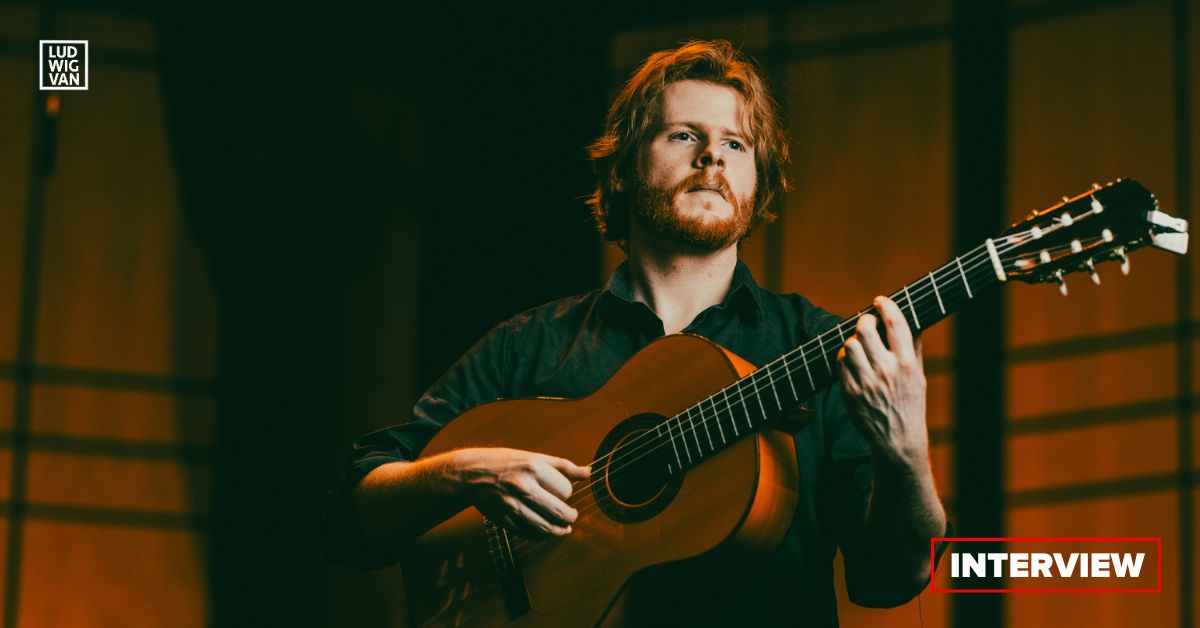
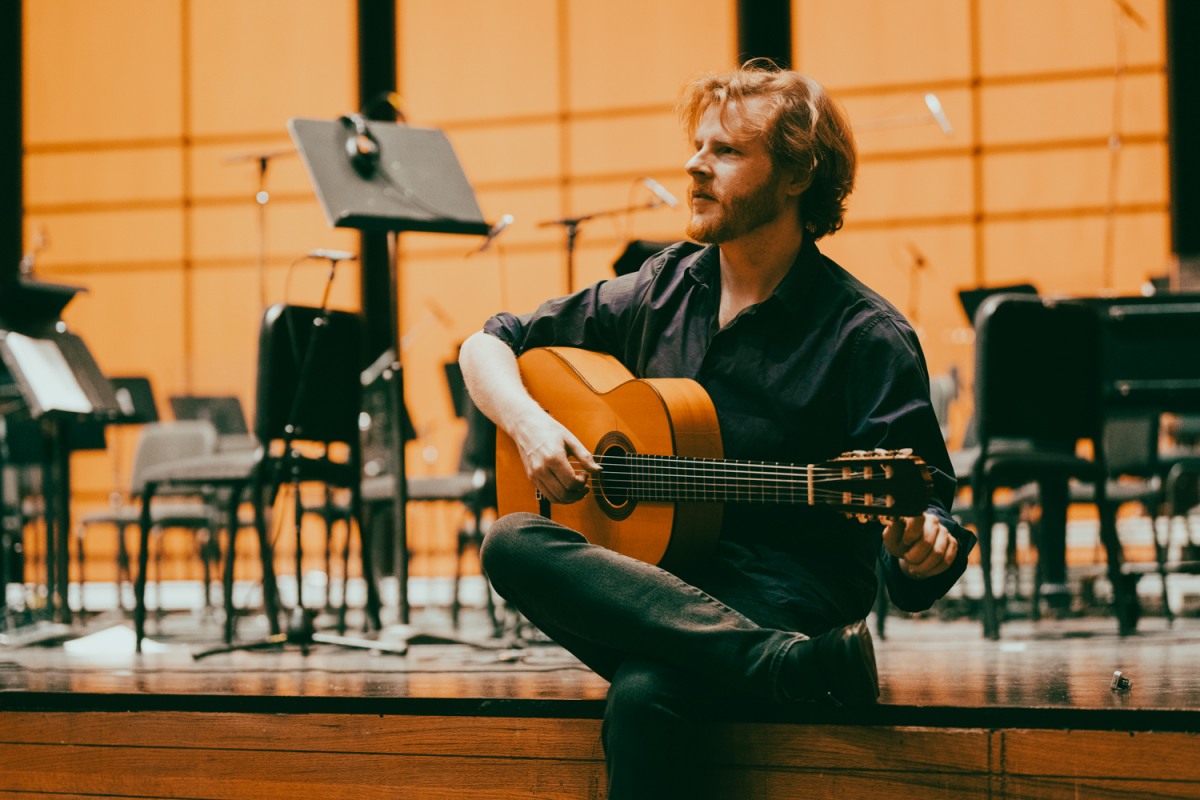
Toronto flamenco guitarist and composer Matt Sellick’s new album Watching the Sky brings a decade-long ambition to life. Recorded with the Thunder Bay Symphony Orchestra and conductor Evan Mitchell, it’s both the culmination of a longstanding relationship, and a new direction for his music.
The music combines various influences, including inspiration drawn from the landscapes of his hometown Thunder Bay, while retaining the passionate soul of flamenco.
LvT spoke to Sellick about his music, and the new album.
Matt Sellick, guitarist
Matt Sellick grew up in Thunder Bay, Ontario, and now makes Toronto his home. He studied music at Lakehead University, where he obtained an HBMus. Subsequently, he went to Spain to continue studying flamenco guitar with various practitioners of the art. For six years, he pursued a career in Thunder Bay, performing regularly as a soloist with the Thunder Bay Orchestra, and Consortium Aurora Borealis. He relocated to Toronto in 2019.
Matt has been on stage with prominent artists such as Jesse Cook, and has performed across Canada, the United States, and in Europe.
As a recording artist, Matt has released five albums of original music prior to Watching the Sky.
His compositions are often inspired by landscapes or streetscapes from Thunder Bay to Spain to Toronto, and the moods they engender. Musically, influences range from Vicente Amigo to Debussy.
The album was recorded live with all musicians in the same space, another first for Sellick, in the Thunder Bay Community Auditorium. Each track is a tone poem that was sparked by his memory of a specific place. When he went back to see those landscapes of his memory, he often tweaked the composition and/or arrangement to reflect the place — and his relationship to it — as it is now.
Longtime collaborator Marito Marques adds percussion in the form of djembe, udu, and hand percussion to several of the tracks. Bassist Martin Blanchet and pianist Paul Rodermond are featured in solos on two of the tracks.
The Interview
The idea for the album, Matt says, goes back a bit longer even than a decade to about 2013, when he had just graduated university. It was just the start of his longstanding relationship with the Thunder Bay Orchestra.
“In a small town, like Thunder Bay, some of the musicians are part of your everyday life. They’re you’re teachers,” he explains. “They become your mentors and your friends,” he adds.
“My mother was a concert level violinist.”
It made the idea of orchestral collaborations more of a natural progression.
“They offered me a show,” he recalls. “That became part of my life.” He went on to perform with TBO every couple of years or so.
Sellick wrote his own arrangements of his material for the orchestra. After so many years, he realized he’d accumulated enough arrangements that he could compile a full-length album. Still, actually bringing an orchestra together to record is a significant undertaking.
“But how am I going to be able to make that happen?” he wondered.
It began the quest for funding, which also took time. Of course, in the meantime he continued to perform and teach. “I don’t know if I could say that it was always in the back of my head.” Still, doing those performances with TBO every now and then offered a tantalizing possibility.
The Music
“It seemed like a natural pairing to do.”
His compositions — despite their arrangements — aren’t written with an orchestra in mind.
“I don’t know if I’d say it’s a concerto format,” he says. “The idea was — a lot of my pieces, I start out with them as solo pieces.” In creating his original arrangements, he’d begin to see there were actually three or more parts to the work he’d composed. To perform it solo, he’d pare the music back to a single part.
When expanding them into guitar + orchestra, he could bring back the other parts he’d heard as a composer. “It became a way of expanding these pieces into what they were originally,” he says. “Personally I think it worked really well.”
While not a concerto in the strict sense, the arrangements pose their own challenges.
“It’s basically solo guitar with an orchestral accompaniment,” he says. “The idea of the guitar having a dialogue with the orchestra.”
Blending the guitar with the power of an orchestra is challenge #1.
“It’s a challenge. It’s like a cello, but it has none of the sustain or cutting power. I don’t want the guitar playing over the strings the whole time,” he says, noting it would require considerable amplification. He was careful to create that balance.
The album includes both older and newer music. “Some of these arrangements are, for my life, very old.” Others have been reworked. Each time he performed with the orchestra, he’d review the video of it the next day in order to tweak and perfect the arrangements year after year.
“It became this long process of developing [the arrangements],” he says. “They feel kind of alive in a way.”
Will there be a live performance in Thunder Bay? It’s something he’s working on.
“In doing these, I realized how much I actually loved performing live with the orchestra.” With the blend of classical and flamenco, guitar and orchestra, it’s a new sound for most audiences. “It’s rare,” he says.
That’s something he’d like to see change, at least in his own case.
“That would be a dream come true, to do this on a regular basis.”
- You can stream Matt Sellick’s upcoming album Watching the Sky [HERE].
Are you looking to promote an event? Have a news tip? Need to know the best events happening this weekend? Send us a note.
#LUDWIGVAN
Get the daily arts news straight to your inbox.
Sign up for the Ludwig Van Toronto e-Blast! — local classical music and opera news straight to your inbox HERE.

- PREVIEW | Classical Guitarist Alexandra Whittingham Makes Toronto & Ontario Debuts - March 13, 2026
- PREVIEW | Soundstreams Presents Quatuor Bozzini: With Strings Attached - March 13, 2026
- INTERVIEW | Award-Winning Librettist & Against The Grain AD Royce Vavrek Talks About Canuck Cantatas - March 13, 2026