
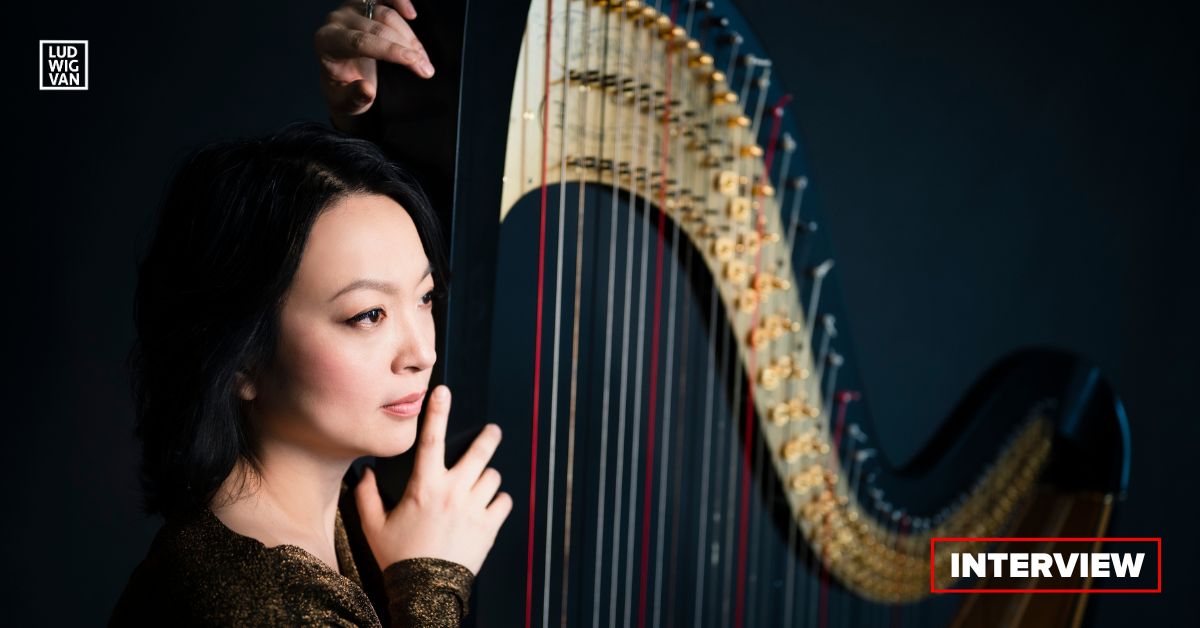
Harpist Teresa Suen-Campbell’s next album, My Voice, will be released on Navona Records on July 11. On it are three harp concerti recorded with Sinfonia Toronto and conductor Nurhan Arman.
It includes the Harp Concerto written for her by two-time Juno Award winning composer Chan Ka Nin, along with Handel’s Harp Concerto in B-flat major, HWV 294, and James W. Campbell’s Concerto for Harp, also written for Suen-Campbell, which premiered in 2014.
Earlier this year, she performed Chan’s concerto at a concert hosted by the Hong Kong Composers’ Guild, and this past weekend, she premiered two new works written for her by Canadian composers Aris Carastathis and Darlene Reid.
LvT spoke to Suen-Campbell about the upcoming release.
Teresa Suen-Campbell
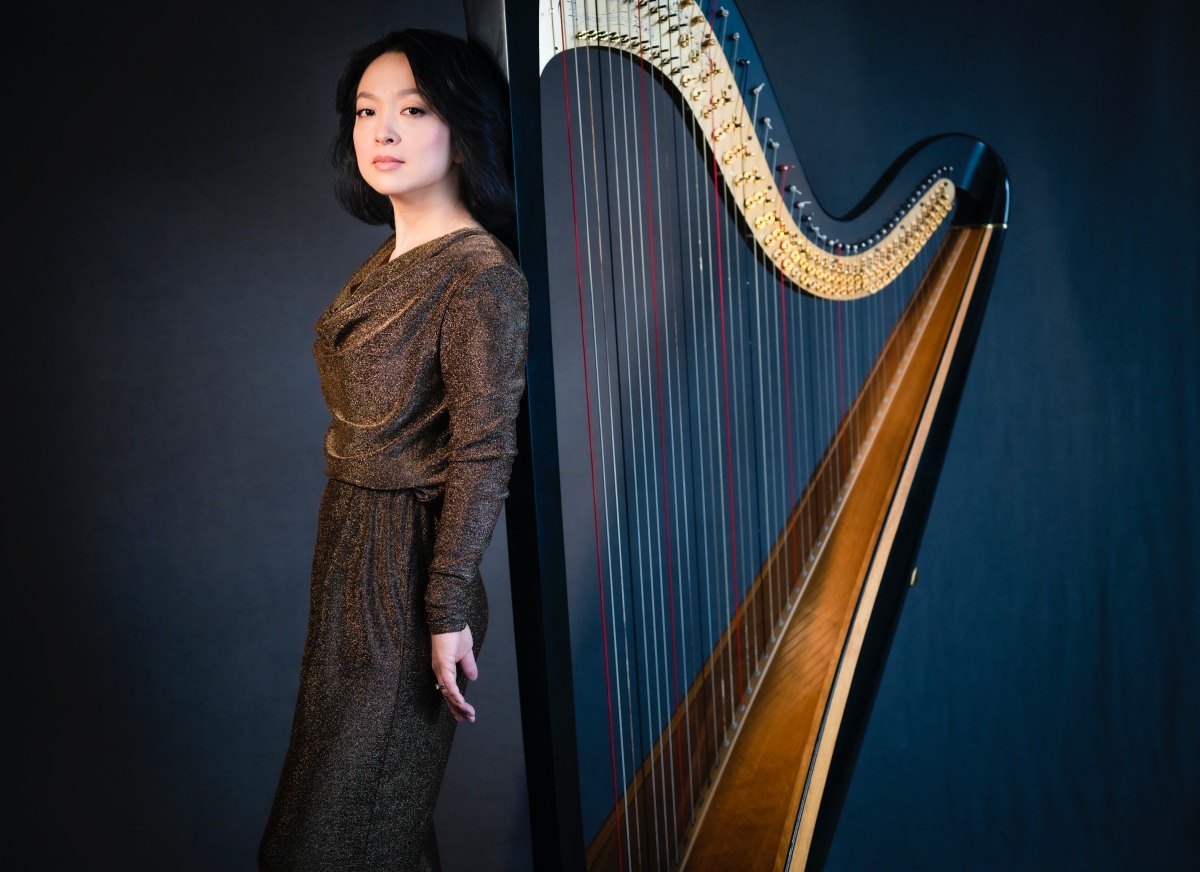
Dr Suen-Campbell studied at Northwestern University in Chicago, and became the first harpist from China to acquire a Doctor of Music degree in harp performance.
As a soloist, Teresa has performed with Sinfonia Toronto, Toronto Concert Orchestra, Hong Kong City Chamber Orchestra, Kindred Spirits Orchestra, Hong Kong Strings and the SAR Philharmonic. She has also performed at numerous music festivals and conferences internationally by invitation, including Ottawa Chamberfest, Toronto Summer Music, and the Hong Kong Arts Festival, among others.
Teresa is currently principal harpist of the Toronto Concert Orchestra and the North Bay Symphony, and formerly, Hong Kong City Chamber Orchestra (2009-2011). She has also performed with the Windsor Symphony, Scarborough Philharmonic, Hong Kong Sinfonietta and the Illinois Symphony.
A strong advocate of contemporary music, she has commissioned three harp concertos, three solo works for the harp, and two solo works for harp and electronics.
Previous recordings include Alice Ping Yee Ho’s “Beyond the Erupting Skies Silver Angels Sing Among the Gold Stars” on the Centrediscs label, and her debut solo album “Longing” (2010).
Along with her performance career, Dr. Suen-Campbell is a harp examiner at the Royal Conservatory of Music, and is currently on faculty at Lakehead University in Thunder Bay, Ontario.
She is also a music scholar whose journal articles have been published by the World Harp Congress Review, German Harp Society Journal, and the American Harp Journal. In recent years, she has also arranged and performed piano music of Beethoven, Schumann and traditional Chinese music for solo harp.
The Interview
When did she know that the harp was her instrument?
“I don’t know when,” Suen-Campbell laughs. “I never thought of why am I doing this,” she adds. “I know it sounds unbelievable.”
She grew up in Hong Kong, where she first studied music. “It was actually very academic. It’s very strong in composition,” she says of the school, which she describes as a kind of Taylor Academy for advanced students. “I was 15 when I started, but I played the piano for a long time. I was very fortunate, my mother gave me that training.”
Teresa began playing piano at the age of five, and eventually decided to pursue the harp at the Chinese University of Hong Kong. She found herself — and the instrument — a centre of attention.
“It’s funny, the atmosphere was like, they all wanted to know the harp,” she says. In China, the instrument doesn’t have the same historical weight as in Europe. “The harp is a relatively new entity compared to the piano.”
The atmosphere sparked the adventurous direction her performance career has taken, favouring contemporary music on an ancient instrument. “Most harpists are just learning the notes,” she explains. In her case, she was surrounded by an environment where composers were constantly asking about her instrument, and wanting to write for her.
“I was already in that environment where composing new music is encouraged.”
She completed her doctoral degree in Chicago, where her professor, Elizabeth Cifani, former principal harpist of the Lyric Opera of Chicago, was also a strong proponent of new works.
“She is a very creative woman. I think that’s a very big factor in why I’m doing what I do today.”
From the world premiere of Chan Ka Nin’s Harp Concerto with Sinfonia Toronto in 2022:
The Composers
Suen-Campbell’s musical relationship with composer Chan Ka Nin began shortly after her arrival in Toronto from Ottawa in about 2017.
“I attended a concert in Toronto when I first arrived,” she says. It was a work for solo cello. “I just thought it was very deep, his music.” It incorporates the features of typical 21st century music — atonality, dissonance… “But he also has a very emotional side. It left an impression, a very strong impression.”
Chan’s combination of musicality and emotions appeals to music lovers, whether they’re typically enamoured of contemporary music. “We want to keep moving, and exploring these new possibilities, but if you go too far […] you still want to appeal to your senses as a human,” Teresa says. “I feel like he kind of has the best of both worlds.”
His Harp Concerto came by way of an invitation.
“I invited him to write a harp concerto for me, and he did,” she says. The inspiration, however, came from his own life. “But it’s about his mother, actually,” she explains. “It’s dedicated to his mom.” Chan’s mother passed away recently. “When he wrote this piece a few years ago, she was still alive, and had dementia.”
The work is a celebration of her. Chan was inspired not just by her story, but those of the many seniors in care homes of one kind or another who’d been isolated by the pandemic lockdowns.
On the album, the two new works by Chan and James W. Campbell, Teresa’s husband, contrast with Handel’s baroque Op. 4, No. 6 (aka HWV 294)
“I just wanted to present a diverse picture of the harp as an instrument,” she says. “The harp is very new, but is also very ancient.”
She chose Handel’s work as one of the oldest for the harp. “It’s also one of the first concertos that I learned. I know there are a lot of recordings, but for some reason, I feel that I need to put my own stamp on it,” she explains.
“I have my own interpretation. I’ve been wanting to record this for a very long time, and I wrote a cadenza for it.” There are few cadenzas for harp, she notes. “I feel it’s not enough. I think my next step is to publish that candenza,” she adds.
“This project is not just me as a performer. I think I’m challenging the status quo. A performer can be a composer,” she says. “Back in the old days, Liszt played his own music. Why can’t we do it now? One my goals is to challenge that.”
She became involved with the compositional process of the harp concertos written by James Campbell and also Chan, advising tweaks and adjustments, and experimenting with performance.
“Is it performable?”
Working with composer James W. Campbell, and his harp concerto, began well before their marriage, or even relationship.
“I worked with him before we got married,” she explains. Campbell was working as a barrister in Hong Kong, and he reached out to contact her about a piece he’d written for his father which had premiered in Hamilton (his home town) with members of the HPO.
“That’s where we met,” she says. James came to one of her recitals. “He was very impressed.”
He was also intrigued by the possibilities of the harp as an instrument. “He showed me the music that wrote.”
Campbell’s compositions are often based on religious themes and music. “The piece was based on a Psalm,” she says. “He started writing these pieces for me.”
Teresa recorded three pieces for his studio album. Their relationship developed after the professional collaboration. The new harp concerto was Teresa’s idea.
“I suggested it,” she says. “I just thought, why not write a harp concerto?”
The piece was composed in 2001, and the process sparked her desire to commission new works. “He opened my eyes. Maybe I can do more on that front.”
His style contrasts nicely with both Handel and Chan. “His music is a bit more romantic,” she says. “I do have a romantic side.”
As such, the three works present a showcase of the harp as an instrument.
“I just wanted to have a diverse album.”
The Harp in Canada
“I think Canada has always, if you look at Canadian history […] I think Canada has been a hub for harp music.”
She cites artists like Erica Goodman, who has been commissioning new works for the instrument for decades. “They did a lot of new music.”
It’s part of an atmosphere she’s noticed in her adopted country. “That’s one thing about this country is that you’re open to new music,” she observes, “particularly in Toronto. When I was there [in Hong Kong], I was one of a few.”
The works she’s commissioned, with a few exceptions, have come from Canadian composers. “I think it’s just an environment.”
She also appreciates the support she’s received from the Canada and Ontario Arts Councils, as well as private sponsors. “I’m just very thankful,” she says.
The recording was made with Sinfonia Toronto and conductor Nurhan Arman.
“I’m very thankful for the extraordinary musicians,” she says. “They were absolutely incredible. We had two days only to do three concertos.”
She also credits her producer and other members of the recording team.
George Frideric Handel — Harp Concerto in B Flat Major, Op.4, No.6, HWV 294: I. Andante allegro:
Upcoming Dates
The album My Voice will be released on July 11, 2025 on Navona Records. Presave/buy/stream [HERE].
There will be an album release concert on July 15 at the Canadian Music Centre in Toronto in a free event. You can RSVP via Suen-Campbell’s calender [HERE].
Are you looking to promote an event? Have a news tip? Need to know the best events happening this weekend? Send us a note.
#LUDWIGVAN
Get the daily arts news straight to your inbox.
Sign up for the Ludwig Van Toronto e-Blast! — local classical music and opera news straight to your inbox HERE.

- INTERVIEW | Composer Andrew Balfour Talks About The Upcoming Concerts With Jubilate Singers & Friends - March 20, 2026
- PREVIEW | The Mississauga Symphony Orchestra Welcomes Canadian Pianist Sheng Cai - March 20, 2026
- INTERVIEW | Composer Aziza Sadikova Talks About The Toronto Premieres Of Her Music With Esprit Orchestra - March 19, 2026