
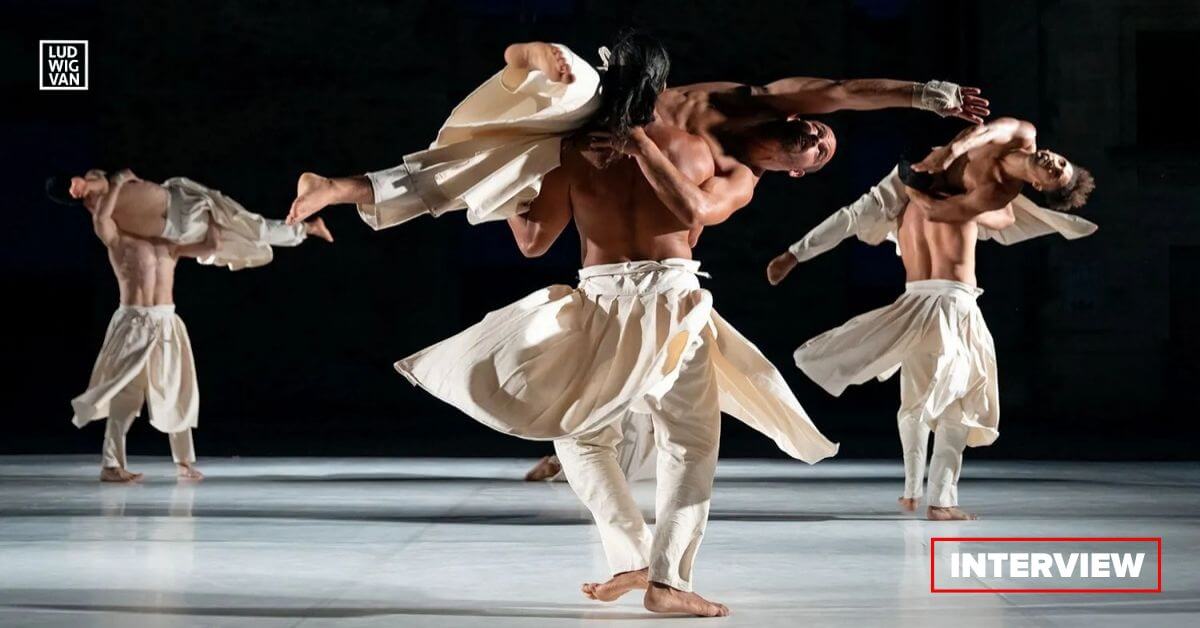
Capoeira, martial arts, street dance, and contemporary movement come together in Hervé Koubi’s dance work, What the Day Owes to the Night, part of Luminato Toronto festival. Presented in partnership with TO Live and Fall For Dance North, performances take the stage at the Bluma Appel Theatre from June 19 to 21.
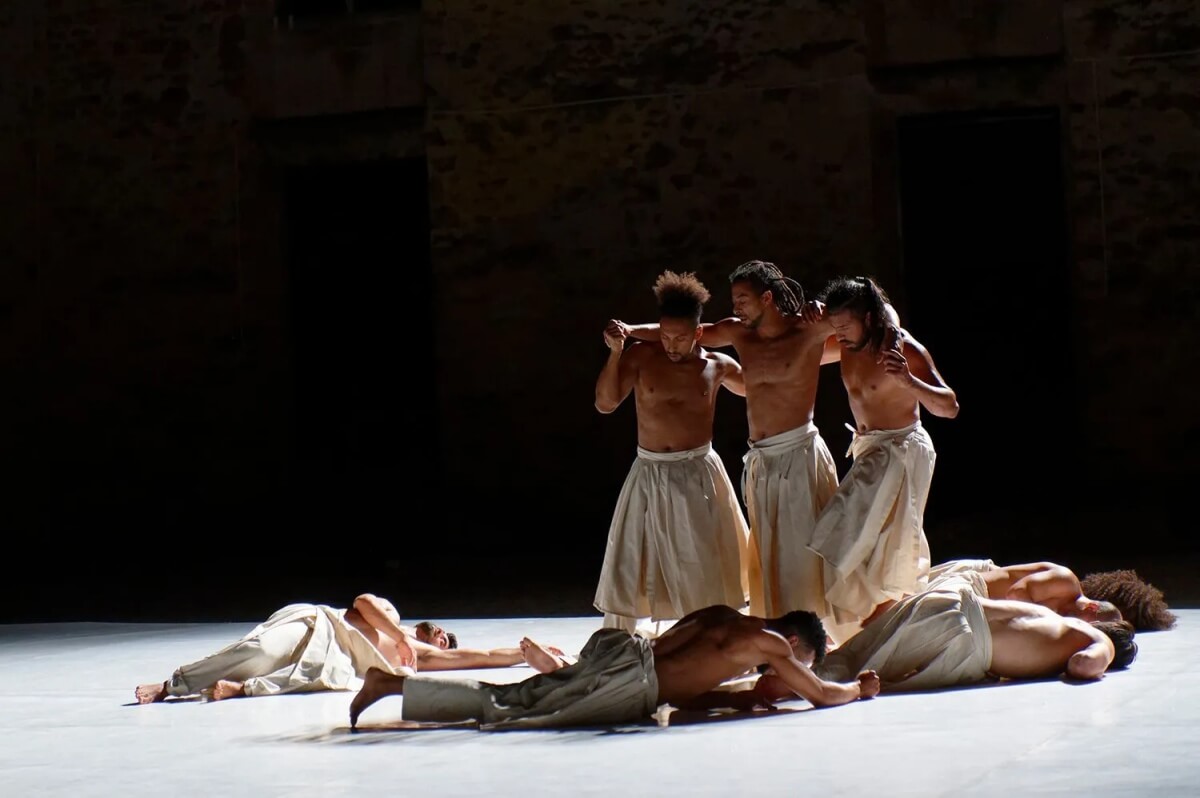
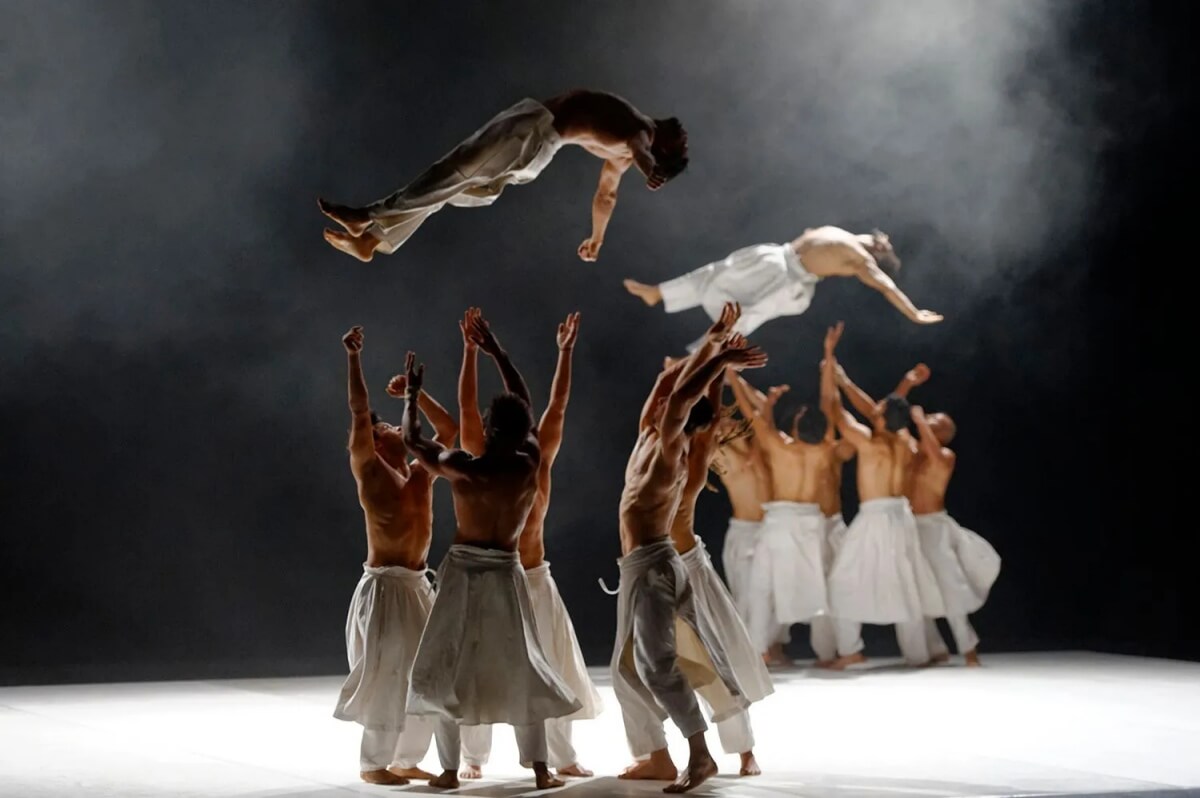
In What the Day Owes to the Night, 12 male dancers create a moving dynamic that swings from raw athleticism to delicacy and grace, using music that ranges from Bach to Sufi and traditional Algerian works. The dance itself blends Eastern and Western cultures and idioms, drawn from the diverse peoples who populate the Mediterranean region.
Choreographer Hervé Koubi grew up in France unaware of his Algerian heritage. The journey of that revelation led to the creation of his dance company, and of this piece.
LvT spoke to Guillaume Gabriel, who is the co-founder of Compagnie Hervé KOUBI, about Hervé Koubi, and What the Day Owes to the Night.
Guillaume Gabriel, Co-founder of Compagnie Hervé KOUBI: The Interview
“We were friends, and I was finishing my PhD in business,” recalls Guillaume Gabriel.
Hervé Koubi was also a student at the time, but he wasn’t studying dance.
“He is also a PhD in pharmacy,” Gabriel says.
Still, both were interested in dance, and began to perform without any plans to make it a profession.
“In the beginning, it was a small project with seven dancers, but grew quickly,” Guillaume says. By the time they staged their first project, the company had already grown. “We were 11 dancers and four musicians.”
Gabriel also danced at the time. “I was inside and outside,” he says. “I worked in the pieces for ten years.”
After a decade of dancing, Gabriel switched from an onstage to a backstage role, working to help produce the works that Koubi was creating.
“I could say we created everything with our little hands,” he says, noting that they weren’t governed by any rules related to funders or the French state, for example. It also meant working without those funds.
“It was maybe crazy,” he laughs. “We created the company.”
The leap from amateur to professional is always at least a little painful. “The only possibility we had at the time with him was entering some competitions,” Guillaume says. Koubi’s wins gained some momentum. “Then we decided to jump [from amateur to professional],” he says.
The Dance: Appreciation
Gabriel notes that people love Koubi’s work in What The Day Owes To The Night, but often find it difficult to describe. But — that’s not really the point.
“People think you need keys, you need a code to understand,” Gabriel says. It’s more about what feeling, however. “I remember one performance touched me deeply, and I said, okay, this is what I want to do.”
A dance performance gives the audience the opportunity to feel, rather than to think.
“Don’t really try to understand or know what the choreograph wants, because nobody knows. Only he knows what he wants,” he laughs.
Whatever connection the audience makes with the movement and dancers is a valid one. “It depends on you also.”
What the Day Owes to the Night
What the Day Owes to the Night is characterized by its energy. “Hervé had this will to create this physicality since he created this company.”
After Hervé, who was born and grew up in Cannes, France, finally found out about his Algerian heritage, he undertook a journey of discovery to Algeria to trace his roots. There, he met a group of street dancers who inspired him with moves that ranged from martial arts to hip-hop.
The inspiration comes equally from sources like yoga dances and Capoeira, the Afro-Brazilian martial art and game, as from the contemporary dance principles that Koubi also studied. Finding the street dancers in Algeria was like finding the missing pieces to his vision.
“He finally met the dancers he wanted [to work with],” Gabriel says. “It was what the youth in Algeria wanted to say. What they wanted to give. To be a dancer in Algeria was something very difficult,” he adds.
“You can only train at night, when the police leave you alone.”
Those were the conditions that Koubi found during his first trip there in 2010.
“For them, the possibility that they had to work with a French choreographer was also a possibility for them to change their lives.”
It’s that joy and sense of possibility that fuels their movements. “The body had to go beyond their limits,” Gabriel says. “The work that Hervé did with them, is to give them some contemporary qualities.”
He worked with them to shape raw athleticism into interpretation, taking the full on assault of street dance to fashion works with an ebb and flow of energy and passion.
“To put aside, for a while, all the things they used to develop in hip hop battles, for example,” he explains. It’s virtuosity for its own sake vs. virtuosity with expression.
“The challenge was to unroll a kind of thread for one hour.” It also meant creating connections between the dancers, as well as the audience.
Dance: Fusion
Gabriel points out that the dance is a kind of fusion of cultures from both sides of the Mediterranean. The first part of the dance refers to North African traditions, leading into a more complex mix that includes different styles of music.
“The actuality wants to divide us,” he says, “but when you realize the geography, the Mediterranean is just like a lake.”
The history of the region, in fact, is a history of people crossing that body of water, mixing and mingling.
“We all have the same roots. We are standing on these global roots.”
That’s where the title of the work takes its inspiration.
“It’s, in a way, what the North owes the South,” he says. “What love owes to war, what the Occident owes to the Orient. Nothing is white, nothing is black. It’s a mix. It’s a kind of travel.”
It’s also where Koubi’s story intersects with the dance. His parents were born in Algeria, a former French colony. But, Hervé does not look Algerian, and his name is French rather than North African. It’s a search for identity through dance.
When Hervé was in his mid-20s, he grew curious about his background, and relatives he’d never heard of. After asking his father several times, he was finally shown a photo of his great-great-grandfather, who spoke only Arabic, in a traditional Arabic dress.
“That was his history,” Gabriel says. “It was a shock.”
That was the catalyst for both the trip and, eventually, the dance.
“What the Day Owes to the Night is in a way to put to life all the dreams he had of North Africa,” he explains.
Koubi was struck by the strong sense of brotherhood he found, and how drastically differently the sense of touch is treated in North Africa as opposed to Western Europe. “It’s all these things that he wanted to put into the show.”
He was also inspired by the experiences of painters in the so-called Oriental style, such as Eugène Delacroix (1798 to 1863), who painted scenes from Algeria both before and after he’d actually travelled there. His paintings were fuelled by his dreams of the region first. “The style changed a lot,” he points out, “before you know, and after you see.”
It’s another aspect of the dance, which blends realism with idealism.
“You could also call it, what imagination owes to reality.”
- Find performance details and tickets to What the Day Owes to the Night [HERE].
Are you looking to promote an event? Have a news tip? Need to know the best events happening this weekend? Send us a note.
#LUDWIGVAN
Get the daily arts news straight to your inbox.
Sign up for the Ludwig Van Toronto e-Blast! — local classical music and opera news straight to your inbox HERE.

- INTERVIEW | Composer Aziza Sadikova Talks About The Toronto Premieres Of Her Music With Esprit Orchestra - March 19, 2026
- PREVIEW | Caelis Academy Ensemble & Thirteen Strings Orchestra Perform Matthew Larkin’s Passion Play - March 19, 2026
- THE SCOOP | Elton John Names Mezzo Emily D’Angelo As The Glenn Gould Protégé Prize Winner - March 18, 2026