
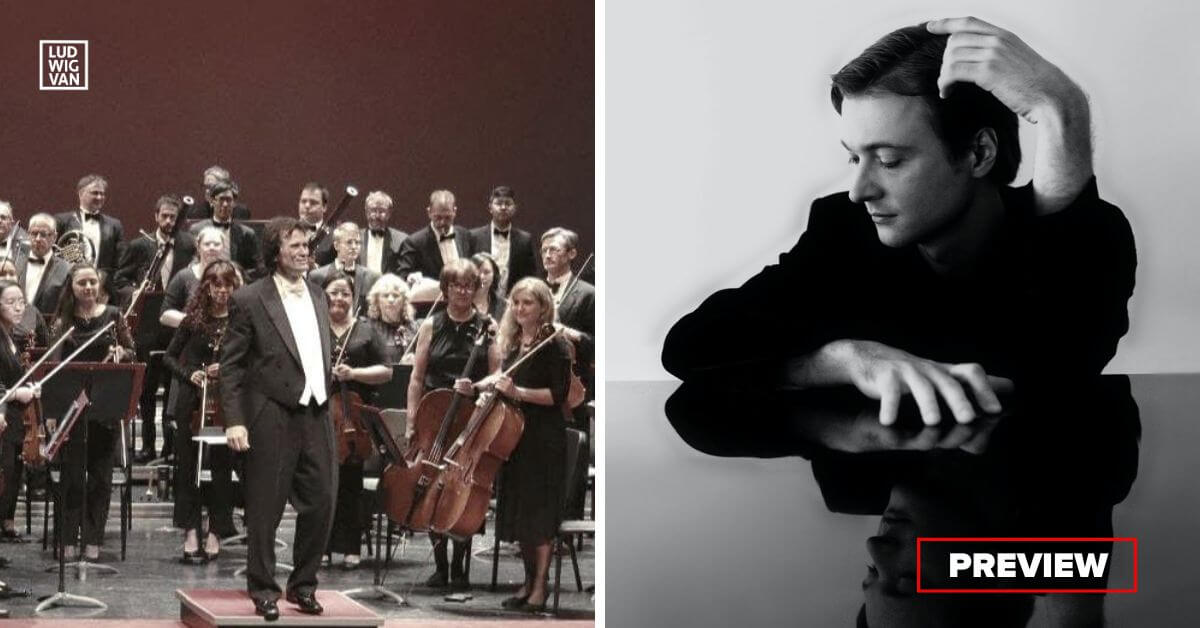
Conductor Kristian Alexander and the Kindred Spirits Orchestra will present their next concert, titled Poems And Portraits, on May 10. Pianist Dmitri Levkovich joins KSO to perform Bartók’s piano concerto No. 1.
The dynamic program also includes Debussy’s iconic Prélude à l’après-midi d’un faune, and Shostakovich, Symphony No. 7 ‘Leningrad’. Each of the pieces has a story to tell.
Pianist Dmitri Levkovich
Ukranian-born Canadian pianist and composer Dmitri Levkovich studied piano and composition with Sergei Babayan at the Curtis Institute of Music for 11 years, emerging with a Bachelor of Music, Master of Music, and Artist Diploma.
He went on to tackle international competitions, and collected several prizes, including the China International (1st and Chopin Prizes), Cleveland (2nd, Chopin and Audience Prizes), German Piano Award (1st), Gina Bachauer (3rd), Jose Iturbi (1st), and the Vendôme Prize (2nd).
His much lauded debut recording of Rachmaninoff’s 24 Preludes garnered a nomination for the 2016 International Classical Music Award.
Over the last couple of seasons, Dmitri has performed with the Cleveland Orchestra, China National Orchestra, and Dresden Philharmonic, and on the stages of the Berlin Philharmonie, Carnegie Hall, and Beijing Performing Arts Centre’s Main Stage. Dmitri recently debuted at the Ravinia Festival, and the 2nd International Mariinsky Far East Festival.
The Music
Debussy, Prélude à l’après-midi d’un faune
One of Debussy’s best known works, Prélude à l’après-midi d’un faune is a symphonic poem. Debussy was inspired by the poem of the same name by French Symbolist poet Stéphane Mallarmé. Written in 1894, it has since been hailed as representing a turning point in Western art music from the traditional to modernism.
It was premiered in Paris on December 22, 1894, with Georges Barrère performing the flute solo. Pierre Boulez wrote that, “the flute of the faun brought new breath to the art of music.” The piece incorporates (six-note) whole-tone and pentatonic (five-tone) scales, and chromaticism (notes outside the main scale), elements which are now associated with musical impressionism.
Bartók, Concerto for piano and orchestra No. 1, Sz. 83, BB 91
Bartók composed his Piano Concerto No. 1 in 1926. It was part of a flurry of pieces he wrote for piano after a three year period during which he produced very little work. His notes indicate that the percussion instruments should be placed beside the piano. It’s an indication of the percussive nature of the work overall. The work is also characterized by syncopation, dissonant counterpoint, and tone clusters which Bartók borrowed (with permission) from piano works by composer Henry Cowell.
Bartók himself was the soloist at the premiere, which took place at the fifth International Festival of the International Society for Contemporary Music in Frankfurt on July 1, 1927. Wilhelm Furtwängler conducted, and critics were largely outraged at its very modern sound.
Shostakovich, Symphony No. 7 in C major, Op. 60 ‘Leningrad’
Shostakovich began composing his Symphony No. 7 in Leningrad, and then completed it in the city of Samara. It was December 1941, during the height of the Second World War, and the German Army was laying siege to Leningrad. The Symphony would later premiere in Samara on March 5, 1942.
The composer had initially dedicated the work to Lenin himself, but changed it to the city of Leningrad. It was finally performed in that city on August 9, 1942, about a year into the siege.
The story of how it got there was itself a tribute to resistance against fascism and totalitarianism. Shostakovich had transferred the score to microfilm in Samara, and it was delivered in secret by a torturous route that went from Tehran to Cairo to New York. There, it received its North American premiere with the NBC Symphony Orchestra under the baton of Arturo Toscanini. The performance was broadcast on July 19, 1942, and Time magazine placed Shostakovich on its cover for the occasion.
The Concert
The concert includes a pre-concert recital and talk.
- 7:10 p.m. Prélude: pre-concert recital
- 7:20 p.m. Pre-concert talk
- 8:00 p.m. Concert begins
Find tickets and more details [HERE].
Are you looking to promote an event? Have a news tip? Need to know the best events happening this weekend? Send us a note.
#LUDWIGVAN
Get the daily arts news straight to your inbox.
Sign up for the Ludwig Van Toronto e-Blast! — local classical music and opera news straight to your inbox HERE.

- PREVIEW | TO Live’s Studio Sessions Presents KUNÉ, The Global Orchestra - March 24, 2026
- PREVIEW | Trombonist Constance Prost Talks About Her Upcoming Concert With Bass Trombonist Shin Tanaka At St. Thomas Church - March 23, 2026
- INTERVIEW | Composer Andrew Balfour Talks About The Upcoming Concerts With Jubilate Singers & Friends - March 20, 2026