
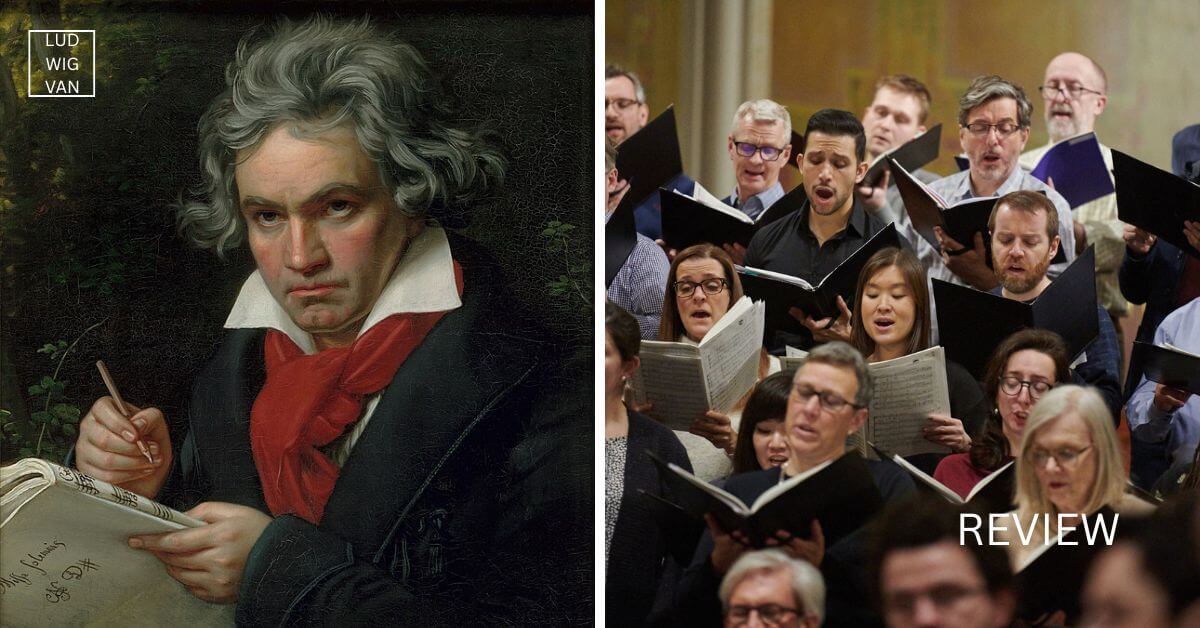
Toronto Mendelssohn Choir/Ludwig van Beethoven: Missa Solemnis, conducted by Jean-Sébastien Vallée, featuring soprano Tracy Cantin, mezzo-soprano Simona Genga, tenor Frédéric Antoun, baritone Brett Polegato, and the Kitchener-Waterloo Symphony, Roy Thomson Hall, Apr. 4.
In a letter dated June 5, 1822, Beethoven called the Missa Solemnis his greatest work.
Judging by the rapturous audience response that erupted at the end of Missa Solemnis, the mighty musical forces under conductor Jean-Sébastien Vallée had just given Beethoven’s epic masterpiece its just due.
Missa Solemnis is a late work written around the same time as the composer’s 9th Symphony, and there are certainly echoes of that revered piece in the mass. In fact, Beethoven drew on many different styles in crafting Missa Solemnis, including monastic chants, polyphony and particularly fugue, which he fused together with influences from Palestrina, Bach, Handel, Hayden, and Mozart.
But the heart of Missa Solemnis — that which empowers the music — is the majesty and grandeur of a Beethoven symphony.
Background
The inspiration for Missa Solemnis was to honour the composer’s great patron and dear friend, Archduke Rudoph of Austria, and the latter’s elevation to Archbishop of Olmütz which was to take place on March 9, 1820.
Beethoven, however, missed the date of the archduke’s investiture because it took the composer four years, until 1824 in fact, to complete this massive undertaking. Composing Missa Solemnis was the most time Beethoven ever spent creating a work. The mass is also his longest piece, eclipsed only by his opera Fidelio.
The Structure
Missa Solemnis is divided into five sections — Kyrie, Gloria, Credo, Sanctus and Agnus Dei, and while each has its own character, there is a narrative flow that links them together, a symphonic stream, as it were.
As one music historian wrote, Beethoven had a characteristic disregard for performers and musicians. He had his vision, and he would not compromise. As a result, the mass is fiendishly difficult, and Vallée, the choir, the soloists and the orchestra faced a daunting task. A performance of Missa Solemnis has been called both technically and physically exacting, with denoted speed being the most troublesome aspect, along with sudden shifts in metre and tempo.
As an audience member, one is acutely aware of just how complex and challenging the work is — for example, the unbelievably intricate nature of the choral music, including ridiculously high and low notes. And, the demands on the soloists who are often singing four different melody lines at the same time. The rapid-fire dynamic changes of mood that the orchestra must contend with — furioso at one moment which turns on a dime into adagio.
It fell to conductor Vallée to pull everything together, and his detailing of the many twists and turns of Beethoven’s musical genius was simply superb.
The Choir and the Orchestra
Under the maestro’s direction, the Mendelssohn Choir has become a very impressive musical ensemble.
Their evenness of tone as a whole, which stems from their perfect vocal balance, coupled with their astonishing ability to stop on a dime in one breath, speaks to the high degree of Vallée’s discipline. The choir did not put a foot wrong throughout the entire performance, executing their many musical difficulties with consummate professionalism. They are an exceptional group of singers.
Then there is the Kitchener-Waterloo Symphony, which has risen from the ashes to become a phoenix of players. It was with shock when this acclaimed group declared bankruptcy in 2023, but clearly their community rallied around to ensure that this august symphonic ensemble, founded in 1945, would continue to generate great music. Their performance under Vallée was outstanding.
The Sanctus calls for a hauntingly beautiful orchestral interlude, (a Beethoven innovation), featuring a solo violin which symbolizes the elevation of the Host. Concertmaster Bénédicte Lauzière gave a poignant and touching rendering of one of Beethoven’s most exquisite adagio passages, accompanied by a sweet-sounding orchestra manifested by Vallée’s sublime reading of the score. It was a ravishing musical experience.
The Soloists
Unlike other religious works where the soloists are given their individual arias, Beethoven used the quartet of singers for emphasis, almost as if they were an integral part of the orchestra — another instrument, as it were.
To that end, Vallée had the quartet sitting behind the violins so we could only see them when they stood up. This positioning, albeit strange, was clever because the singers became part of the whole.
The four Canadian soloists are very fine singers in their own right, but together there was an imbalance. This was the only flaw in the concert, although it certainly did not diminish the tremendous impact of the performance in any way.
Soprano Tracy Cantin has such a ringing, even thrilling, voice that it swept over everyone else. Mezzo-soprano Simona Genga and tenor Frédéric Antoun were a matched pair, but astonishingly, baritone Brett Polegato sounded washed out at times. When he finally had a brief solo that began the Miserere, his very attractive, mellifluous voice finally broke through.
I found Genga’s sound to be striking, but then I love fulsome, hearty mezzo voices. Not surprisingly, she was a Metropolitan Opera Contest semi-finalist in the 2022-2023 competition.
For his part, Antoun possesses a glorious lyric tenor that is smooth and velvety to the ear. I first encountered Antoun at the Spoleto Festival in Charleston, South Carolina, at the very beginning of his career. In fact, I interviewed him for the Globe and Mail, as I recall, and I’m delighted that the promise he showed then has flowered into a deservedly international career.
Impact
The Missa Solemnis is one of the most intensely personal works that Beethoven ever composed. He was a non-observant Catholic, to the point where he was accused of being a freethinker. He even produced a German version of Missa Solemnis so it would appeal to Lutheran Protestants, which shows how little loyalty he had to the Catholic church and the Latin mass.
Thus, we must assume that Missa Solemnis is not about religious fervour, but rather, it is an expression of the composer’s intense spirituality and his quest for the meaning of life. Beethoven was, after all, a product of the Enlightenment.
Final Thoughts
A mass is a meditation, a prayer, an acceptance of the divine, a comfort for the believer, but Beethoven’s Missa Solemnis is unsettling. The passion and the emotion, the boldness and the challenge, the sheer overwhelming force of the music is, perhaps, a reflection of Beethoven’s own crisis of faith.
This internal struggle is what Vallée brought out so magnificently in his reading of the score. This questioning spirit is what the Mendelssohn Choir and the soloists conveyed.
In turn, the audience was captivated by the sheer power of Beethoven’s musical genius.
Are you looking to promote an event? Have a news tip? Need to know the best events happening this weekend? Send us a note.
#LUDWIGVAN
Get the daily arts news straight to your inbox.
Sign up for the Ludwig Van Toronto e-Blast! — local classical music and opera news straight to your inbox HERE.

- SCRUTINY | The National Ballet Of Canada’s Pinocchio Delights Adults And Children Alike - March 18, 2026
- SCRUTINY | Mirvish’s Shucked Is Loud, Brash & Unapologetically Corny - March 10, 2026
- SCRUTINY | The National Ballet of Canada Opens Winter Season with Classical Purity and Contemporary Power - March 2, 2026