
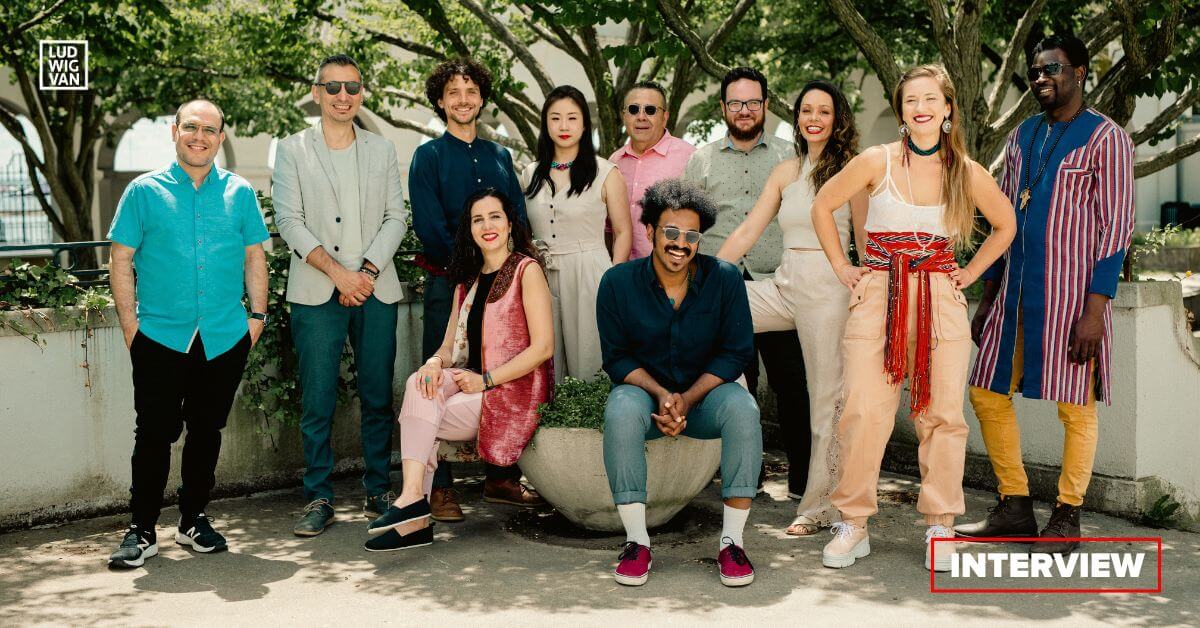
Chamber music with a difference, and a message that resonates with Earth Month — that’s the concept behind the next concert presented by The Chamber Music Society of Mississauga, which features the ensemble Kuné. Their concert program titled Universal Echoes takes its inspiration from the four natural elements: earth, fire, air, and water, and takes place April 10.
Kuné is made up of ten immigrant musicians from all over the world, and one Metis-Canadian, creating a rich base of traditions to draw from in creating original music. Universal Echoes is the title of their 2023 album.
Kuné
Kuné was formed in 2017 as the result of an initiative by The Royal Conservatory of Music. Executive Director of Performing Arts Mervon Mehta chose the ensemble’s 11 performers with a view to celebrating the cultural diversity of Toronto, and Canada. Its members hail from countries as widespread as Peru, Burkina Faso, China, and Iran, bringing their own musical traditions and practices together to create a truly unique sound.
The ensemble recorded their first album with the RCM. In 2021, they became independent, and released their second album on the Lulaworld label in 2023. They have performed at Koerner Hall, the National Arts Centre, the National Music Centre, and at the Ness Creek, Hillside, and Sunfest music festivals, among others.
Together, the members compose and arrange music that comes from a sense of experimentation and play, and constant dialogue.
Its members are:
- Ahmed Moneka, darbuka, vocals
- Aline Morales, vocals, percussion, vocals
- Demetri Petsalakis, guitar and oud
- Alyssa Delbaere-Sawchuk, violin
- Dora Wang, dizi, xiao & alto flute
- Salif “Lasso” Sanou, vocals, djembe, n’goni, peul flute and tama
- Luis Deniz, alto saxophone
- Matias Recharte, drums & percussion
- Paco Luviano, double bass & electric bass
- Padideh Ahrarnejad, tar
- Selcuk Suna, vocals, clarinet & tenor saxophone
We spoke to Matias Recharte about the ensemble and the music.
Water, Part III
Matias Recharte: The Interview
The Universal Echoes program and its music goes back a few years.
“This project it started back when we were still at the Conservatory in 2018,” Matias recalls. “We were commissioned to do a suite.”
The music, which focused on the four elements of earth, fire, water, and air, was composed, arranged, and even performed live over the course of a couple of years.
“And then the pandemic happened,” he laughs.
While the lockdowns were in place, however, it gave the ensemble the time and opportunity to apply for funding that was then turned into their 2023 album, Universal Echoes. Musically, the four elements theme evolved into reflection on the climate crisis.
“We all come from different places and we come from all over the globe,” he points out. The situation offers varying but related perspectives on the environment and its issues. For some regions, oil spills are common. For others, it may be drought. But, there are also commonalities, the “Echoes” that resound throughout the world, and the music.
“It’s a little bit like an ode to these things that keep life going.” The other side of the coin is mourning for what has been lost.
The music has been part of their repertoire for a few years. “We’ve been playing some of these songs for a while,” he says.
It’s also about Earth Day. “We’re also celebrating that.”
The Music
Genre-wise, Kuné’s music is essentially undefinable.
“It’s hard,” he begins. “The best way to describe it is, it sounds like Toronto a little bit.”
The ensemble’s music specifically tries to avoid approaching the label of an “African song” a “Middle Eastern song”. “But all those elements are present,” Matias says. One of the songs, for example, is sung in both Portuguese and Arabic.
It’s about bringing the various elements together in a musical conversation. Over the years, that process itself has resulted in different directions, and the musicians learning from each other.
“We’ve evolved quite a lot,” he says.
“It sounds organic, in a weird way,” Matias adds. “It’s really trying to capture that experience.” It’s something every Torontonian, or anyone who lives in a diverse city, can relate to. Everyone comes from a different background.
“What happens when you put them together?”
World music, rightly, is passé as a term nowadays. “World music. […] It’s like a bit of a safari. We’re trying to avoid that,” he says.
It’s really just music that comes from the realities of coming to a new country as an artist. Who do you get together with first? Obviously, other musicians.
“When I arrived […] I was very curious,” he says of his own experience. Getting together with other musicians was a natural early step, long before Kuné. “It’s really sharing.”
He’s noticed that many of the people who will come up to band members to talk after shows are also immigrants. They’ll recognize familiar aspects of the music, even outside the usual context, and even outside their own backgrounds. “There’s something that sounds familiar.”
“Music doesn’t care about borders,” he notes. All the same, there are few opportunities outside global music festivals to see that kind of true cross-cultural experimentation on stage. The traditions survive largely intact in immigrant communities. While he appreciates the nostalgic appeal, it can’t be the only direction for the music — one that doesn’t take into modernity or evolution into account.
The perspective of immigrant musicians, he points out, is unique. After bringing your traditions and established practices, you now cross paths with others who come from virtually anywhere in the world. It’s just another aspect of adapting to the new environment.
“What now, that we’re all here?”
Honouring your roots while reaching out to the rest of the world expands the limits of the art form, as he points out.
“Once people hear it, and they see it, they’ll get it,” he says, and points out, “Even if you’ve been here for generations, your neighbours come from everywhere.”
Performances
Kuné’s performance calendar is fairly relaxed, given its larger size, and the fact that many of its members have high profile careers on their own, including Brazilian-Canadian percussionist and singer Aline Morales and rising star in the worlds of theatre, film, and musician Ahmed Moneka.
“That’s how we like it.”
Typically, before any show, the ensemble will precede a show with a free preview and community outreach.
- Six of the members will be performing a free concert as a preview of the Universal Echoes program at the Meadowvale branch of the Mississauga Library on April 5 at 11 a.m. Admittance is first come, first served.
- Find out more about the April 10 concert [HERE].
- They’ll be taking the same program on the road to Huntsville, ON (July 11), and Trail, BC (July 24), with dates through the year, including Quebec and St. Catharines, ON. Find more information [HERE].
Are you looking to promote an event? Have a news tip? Need to know the best events happening this weekend? Send us a note.
#LUDWIGVAN
Get the daily arts news straight to your inbox.
Sign up for the Ludwig Van Toronto e-Blast! — local classical music and opera news straight to your inbox HERE.


- INTERVIEW | Tim Gentle Talks About Ian White’s Children’s Book Snowball: A Christmas Dilemma - December 12, 2025
- INTERVIEW | Composer Njo Kong Kie & Librettist Douglas Rodger Talk About Their Digital Opera The Futures Market - December 12, 2025
- PREVIEW | Something Different For The Holidays: Sex Dalmatian’s Hot Holiday Spectacular - December 11, 2025