
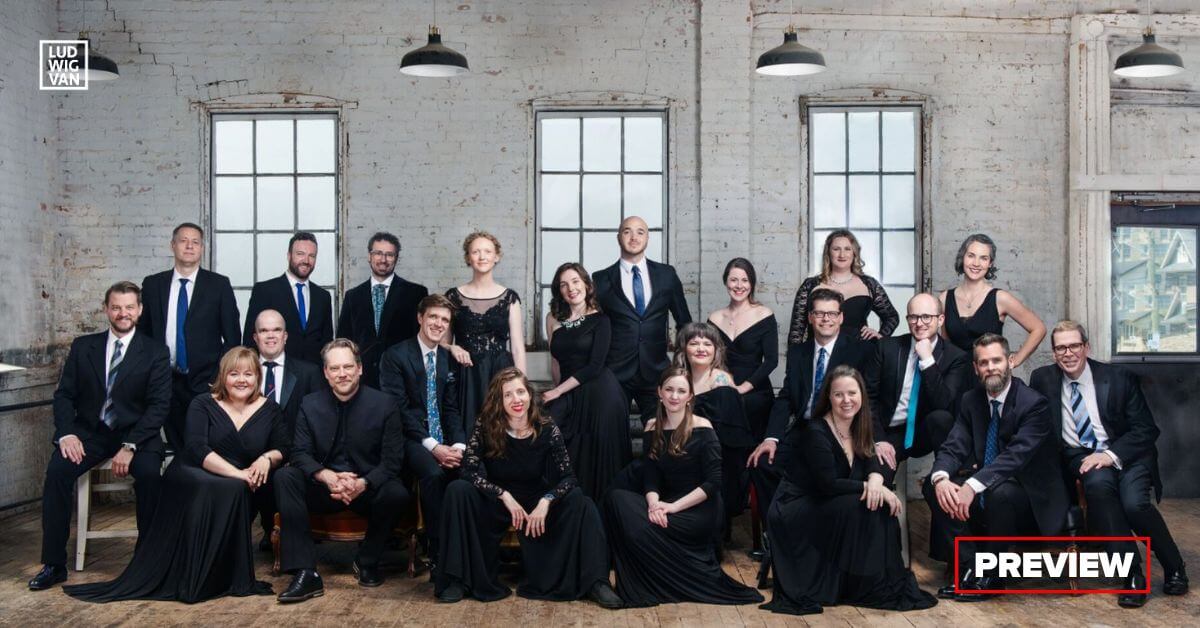
The 2024/25 concert season will close for The Elora Singers with a concert titled Burning Measures, and a program that spans centuries of music. On the bill are choral masterpieces by Tarik O’Regan, Arvo Pärt, and JS Bach.
Mark Vourinen, Artistic Director of the Elora Singers, leads the Grammy and JUNO nominated Elora Singers, and musicians from the Kitchener-Waterloo Symphony.
The Music
Tarik O’Regan: Triptych (2005)
Tarik O’Regan’s Triptych has been performed more than 150 times since it was composed two decades ago. It sets to music a variety of texts from wide ranging sources, including William Penn, William Blake, the Biblical Psalms of David, and those taken from teh book Anecdotes and Psalms by early 20th-century Egyptian poet Muhammad Rajab Al-Bayoumi.
Triptych expands on an earlier work of O’Regan’s that was originally composed for a Remebrance Sunday concert. Musically, the work begins with two movements that are slower, and more reflective, in keeping with the usual mood of commemorative pieces. For the third movement, however, O’Regan was inspired by his buzzing New York City neighbourhood, and he uses the urban rhythms and North African syncopations he hears in his environment to add a faster pace and more energetic finish to the work.
Arvo Pärt: Berliner Messe (1990)
Arvo Pärt composed his Berliner Messe for the 90th German Catholic Days celebration in Berlin in May of 1990. It was the first to be held after the Berlin Wall came crashing down in late 1989. It premiered at Hedwig’s Cathedral in its original version for four soloists (SATB) and organ. He also wrote a second version for mixed choir or four soloists, and a string orchestra.
Pärt wrote the Messe so that it could be used in liturgy as well as performed as a concert piece. As such, he adhered very closely to the text. “Each step is derived from the text. Hence, this is not a result of a so-called inspiration, but something more objective,” he has noted.
The music is inspired by the composer’s study of early music, and influenced by Orthodox Russian as well as medieval and Renaissance musical elements. He used a vocal technique he calls “tintinnabuli”, which refers to the bell-like sounds of a triad. The work often employs a melodic voice which moves around a central pitch, sounding a tonic triad.
JS Bach: Nach dir, Herr, verlanget mich, BWV 150 (1708?)
The original score for Bach’s church cantata BWV 150 has been lost to time. Luckily, we know it today because of a copy made by one of Bach’s last students. It’s generally considered to be one of his earlier works, however, due to certain musical features, and may have been composed while he was at Weimar, Mühlhausen, or Arnstadt between the years of about 1707 to 1712, and is believed to be his very first church cantata.
It consists of seven movements: an instrumental sinfonia, four choral movements, with two arias, sung third and fifth in sequence. In contrast to most of Bach’s other cantatas, there is no chorale tune, and the music is characterized by choral fugues and polyphony.
JS Bach: Sanctus in D, BWV 238
The Sanctus in D was first performed on Christmas Day, 1723, most likely Bach’s first Christmas in Leipzig. Musically, the work differs from the majority of Bach’s cantatas in that there are only two independent instrumental parts, namely the bass and first violins. All the other instrumental parts double the choir’s SATB parts.
The text is in Latin, and it was the second of five Sanctus Bach composed as a series, now known as BWV 237 to 241, plus BWV 242, another mass. They were composed between 1723 and 1748 during his Leipzig period; in contrast with other locales in Germany, in Leipzig Latin was still widely used in religious ceremonies and education. Elsewhere, it had been banned in favour of German during the Protestant Reformation.
- Find more information about the concert, and tickets, [HERE].
Are you looking to promote an event? Have a news tip? Need to know the best events happening this weekend? Send us a note.
#LUDWIGVAN
Get the daily arts news straight to your inbox.
Sign up for the Ludwig Van Toronto e-Blast! — local classical music and opera news straight to your inbox HERE.

- THE SCOOP | Canada’s National Arts Centre Orchestra Launches 100th Tour On April 14 2026 To The Maritmes - March 24, 2026
- PREVIEW | TO Live’s Studio Sessions Presents KUNÉ, The Global Orchestra - March 24, 2026
- PREVIEW | Trombonist Constance Prost Talks About Her Upcoming Concert With Bass Trombonist Shin Tanaka At St. Thomas Church - March 23, 2026