
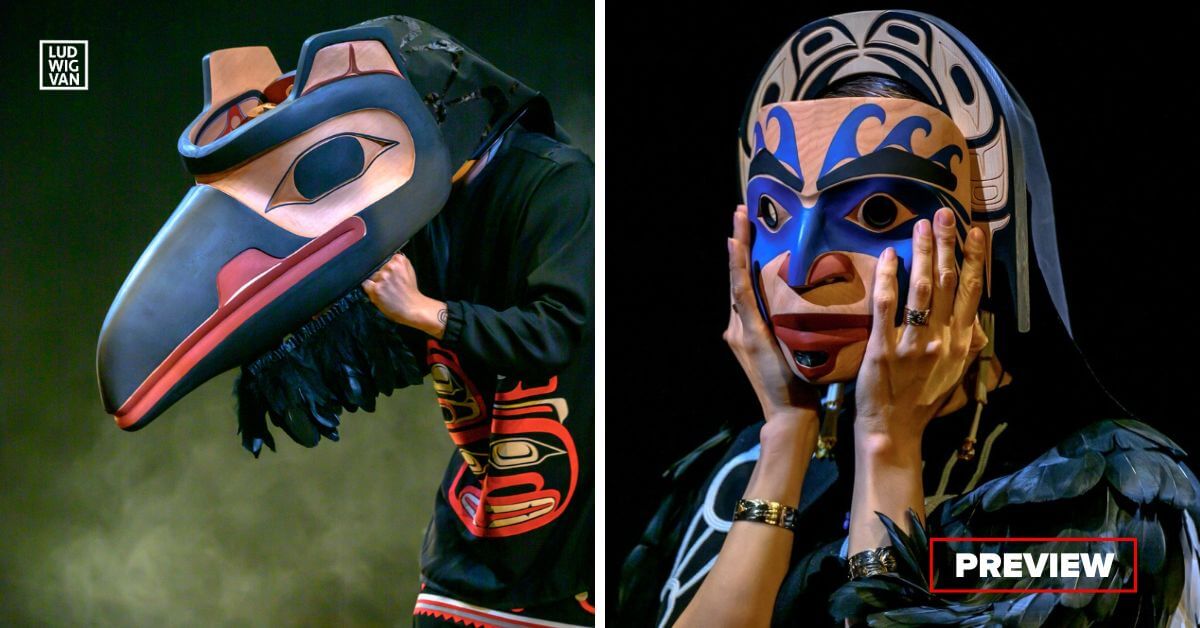
Dancers of Damelahamid full-length work Raven Mother will hit Toronto’s Fleck Dance Theatre on November 29. The performance is part of a cross country tour supported by a number of dance presenters.
Raven Mother celebrates the impact of strong matriarchs across the generations, and is performed to live original music and vocals. Specifically, it’s an homage to the late Elder Margaret Harris, who co-founded Dancers of Damelahamid in 1967.
She is also mother to the company’s Executive & Artistic Director Margaret Grenier. The performers include Margaret Grenier, and Harris’s grandchildren Nigel Baker-Grenier and Raven Grenier, as well as Margaret’s niece Tobie Wick and daughter-in-law Rebecca Baker-Grenier.
We spoke with Margaret Grenier about the tradition as well as Raven Mother. First, a little necessary background.
The Potlatch Ban
Many Canadians remain unaware of the extent of the means by which the Canadian government attempted to erase Indigenous culture.
In the late 19th century, what was called the anti-potlatch proclamation went into effect, becoming law on January 1, 1885. It outlawed the celebration of the potlatch ceremony, and specifically dance. For the Indigenous people of North America’s Pacific Northwest coastal region, the potlatch ceremony was a cornerstone of not only their culture, but their society itself, expressed in ceremonial form.
The law was in force for more than six decades, many Indigenous people were charged and imprisoned for the offence of performing traditional dance. The Potlatch Ban was in effect until 1951.
Those cultural practices, however, continued and survived in secret within Indigenous communities.
Elder Harris
Elder Harris (1931-2020) was a Cree Elder. Originally from Northern Manitoba, she would spend most of her life on the Northwest Coast of British Columbia. She trained with her mother-in-law, Gitxsan Matriarch Irene Harris, and became determined to revitalize and teach Indigenous cultural practice, where music, dance, storytelling and regalia making are an integral part of heritage.
In co-founding Dancers of Damelahamid, and teaching future generations, she had a huge impact on the revitalization of Indigenous dance along the whole Northwest Coast. Part of the theme of Raven Mother is underscoring the pivotal role women have played in terms of preserving cultural knowledge, including song, dance, stories, and regalia making.
Today, because of the legacy of Harris and others, traditionally based cultural practices are seeing a resurgence.
Executive & Artistic Director Margaret Grenier: The Interview
Dance forms an integral part of Gitksan culture, and that of other West Coast First Nations.
“That’s something that encompasses a lot more for us in our practice. We’ve used dance to carry our oral history forward throughout time. Essentially, dance has told the stories, going back to our origin stories, significant events in our history,” explains Margaret Grenier.
“The way I would describe dance is that is carries the ancestral knowledge that we use to establish our values or the way live and carry ourselves in our world.”
It goes beyond the idea of creating art or performance; it’s an essential part of identity. The Potlatch Ban turned cultural practice into an underground act of resistance.
“The Potlatch ban, for us, in our families, it lasted the majority of the life of my grandmother,” she points out, noting that her own grandmother, who was born in 1880s, was already an elder when it was finally rescinded in the 1950s.
Her mother Margaret Harris would become an elder in her own right.
“She trained people, and then they carried it on to make sure it would be revitalized, that we would have the ability to carry it forward today.”
The dance as it is practiced today retains the same forms as the tradition, but has also evolved. As a way of preserving history, it now also tells the story of what happened during the Potlatch Ban, and its effects that extend to today.
“We add to that narrative with the voices of today,” she says. Today’s story includes a narrative of resurgence, and of establishing their own space within the colonial context. “That does become part of our story as well.”
The pandemic added a focus on the need for health and wellness, and the isolation of young people in particular during the lockdowns. Dance, music, and storytelling connect the community where the role of matriarch is an important one.
“It ties into what we’re saying about it being a practice,” Grenier explains, “the care that comes with it, because it does come from women, mothers and grandmothers, they’re doing it for their children too. It’s not an easy weight to carry.”
The generations who have taken on the task of rebuilding have a crucial task. “It has been done with such love, such vision, and hope for change.” That hope is for an impetus that moves towards something that is less fragile. “For past generations, it really was on the shoulders of individuals,” she notes. Reaching more people, and creating and expanding the reach of a vibrant and living culture is the goal, where a network and established institutions can take the weigh off the shoulders of individuals.
“It’s more than just the gentleness that we might associate with women, it’s really that deep strength that is needed to do the work,” she says. “That’s something very special that women really carry — the capacity to persevere […] to hold on to the hope.”
Raven Mother
“Margaret Harris, she was very remarkable,” says Margaret Grenier. She describes a woman who not only worked tirelessly for her own family, but who created a home that was always open for others. She recalls her fostering dozens of children over the years, and working with troubled women in the Downtown Eastside of Vancouver. “She did so much for others. A lot of it was through cultural teachings, teaching song and dance.” Harris created community through those practices.
To commemorate her, it had to be something special. “We wanted to do a work that really spoke to what she left us, not just in terms of art, but what she taught us through her generosity, her dedication to others.”
The lessons she learned from her mother were many. “We need to be able to see as individuals, what we can do. What may look like too much, really isn’t.”
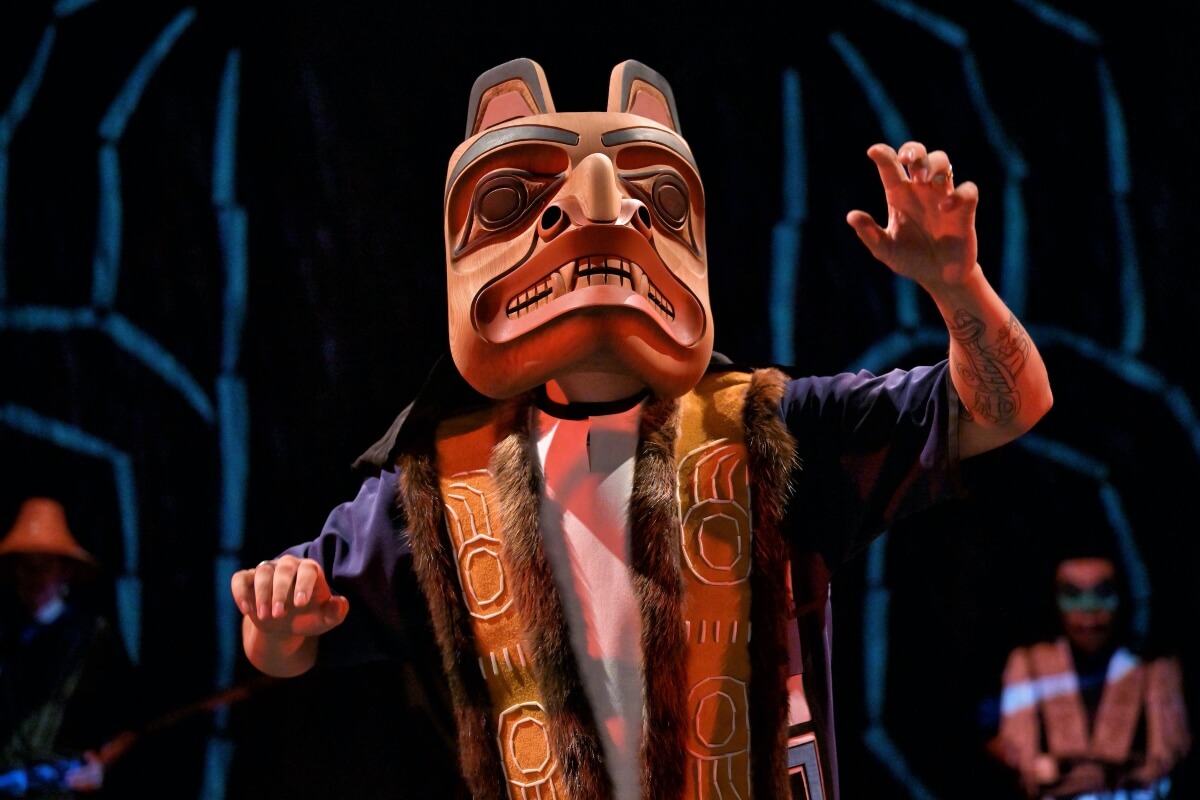
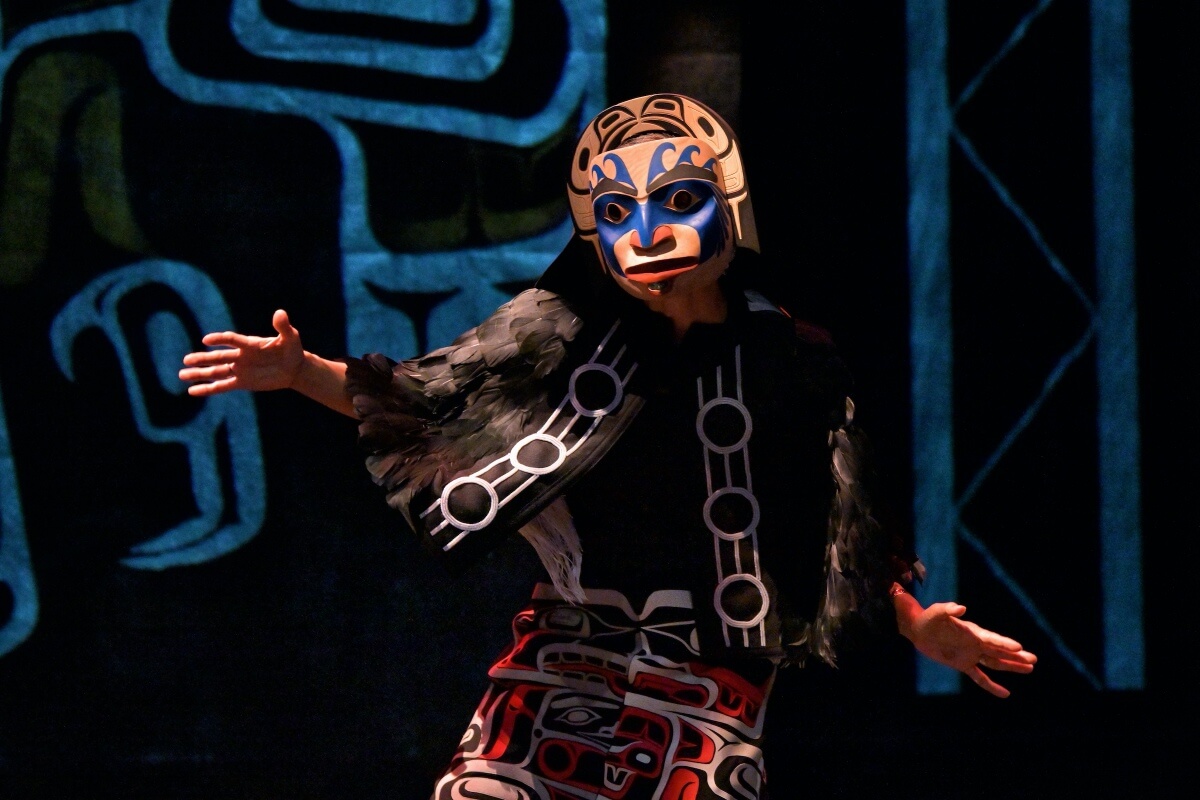
Raven Mother unfolds in a series of vignettes that tell a story, blending movement, song, music, regalia, masks, and sculptures of the Gitxsan people. Traditionally, the Raven crest, which appears in various forms throughout the piece, denotes transformation, and it embodies the lineage of cultural teachings.
The production is set to original music and live vocals by Raven Grenier, in collaboration with composer Ted Hamilton, and incorporates multimedia projections by Indigenous artist Andy Moro.
Northwest Coast artists David A. Boxley, David R. Boxley, Jim Charlie, Raven Grenier, Kandi McGilton, and Dylan Sanidad contributed their work to the production, including a Raven transformation mask that opens to reveal a series of smaller human faces, interconnected, inside. Each of the smaller masks represents a generation of daughters who’ve been inspired by their matriarch. Designer Rebecca Baker-Grenier crafted a raven cloak made of feathers. The work represents a traditional Gitxsan piece that has not been used in dance performance for many generations.
Creating a multimedia piece came naturally. “I think that in itself is in many ways is reflective of our practice,” Grenier says. “In order to have dance, we need song,” she says.
“That’s what our mother really instilled in us, was, that in order to do the practice, you can’t leave any of it behind.”
She says that the response has been overwhelmingly positive, in tune with the way the work was conceived. “Work that is created with that intention, is also felt by the people who see the work.”
- There will be two performances of Dancers of Damelahamid’s full-length multimedia work Raven Mother for its Toronto premiere on November 29 at Harbourfront Centre’s Fleck Dance Theatre. Find more details and tickets [HERE].
Are you looking to promote an event? Have a news tip? Need to know the best events happening this weekend? Send us a note.
#LUDWIGVAN
Get the daily arts news straight to your inbox.
Sign up for the Ludwig Van Toronto e-Blast! — local classical music and opera news straight to your inbox HERE.


- INTERVIEW | Composer Andrew Balfour Talks About The Upcoming Concerts With Jubilate Singers & Friends - March 20, 2026
- PREVIEW | The Mississauga Symphony Orchestra Welcomes Canadian Pianist Sheng Cai - March 20, 2026
- INTERVIEW | Composer Aziza Sadikova Talks About The Toronto Premieres Of Her Music With Esprit Orchestra - March 19, 2026