
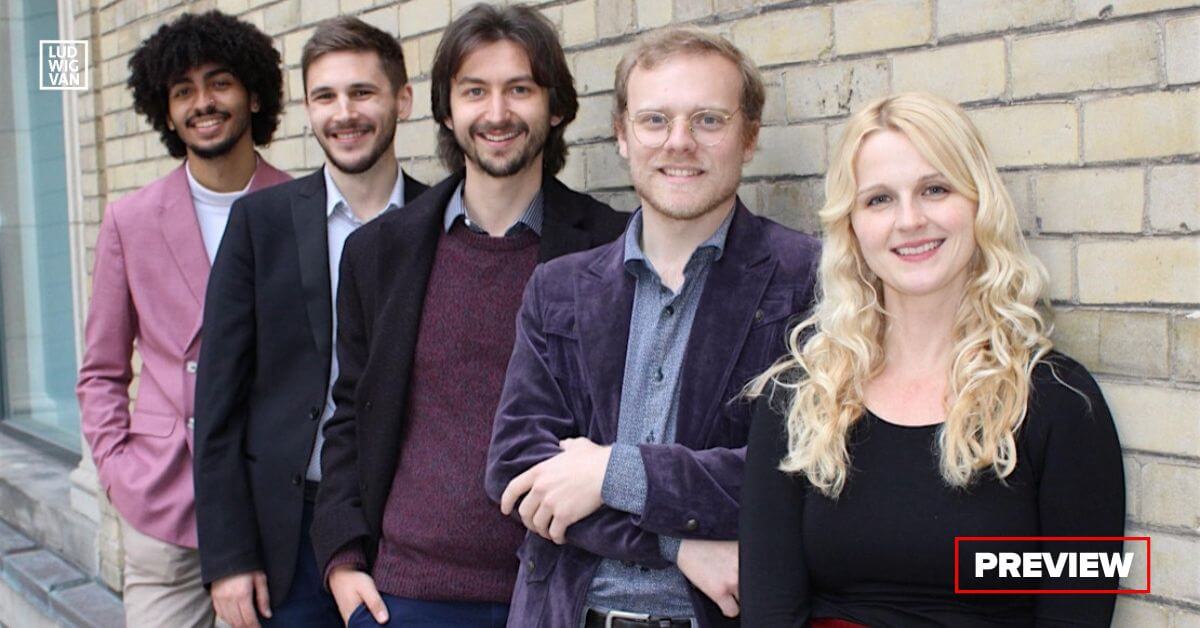
The Diapente Renaissance Vocal Quintet makes a return to the stage for its second annual concert featuring the Diapente Book of Carols. The Christmas traditions and music of Europe and Central America during the Renaissance is the focus.
The concert takes place November 29 at the atmospheric St. Thomas’ Anglican Church, presented as part of the 2024/25 season for Apocryphonia.
Peter Koniers, Diapente’s countertenor, has transcribed the material for the Book of Carols directly from Medieval and Renaissance era manuscripts. The carols, now in modern notation, are collected into a book of holiday musical arrangements that brings the historical music forward to the present as viable concert material.
The Program
The composers include lesser and better known artists of the period. Many of the selections for the concert come from newly transcribed Book of Carols, including The Salutation Carol, an anonymously penned work taken from a 15th Century English manuscript.
Storytelling is a common thread through the musical selections for this year’s holiday program, including texts with dialogues like Guillaume Bouziniac’s Noe Pastores Cantate Canticum Novum. In the carol, the angel Gabriel tells shepherds about the birth of Jesus in a conversational style.
Along with Anonymous, the composers of works in the Book of Carols 2 include:
- French composer Guillaume Bouzignac (1587 — 1643) studied at the Cathedral of Narbonne, later becoming choirmaster at the Cathedrals of Angoulême, Bourges, Tours, and Clermont-Ferrand. His two manuscripts of motets are considered among the gems of the Renaissance vocal music.
- German composer and organist Michael Praetorius (1571 — 1621) was also known as an important music theorist of his time. His works include many Protestant hymns, a genre in which he is credited with developing many of its forms.
- German composer and kapellmeister Johann Eccard (1553 — 1611) was a principal conductor at the Berlin court chapel. Eccard’s wrote choral and vocal works exclusively, including songs, cantatas and chorales, both sacred and secular. His is known for his mastery of polyphonic structure; his works included four, five, even eight or nine different voice.
- Portuguese-Mexican composer and organist Gaspar Fernandes (1566 — 1629) was a singer and instrumentalist by his early 20s. He became organist, and later maestro, of the Cathedral of Guatemala (today in Antigua), where he remained for seven year. He later went to Puebla, Mexico, where he was maestro de capilla (chapel master) until his death in 1629. His piece Tleycantimo Chocquiliya was a hit last year, and makes a return in 2024, along with two other piece drawn from a collection of Fernandes’ music from the Cathedral of Oaxaca: A Belén me llego, tío and ¿A do vas, Carillo, di?
- Leonhard Päminger (1495 — 1567) was a Lutheran theologian and poet as well as a composer, born in Aschbach, upper Austria, where his father was mayor. He worked largely in Bavaria, in Germany, and composed both within and outside the Lutheran church. A large body of his works survive today, including more than 700 compositions. They’ll be performing his Omnis mundus iocundetur, a piece where two carols and a chorale are sung in intricate counterpoint.
From a concert earlier this year:
The Performers
About Apocryphonia
Apocryphonia was founded in 2022 by Alexander Cappellazzo, the name derived from the Greek terms apokyrphos, or that which is obscure, and phōnḗ, or sound. Apocryphus was a term used to denote texts that were both sacred and meant to be secret, or outside the common understanding.
As an ensemble, they look to discover and bring to light music you’ve (probably) never heard before, include composers obscured by history, and the forgotten and overlooked works of more famous artists.
The Diapente Renaissance Vocal Quintet was also founded in 2022 with a mandate of specialization in the rare and unique vocal works of the 15th, 16th and 17th centuries.
Diapente Renaissance Vocal Quintet
The singers are:
- Jane Fingler, soprano
- Peter Koniers, countertenor
- Jonathan Stuchbery, tenor, guitar & lute
- Alexander Cappellazzo, tenor
- Martin Gomes, bass
Coming up after The Diapente Book of Carols 2 in their 2024-25 season: Faignient and Friends: The Music of Antwerp 1568-1598; details here.
- Find tickets and more details about The Diapente Book of Carols 2 concert on November 29 [HERE].
Are you looking to promote an event? Have a news tip? Need to know the best events happening this weekend? Send us a note.
#LUDWIGVAN
Get the daily arts news straight to your inbox.
Sign up for the Ludwig Van Toronto e-Blast! — local classical music and opera news straight to your inbox HERE.

- PREVIEW | Classical Guitarist Alexandra Whittingham Makes Toronto & Ontario Debuts - March 13, 2026
- PREVIEW | Soundstreams Presents Quatuor Bozzini: With Strings Attached - March 13, 2026
- INTERVIEW | Award-Winning Librettist & Against The Grain AD Royce Vavrek Talks About Canuck Cantatas - March 13, 2026