

Canadian Stage/My Name is Lucy Barton, from the novel by Elizabeth Strout, adapted by Rona Munro, directed by Jackie Maxwell, Bluma Appel Theatre, closes Nov. 3. Tickets here.
Canadian Stage’s production of My Name is Lucy Barton features a tour de force performance by the always excellent actor Maev Beaty. At curtain call, the enthusiastic crowd showered Beaty with well-deserved cheers and a standing ovation, and you can already hear the hum of a Dora nomination.
The solo show, adapted for the stage in 2018 by acclaimed Scottish playwright Rona Munro, is based on the bestselling 2016 novel by the prolific Pulitzer Prize-winning American author Elizabeth Strout. The book was longlisted for the prestigious Man Booker Prize, and shortlisted for the International Dublin Literary Award. Apparently, Strout has also written several subsequent novels anchored in Lucy Barton’s world.
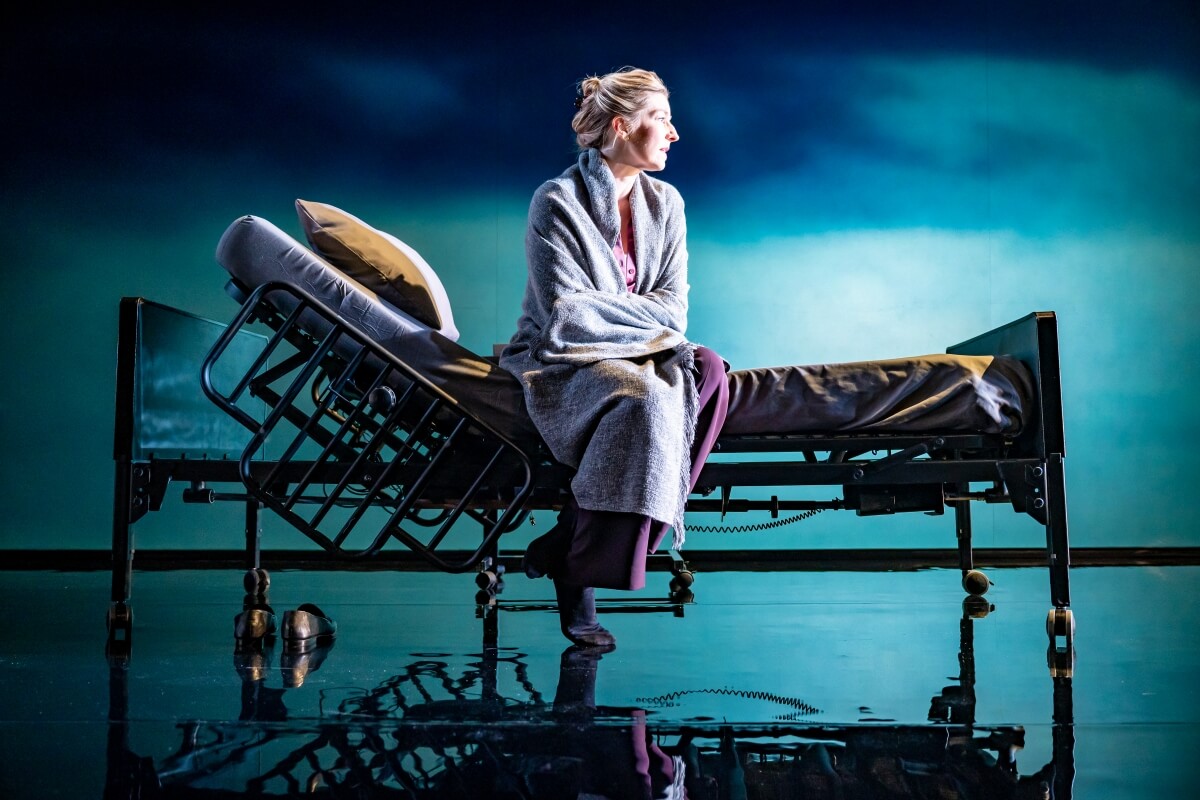
At the heart of the play is Lucy Barton’s reunion with her long-estranged mother. It takes place over five days in a New York hospital room where Lucy spent nine weeks recovering from complications following an appendectomy. What follows is a subtle, complex journey detailing the intersection between two complicated lives.
The incandescent Beaty portrays both Lucy and her mother, and director Jackie Maxwell has worked out that intricate structure with the fine precision of a drill sergeant. Just how Beaty effortlessly moves between the two characters is one of the masterstrokes of the play. The actor’s physicality is marvellous, at one point being the hunched, tightly wound mother, all gravelly-voiced, with clenched arms, and broad Midwestern accent, then back to the vibrant, yet tentative, Lucy.
The Story
The play is not just the telling of a family history. As Lucy reminisces about the past, she also philosophizes about events in her life, and theorizes about their consequences. She is learning things as she goes along in her telling, questioning herself, second guessing herself, always with a touch of irony. In short, My Name is Lucy Barton presents a very real portrait of a woman whose story represents the very heart of the human condition.
Humanity is writ large in this play.
We don’t get a linear line. Presumably, Strout in her novel, and Munro in her adaptation, reveal details of Lucy’s life as the thoughts randomly strike her memory. The throughline is exquisitely built on those memories as one thought triggers another. It is certainly masterful writing, and Beaty is brilliant in allowing us to see the wanderings of her mind making those connections. One of the glories of the play is the way we end up actually living in Lucy’s mind.
The interaction between Lucy and her mother is the crucial nexus of My Name is Lucy Barton, and what Beaty weaves on stage, with Maxwell’s aid, is a portrait of two fascinating women — a Lucy who finds herself vulnerable and needy, and a mother who is gruff and uncompromising. What is unspoken is almost more important than what is said.
The mother never really talks about the Barton family per se. Rather, she’s more interested in gossiping about people in and around the hardscrabble rural community of Amgash, Illinois where Lucy was born, and from which she escaped by winning a scholarship to college.
Yet, Lucy definitely wants to hear these stories. Yet, obliquely, as we learn about the Barton family’s life of poverty from Lucy’s memories, her mother’s stories seem to be metaphors for the Bartons themselves — in other words, what can’t be said directly.
The Production
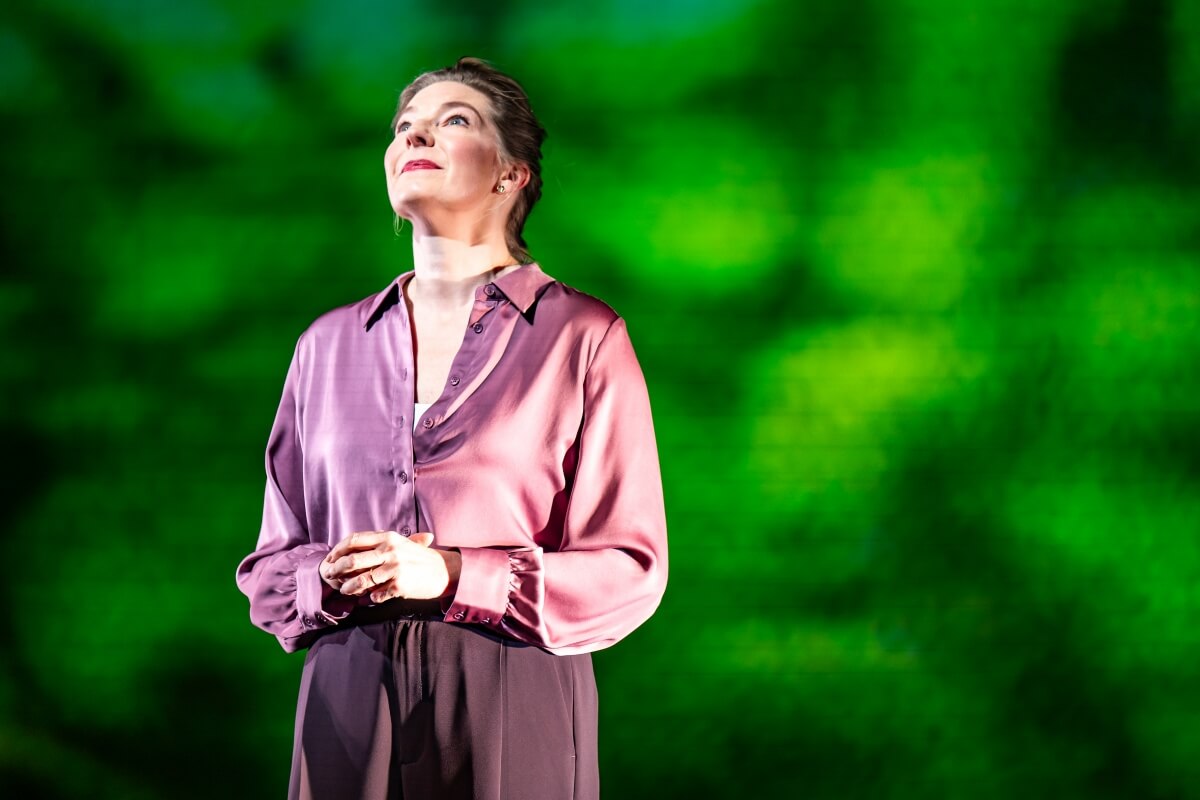
Michael Gianfrancesco’s set is very simple — just a hospital bed and chair as the only furniture — with the main feature being a huge projected backdrop, (projection design credited to Amelia Scott). The pictures are constantly changing, but whether they depict fuzzy farm fields or New York’s darkened skyscrapers, they represent both reality and memory. Jacob Lin’s effective sound design adds both real sound effects and suitably ambient music as needed.
Bonnie Beecher’s lighting is extraordinary, and this should be another Dora nomination for the veteran designer if ever there was. The many changes of colours she plays with on the projected images are stunning in their conceit, and form a river of memory on their own.
Final Thoughts
Nothing truly catastrophic happens in the Barton storyline. There is no high drama or melodrama. Rather, like all families, there exists tortured relationships, past hurts, and most of all, the things either not said, or never explained.
Underpinning it all is telling the truth, and Lucy never shows subterfuge or delusion. She draws us into her story because of that very truth.
You could say My Name is Lucy Barton is an ordinary story. Lucy even tells us that it could be anyone’s story, but in fact, it is her story and she is not giving it up.
Are you looking to promote an event? Have a news tip? Need to know the best events happening this weekend? Send us a note.
#LUDWIGVAN
Get the daily arts news straight to your inbox.
Sign up for the Ludwig Van Toronto e-Blast! — local classical music and opera news straight to your inbox HERE.


- SCRUTINY | Mirvish’s Shucked Is Loud, Brash & Unapologetically Corny - March 10, 2026
- SCRUTINY | The National Ballet of Canada Opens Winter Season with Classical Purity and Contemporary Power - March 2, 2026
- SCRUTINY | Mirvish’s Some Like It Hot Celebrates Broadway Glam Updated For 2026 - February 24, 2026