

The Art of Time Ensemble will be ending its season, and its programming life as an organization, with a reworking of Stravinsky’s A Soldier’s Tale. In Sankofa: The Soldier’s Tale Retold, the story has been reworked to focus on the experiences of a Black Canadian soldier during the Second World War, using a real historical context.
We spoke to AoT artistic director Andrew Burashko, who’s acting as music director for the production.
Andrew Burashko & AoT
Andrew Burashko was born into a family of musicians in Moscow, but began his music studies in earnest in Toronto at the Royal Conservatory of Music. From there, he went on to study in Vancouver with Lee Kum-Sing, came back to Toronto to work with Leon Fleischer, and then Bella Davidovich in NYC.
Along with a career as a soloist and chamber musician that kicked off with his debut with the Toronto Symphony Orchestra at 17, he was a collaborator on an ongoing basis with iconic Canadian dancer Peggy Baker for more than two decades.
He created the Art of Time Ensemble in 1998 with the goal of creating a versatile chamber ensemble that would place art and pop culture on an even keel, blurring genres and gaining new audiences for orchestral music. Andrew has collaborated with conductors Sir Andrew Davis and Marin Alsop, and musicians like Branford Marsalis and Madeleine Peyroux, along with a who’s who of Canadian talent.
In May 2023, Burashko announced the 25th anniversary season lineup, along with the culmination of the Art of Time Ensemble itself.
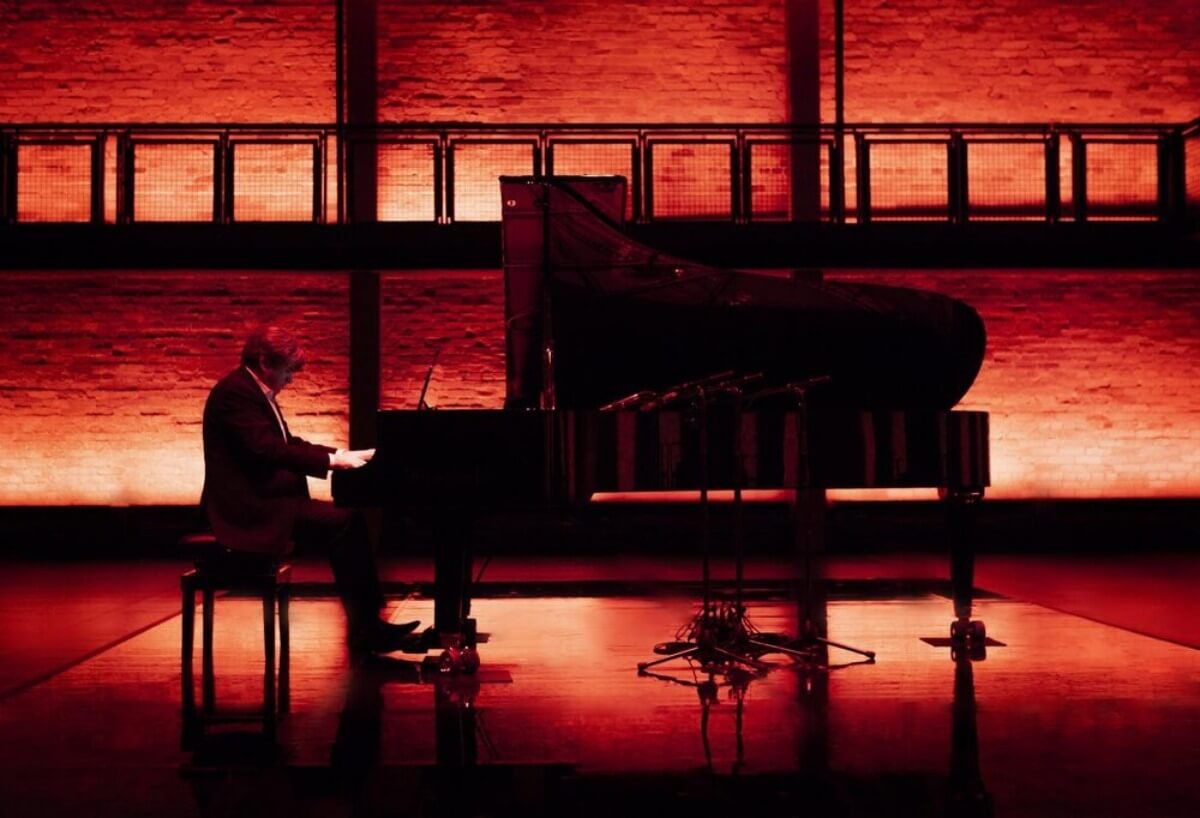
A Soldier’s Tale Retold
Finishing AoT’s run with Sankofa: The Soldier’s Tale Retold wasn’t necessarily the original intention, according to Artistic Director Andrew Burashko.
“It was a combination of things,” he explains. “I think it was a fortunate accident. It wasn’t initially supposed to be part of our last and final season.”
It was intended for the 2023/24 season instead, but waiting on key personnel pushed the project too late to program last season.
“We were waiting on the director we’d approached,” he explains. That party proved unable to make the commitment.
After the period of uncertainty, AoT was thrilled to find that Toronto theatre artist Tawiah M’Carthy, a Dora Mavor Moore nominated actor and playwright who uses both Western and African theatre traditions in his work, was willing to come on board. His pieces often combine dance, music, storytelling and poetry along with the structures of theatre. In recent years, he’s led acclaimed productions at the Stratford Festival (Death and the King’s Horseman, 2022), and Canadian Stage (Topdog/Underdog, 2023), among others.
“I think it’s an opportune situation, because it will be great to end it on such a strong note,” he says. “This project embodies everything that Art of Time stands for.”
Stravinsky published his Histoire du soldat, or Tale of the Soldier, in 1918 with the instructions that it was a work to be “read, played and danced” (lue, jouée et dansée) by three actors. One or more dancers, and a septet of musicians, including clarinet, bassoon, cornet, trombone, percussion, violin and double bass, accompany the story. The music is challenging, with frequent changes of time signature, among other elements.
The original libretto was based on the Russian story about The Runaway Soldier and the Devil as it was published in a collection of stories by Alexander Afanasyev.
Putting It Together
The project itself will be the happy ending of a long process. “It was a combination of many, many things — a confluence,” he says, “coincidences. I’ve always had a deep fascination with this piece.”
Along with the dramatic possibilities, it was Stravinsky’s score that stood out. “I’ve always loved this piece of music particularly,” Andrew says. “For years, I wondered how to do something new and fresh with it.”
He says that about a decade ago, he discovered Kurt Vonnegut’s version of the story, An American Soldier’s Tale. Vonnegut had been commissioned in 1993 to write a new libretto for the piece by New York Philomusica. Vonnegut, a Second World War POW who had witnessed the fire bombing of Dresden, was concerned that the original didn’t talk about the horrors of war at all. His libretto is influenced by The Execution of Private Slovik, a nonfiction account by William Bradford.
Burashko was intrigued by the idea of using the same kind of story, the same three actors, but giving them strikingly different roles. In the end, he abandoned the idea of staging Vonnegut’s version, and decided to come up with his own.
“Fast forward to the summer of 2020, when we were all in lockdown,” Andrew says.
A friend sent him the album by rapper Shad, A Short Story About a War, around the same time that the George Floyd story broke. “That profoundly affected me,” he said. One of the recurring characters on the album is a Black Canadian sniper.
“It made me think, to hell with Kurt Vonnegut. It made me think about a story about a Black soldier in a white army.”
As an homage to the original, the new version uses essentially the same characters: the narrator, the soldier, the devil, and is performed in a rhyming verse. As for the true story behind the revision, that of the soldiers in Canada’s first Black army unit, the No. 2 Construction Battalion, and their mistreatment by a racist system, as Burashko notes, Prime Minister Trudeau made a formal apology to the soldiers and their heirs in 2022.
Once the story’s angle had been sketched out, the remaining decisions became clearer. “I knew that it had to be a Black artist to tell this story,” he says. It was Joel Ivany, artistic director of Edmonton Opera, who pointed him towards Titilope Sonuga.
“I investigated her writing, and took a chance on her. It really paid off.”
Nigerian-Canadian poet, playwright, and performer Titilope Sonuga makes her home in both Edmonton and Lagos, Nigeria. She is the author of three books of poetry, Down to Earth (2011), Abscess (2014), and This Is How We Disappear (2019) and has composed and released two spoken word albums. Sonuga has written three plays, and scripted global advertising campaigns for major brands that include The Bill and Melinda Gates Foundation, Google, and Intel Corporation. She is the former Poet Laureate of the city of Edmonton (2021 – 2023), and was a writer and actor on a hit Nigerian TV series.
“It’s a great team,” he says. “One thing I’m incredibly proud of, is that the hardest thing was to make it work with the original music, which supported a completely different story.” Still, the nature of Stravinsky’s music was a plus. “The visceral immediacy of music transcends any figurative meaning attached. That helped a lot.”
After…
What’s next, once Sankofa: The Soldier’s Tale Retold closes?
“There’s still work to do,” he says. “For this project, we’re putting together an archive.”
There’s also one more show, taking a Leonard Cohen tribute to New York City.
“And, we’re going to make one more recording,” he says. “After that, I honestly don’t have a clue, and that’s an incredibly exciting place to be. But, I really needed to do this in order to catch my breath after 26 very productive years,” he adds.
“I got tired of all the work that goes into presenting and producing shows. I wanted more time to dream.”
- You can find out more about Sankofa: The Soldier’s Tale Retold, at the Harbourfront Centre Theatre (October 24 to 27), including tickets, [HERE].
Are you looking to promote an event? Have a news tip? Need to know the best events happening this weekend? Send us a note.

- INTERVIEW | Composer Ana Sokolović & Director Michael Hidetoshi Mori Talk About Love Songs At Tapestry Opera - March 16, 2026
- CRITIC’S PICKS | Classical Music Events You Absolutely Need To See This Week: March 16 – March 22 2026 - March 16, 2026
- PREVIEW | Classical Guitarist Alexandra Whittingham Makes Toronto & Ontario Debuts - March 13, 2026