
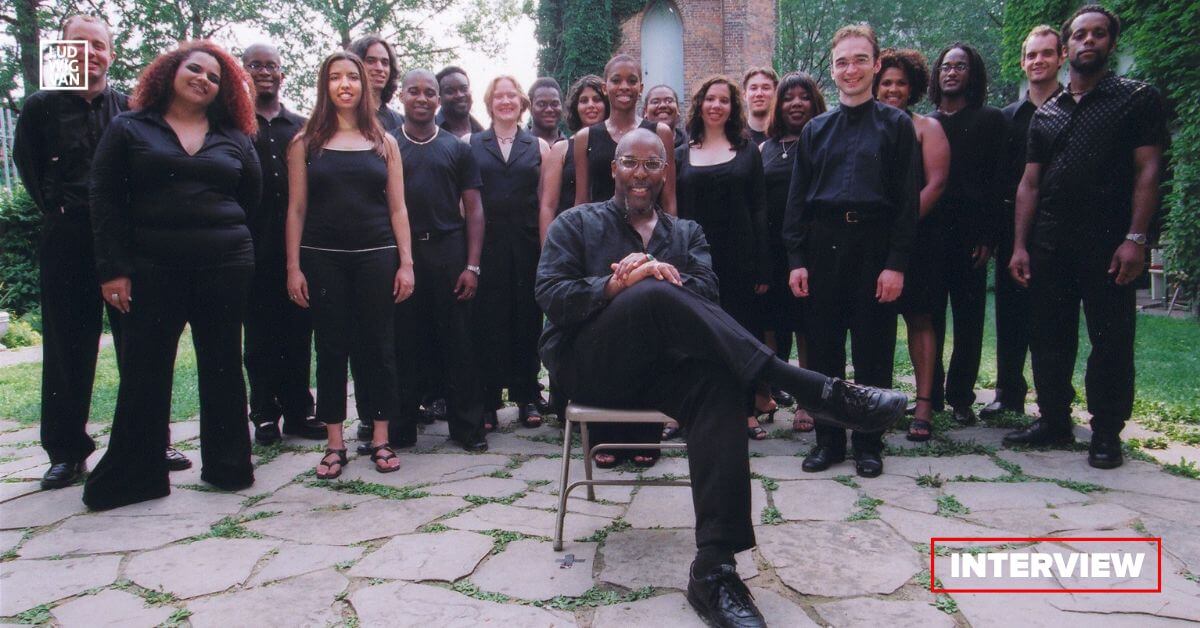
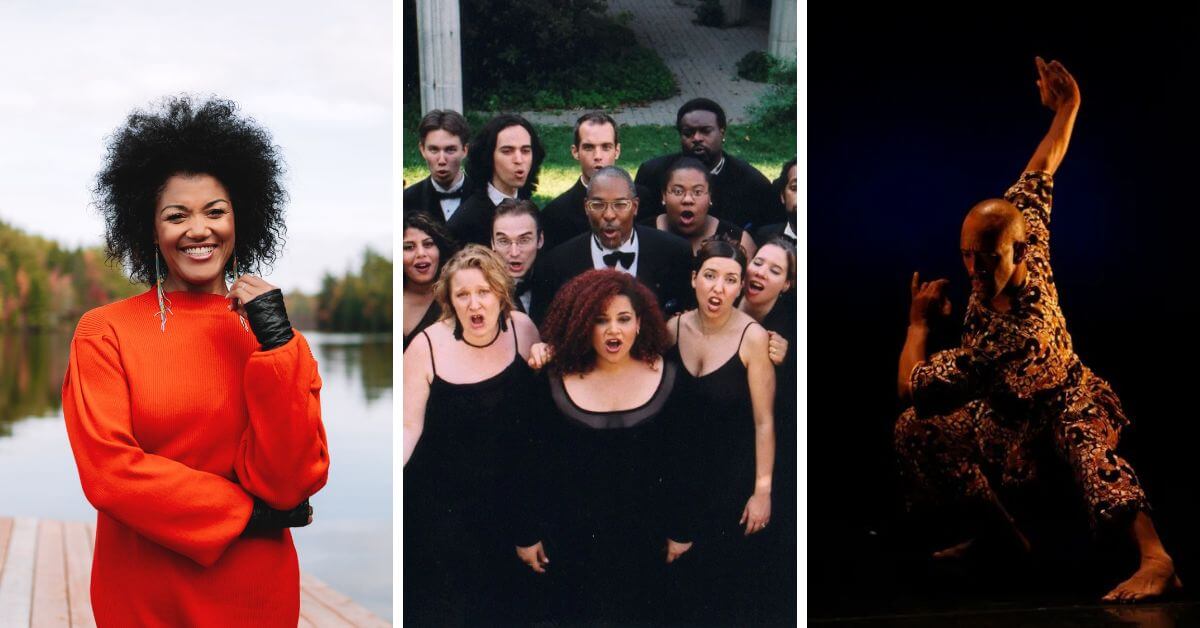
The Nathaniel Dett Chorale will celebrate their 25th anniversary season gala with a concert titled And Still We Sing… Afro-Brasiliera. The performance features soprano Measha Brueggergosman-Lee, along with dance by BaKari I. Lindsay & The AFeeree Project in an event that’s part of the Luminato Toronto festival on June 11.
Brainerd Blyden-Taylor founded the Nathaniel Dett Chorale, named after the Canadian-American composer, musician, and music professor who became a prominent composer in the early 20th century, in 1998.
We spoke to him about the Chorale, the upcoming gala, and the power of choral music.
Brainerd Blyden-Taylor
A native of Trinidad, Brainerd Blyden-Taylor came to Canada in the 1970s, and took up the position of music director at the Oakwood Wesleyan Church in Toronto. By 1977, he’d joined the University of Toronto’s Hart House Chorus, and became the choir’s assistant conductor. Brainerd became one of the first in Canada to promote Afrocentric music through study and performance.
He was the conductor of the Orpheus Choir of Toronto from 1987 through 2002. Brainerd has also conducted the Peterborough Singers, and toured with youth choirs through Canada. He’s an active choral conductor, educator and church musician, and is the Music Director at St. Timothy’s Anglican Church in North Toronto.
With the Nathaniel Dett Chorale, he has guest conducted the Toronto Symphony Orchestra, Symphony Nova Scotia, and the Hannaford Street Silver Band. The Chorale also usually serves as the chorus in productions by Opera Atelier.
As an educator, Blyden-Taylor has worked as a lecturer, workshop leader, clinician and adjudicator with the University of Toronto, Queen’s University, and with the Toronto District School Board, as well as festivals and institutions internationally.
He has toured internationally as a conductor, and has recorded several albums on the Marquis Classics label. Carry me Home — The Story of the Nathaniel Dett Chorale, a documentary about Blyden-Taylor and the ensemble, was the winner of a Gemini award in 2003.
The Nathaniel Dett Chorale, in addition to focusing on Afrocentric repertoire, blurs the lines between genres by blending secular and sacred music, pop and art song.
Brainerd Blyden-Taylor: The Interview
At the moment, the Chorale is recently back from a featured performance at the PODIUM Conference, just performed a COC lunchtime concert on June 3, and is looking forward to a trip to Newfoundland to perform later in the summer, after the Luminato concert.
“We haven’t flipped programs like this for a while,” he notes of their hectic schedule. “Then we’re off to Newfoundland at the end of June for an international choral conference.”
Choirs and choral music, while well out of the spotlight when it comes to mainstream music media, have a strong presence across Canada. “Every community has its choirs,” Blyden-Taylor notes. Many aren’t part of the larger choral community, existing only to be part of a local scene.
As the description of The Nathaniel Dett Chorale reads, it was founded “to address a musical gap in Canada. Prior to its formation, there had never been a professional ensemble focused on promoting Afrocentric choral music.”
Twenty-five years later, has the situation changed?
“Well, you know, I would say there is an awareness — there is an increased awareness. One just has to keep telling the story over and over and over again, because it escapes,” he says.
As he points out, it was back on December 23, 2013 that the UN declared a Proclamation of the International Decade for People of African Descent. “Most people didn’t even know that was a thing,” he laughs. “So this year, should really be the final year of the decade.”
The Canadian government, however, didn’t ratify that resolution until 2018, and in February 2024, resolved to extend that recognition until 2028.
“George Floyd, the I can’t breathe moment […] that happened during this decade,” he points out. What has changed, however, is an awareness of the issues in the choral community. “When I look at our choral conferences, both in Canada and the United States, there has been an expansion of awareness of this.”
He counts more and more colleagues writing academic papers on Afrocentric culture, and during the pandemic, he reports many also reaching out for information, manuscripts and scores.
“I think there is an increased awareness, but there is still a gap.”
It’s moments when he gets direct feedback that bring the importance of his work home. He says that recently, a young Black woman from the Southern US came to sing with the Chorale while studying at the University of Toronto. Her words underscored the continued importance of the work. “I can’t tell you what this experience has meant to me,” she told him of discovering and rediscovering the choir’s repertoire.
“The work is ongoing,” he says. Still, small steps have been made. “I had to explain to people what ‘Afrocentric’ meant back in 1998.”
And Still We Sing… Afro-Brasiliera: The Music
Afrocentric means music that has an African influence or experience at its heart. It may or may not involve a Black composer per se. He cites Gershwin as an example, a composer whose works, notably Porgy and Bess, were heavily influenced by Black music.
“I’m just trying to expand the sandbox in which I play.”
For the upcoming concert on June 11, the spotlight of the second half will be the Missa Afro-Brasiliera by Carlos Alberto Pinto Fonseca.
“Here’s an Afro-Brazilian mass written by a Brazilian composer who’s not Black, but whose work was steeped in that tradition,” Blyden-Taylor says. Fonseca, as he explains, grew up in a neighbourhood where Afro-Brazilian spiritual traditions were an everyday reality that seeped into his music.
“It really influenced him.”
His Missa uses the full Roman Catholic text, while infusing it musically with Afro-Brazilian rhythms and lullabyes. The lyrics are written in both Latin and vernacular Portuguese.
“He used both languages,” he says. “He did not write it for percussion, he did not write it for dance, but his work was informed by all of those traditions.”
The singers, as he describes it, perform in a detached and percussive mode in some sections, sung in Latin, juxtaposed with other more intimate sections sung in Portuguese and using traditional lullabye melodies.
The fusion represents another way of mining the enormous and rich tradition of Afrocentric choral music.
“I promised myself that when I approached the work again, I wanted to do something different, so we commissioned this choreography.”
BaKari I. Lindsay is a Trinidadian-Canadian choreographer who has developed AFeeree, an Afrocentric physical language and aesthetic. He’s developed dance around the music. Blyden-Taylor notes that the spiritual traditions of Trinidad are Yoruban in origin, and similar to that of Afro-Brazilian, Haitian, and other Caribbean Black communities.
“There’s a synchronicity in the music,” he says. “While you’re singing, you’re not just worshipping the Christian saints, you’re worshipping the African deities as well.”
Also on the program, and in the first half of the concert: Sid Robinovitch’s Canciones for las Americas and Cinco Canciones Negras by Xavier Montsalvatge.
“We’re focusing more on the Latim American and Spanish side of things.”
The piece by Jewish-Canadian composer Sid Robinovitch was inspired by the PanAm Games, and uses text from Latin American poets Juana de Ibarbaru, Nicholas Guillen and Octavio Paz.
“He’s created these three very different pieces in the Spanish language.” He notes that Cuban poet Nicholas Guillen also invokes spiritual traditions, tying the concert together in a theme.
Soprano Measha Bruegergosman-Lee is the other special guest on the program.
“She is somebody that I first met when she was an undergrad,” Blyden-Taylor says. “She sang with the Chorale for the very first year, and then she was off like a rocket. We knew that.”
In her solo set, she’ll interpret the song cycle by Catalan composer Xavier Montsalvatge, set to the words of Spanish poets Rafael Alberti, Néstor Luján, Nicolás Guillén, and Ildefonso Pereda Valdés.
“There’s a real sort of synchronicity between the two pieces in the first half,” he says.
The Power of Choral Music
Choral music, perhaps better than any other genre, has the ability to connect with people’s emotions, and that goes for both the singers and any listeners. While there are professional choirs like Nathaniel Dett, it’s also an art that’s accessible at some level to virtually anyone who can carry a tune.
It connects people, put simply.
“It does have that power.”
It means that performance can be much more than a pleasant accompaniment to pass the time.
“It’s the way I endeavour to work most of the time – I try to be in that mode. I feel that […] I personally, as well as the ensemble, are called not just to entertain people […] to sing a little ditty and have people say that’s nice,” he says. “I hope they will be changed, I hope they will be inspired to do whatever.”
Audience feedback often tells him he and the Chorale are on the right track.
“What a sacred calling is that?” he asks. “How many people play music just because? I tell [the singers] don’t phone it in.”
Just before going on stage, he says he and the members of the ensemble share a mantra that reinforces the notion not just of performing, but sharing the music and sentiments with the audience.
“We extend the circle to include them,” he says. “People should be touched. That’s what we want to do.”
As performers, he feels it as not just a gift, but a responsibility.
“It’s very, very, very powerful. Every artist and every performer should know that. We have the gift and the ability, and dare I say, the calling, to turn people’s lives around.”
When people come to a concert, as a performer you don’t know what kind of day they’ve had, what they’re dealing with — what’s on their minds. You only know your job is to reach out to them and connect.
“That’s what we do. That’s what we can do,” he says. “What we offer has the power to change lives.”
- Find out more about And Still We Sing…Missa Afro-Brasileira: A Syncretism of Voice and Dance on June 11 at Luminato Festival Toronto, and get tickets, [HERE].
Are you looking to promote an event? Have a news tip? Need to know the best events happening this weekend? Send us a note.
#LUDWIGVAN
Get the daily arts news straight to your inbox.
Sign up for the Ludwig Van Toronto e-Blast! — local classical music and opera news straight to your inbox HERE.


- THE SCOOP | Glenfiddich Has Named The 2026 Canadian Recipient Of Its Artists In Residence Program - March 25, 2026
- THE SCOOP | Principal Dancer Siphesihle November To Leave The National Ballet of Canada - March 25, 2026
- THE SCOOP | Canada’s National Arts Centre Orchestra Launches 100th Tour On April 14 2026 To The Maritmes - March 24, 2026