
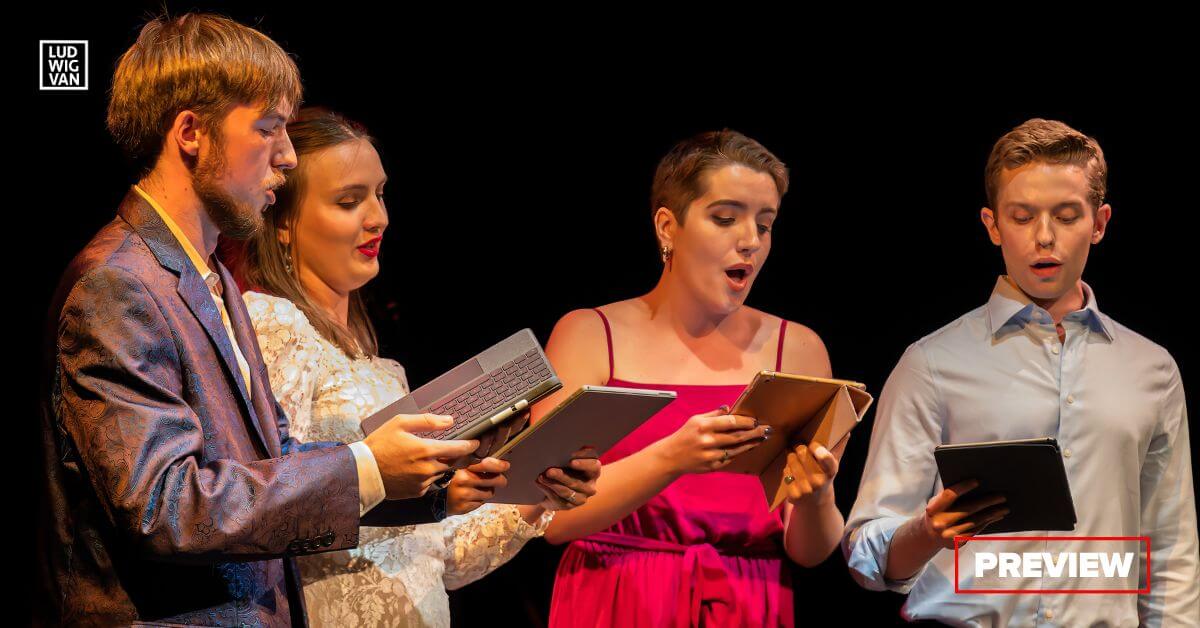
Toronto’s venerable TRANZAC Club will be the backdrop for a performance by rising young opera stars with a feminist theme. Slow Rise Music presents Here Be Sirens, their third production, which will be performed in front of a live audience and livestreamed across Canada.
Slow Rise Music is a concert series based on exploring the human voice. Founded by Saskatchewan-born soprano McKenzie Warriner and Toronto-based composer and musician Tristan Zaba, they look to commission new works from diverse Canadian composers, and work with emerging artists to blend both music and poetry together in immersive concert experiences.
The Concert
The performance takes place November 18 at the TRANZAC Club’s main hall. The mythical figure of the Siren — the creature who appears as a beautiful woman to lure sailors to their watery deaths — will be the theme.
Central to the programme is American composer Kate Soper’s opera Here Be Sirens. Soper’s work was originally funded in 2012 by the Guggneheim Foundation. It will be presented in a modified format, interspersed with new sound design, and new works by Canadian composers.
The Canadian composers include:
- Vancouver-based transgender composer Ashley Seward;
- Toronto-based Kathryn Knowles;
- Iranian-Canadian Aida Khorsandi;
- Composition professor Paul Lessard, currently Tennessee-based, but a native of Ontario.
The soprano voice will be highlighted in the programming, accompanied by cellos and surround-sound electronics. The singers include:
- Dora-nominated Ukrainian-Canadian Natalya Gennadi;
- Midori Marsh, a Metropolitan Opera Laffont Competition semi-finalist and COC Ensemble Studio alumna;
- McKenzie Warriner, 2023 Eckhardt-Gramatté Competition winner and former Vancouver Opera young artist;
- Shantelle Przybylo, gradtuate of the Washington National Opera’s Domingo Cafritz Young Artist Programme.
The music will be performed by the VC2 Cello Duo, and the creative team includes award-winning set designer Jessica Hiemstra, music director Jo Greenaway, and sound designer Tristan Zaba.
Other highlights include a transgender reading of the Ulysses myth, and an electronic exploration of the protests surrounding the suspicious death of Mahsa Amini, a young woman who died in the custody of Iran’s notorious Morality Police.
Q&A
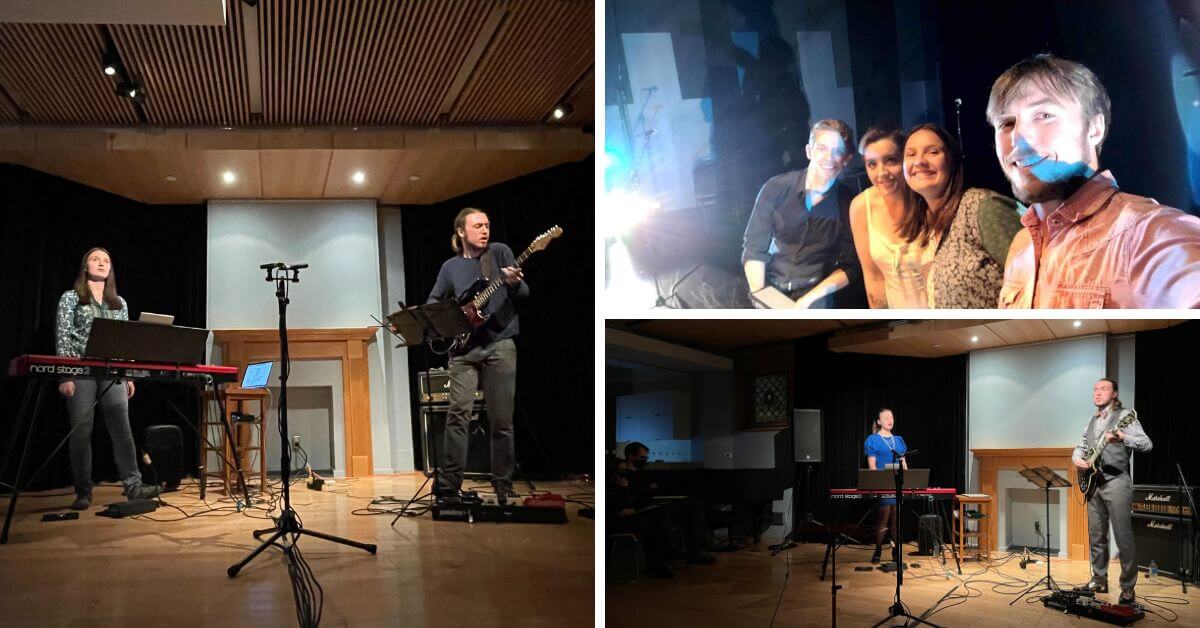
Tristan Zaba (TZ) has a multi-hyphenate career as a sound technician, producer, composer, vocalist, and poet. McKenzie Warriner (MW) is the recent 1st prize winner of the 46th Eckhardt-Gramatté National Music Competition (E-Gré) for the performance of Canadian and contemporary music in voice.
We asked them a few questions about the organization and their upcoming show.
LvT: From what I understand (reading your website), it seems like you’ve formed Slow Rise Music to fill a gap in the classical music environment. Can you elaborate on how that came about?
TZ: It’s specifically (multiple) gaps in the Toronto classical music environment, although it’s present to lesser degrees in other cities as well. I was just at an industry round table at the Music Gallery where colleagues in other genres also commented on Toronto’s somewhat siloed arts scene. There’s a massive difference in audiences and performers between choral music, opera, new music, chamber music, etc., when logically these should have a lot of overlap, especially considering the classical scene is so small.
There’s also a limit on the sorts of innovation and projects that are acceptable to each one, meaning in most cases you’re pressured to choose a community you belong to and act according to its norms. McKenzie and I began our arts careers in Winnipeg, which is very much a free-for-all, and coming to Toronto we made it our mission to do “in-between” things as an act of rebellion. This show features opera, but in a concert setting that also includes electronics. We’re also presenting new chamber music, but featuring opera singers, who emote slightly differently from hardcore new music people, and showcasing works for a wide array of instrumentations and in a wide array of styles. It’s truly a variety show in the sense that one can’t otherwise classify what it is. We find this very exciting.
LvT: What kind of response have you had to the concerts you’ve presented so far? What has your audience been like — outside the usual classical music crowd?
MW: Our goal with our concerts is to bring many groups of arts lovers together, and so far we have been successful. Our last concert had classical musicians, avant-garde composers, people from the pop music scene, filmmakers, opera audience members, and poetry lovers in attendance. We’ve had many tell us, whether they’re deep into classical music or know nothing about it, that our projects are unlike anything they’ve experienced before, which is cool!
LvT: What made you add poetry as a focal point to your productions, alongside the music?
MW: As singers, the only musical instrument that can convey text, poetry is so integral to our understanding of music. Although the notes are important, a singer’s definition of a successful performance is really based on whether they effectively communicated the text to their audience. We’ve placed a special focus on commissioning poetry because of this.
The vast majority of organizations commissioning vocal music do not provide a budget for text, which means a disproportionate number of works being composed today use public domain texts written a hundred-plus years ago. As much as we love Emily Dickinson and Walt Whitman, there are so many incredible, up-and-coming poets that deserve a spotlight. By offering our composers the option to commission poetry for their work, we encourage collaboration, but also allow for the exploration of current cultural concerns that can only be expressed through texts written today.
Mezzo-Soprano Máiri Demings performs Void | I only sleep in daylight by Kiara Nathaniel, commissioned for Slow Rise Music’s production Fair Use (September 2022), a programme of new vocal works for SATB vocal quartet and vocal soloists themed around the legal doctrine of the same name.
LvT: Are there any particular qualities that you look for in the composer and/or their music when you commission works?
TZ: We look for composers who are open-minded towards growing their craft and unique in their writing. The first is important because for our shows they’re usually commissioned to write for weird and specific creative situations they’ve never had to deal with before. The second because we put a lot of thought into contrast in our programmes. A programme of all the same sort of music is more likely to be boring, and therefore, to our minds, presents concerns on the level of audience accessibility. If we commission (for example) four pieces, it’s important to us that none of those four pieces sound dramatically similar, so we can put them back to back and every one will sound new from an audience perspective. As far as cohesion, all our concerts are themed, so disparate pieces are unified towards a common goal through thematic focus.
LvT: In the upcoming production Here Be Sirens, how do the new works fit into Kate Soper’s opera?
MW: Although I someday dream of performing Kate Soper’s full Here Be Sirens opera, we are performing her condensed, concert-suite version of the piece. This allowed us room to commission other pieces, also around the theme of Siren Song, to be interspersed between the movements. When I first pitched this concert concept to Tristan, he was worried that the siren theme might be too one-note, but it’s become clear both in our exploration of Soper’s piece and the different angles taken by our composers that there is a lot to unpack in this mythology. Why do we equate femininity with danger? Is temptation always such a bad thing?
TZ: When we told the composers about the overarching theme for them to follow, we encouraged them to treat it loosely so they could find their own personal connections to Siren Song in their work. While I did initially think this theme was maybe too specific, it really connects to a lot; femininity, one’s calling, loneliness, ambulance sirens, destruction, love, repression, etc. We’re delighted how each composer took this and ran with it in their own way. One is exploring her thoughts on the Mahsa Amini protests. Another has laid out a trans reading of the Ulysses myth, whereby Ulysses is drawn in by femininity itself yet still lashed to the ship.
MW: The Sirens in Kate Soper’s work are multidimensional: they menace, they yearn, they remember. Just as our commissioned composers have all gone in different directions, we hope all our audience members will leave with a different idea of what Siren Song means to them.
LvT: Is there anything else you’d like to add about the upcoming show?
TZ: It will be an absolutely one-of-a-kind experience. We have some of the best up-and-coming singers in the country collaborating with the amazing chamber ensemble VC2 and some very exciting composers, in an environment with quadrophonic surround sound design and a tactile (freely moving) set by award-winning set designer Jessica Hiemstra. Here Be Sirens is our vision of what classical music can be in the 21st century, and we are excited to share it with the world.
- For more information, check [HERE], and find tickets to both the in-person performance and livestream [HERE]
Are you looking to promote an event? Have a news tip? Need to know the best events happening this weekend? Send us a note.
#LUDWIGVAN
Get the daily arts news straight to your inbox.
Sign up for the Ludwig Van Toronto e-Blast! — local classical music and opera news straight to your inbox HERE.

- PREVIEW | Director Robert Lepage And Choreographer Guillaume Côté Bring Back The Tragedy Of Hamlet: Prince Of Denmark - April 10, 2026
- THE SCOOP | Benevolence Opera Project & Redwood Theatre Present Don Giovanni To Support The Redwood Women’s Shelter - April 10, 2026
- PREVIEW | The Guitar Society Of Toronto Presents The 2026 Toronto Guitar Weekend - April 9, 2026