
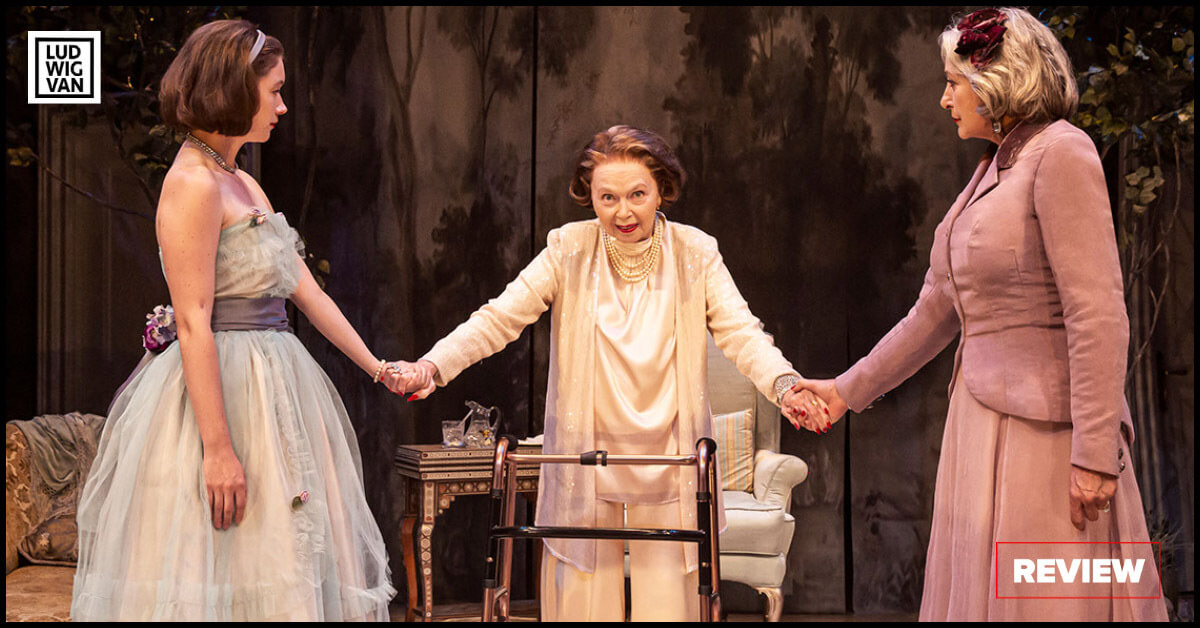
My last encounter with the sublime artistry of actor Martha Henry: Stratford Festival/Three Tall Women by Edward Albee, directed by Diana Leblanc, Studio Theatre, Aug. 10 to Oct. 9.
How utterly ironic that Martha Henry’s final performance on this mortal coil, was in a play about dying.
Edward Albee’s Pulitzer Prize winning Three Tall Women (1991), features as its central character, (known only as A), an imperious, caustic, bitter, foulmouthed, bigoted old woman who is terminally ill. It is the type of role an actor loves to sink their teeth into, and it was right up legendary Henry’s alley. To say she chewed up the scenery is an understatement.
Albee based the character of A on his estranged adoptive mother (who famously cut the playwright out of her will). He left home at 18, disgusted by the smug, self-satisfied, narrow-minded and entitled lifestyle of his super rich parents and their friends. In the play, derogatory ethnic and racial slurs shockingly roll off A’s tongue like a matter of course. Apparently, Albee’s mother could not accept his homosexuality, and A’s homophobia joins her list of prejudices.
Initially, Three Tall Women was slated for Stratford’s 2020 season, but COVID put an end to that. The pandemic, however, proved to be a boon to Henry, who had just been diagnosed with cancer. The lull allowed Henry to undergo treatment, which gave her this last gasp at theatrical greatness. She passed away a mere 12 days after Three Tall Women closed.
In the first act, I noticed that Henry seemed particularly frail, and throughout her performance were some almost imperceptible pauses in the rhythm of her delivery, but the actor was 83 after all, so you don’t expect total perfection. That Henry had memorized this huge acting role is an amazing feat in and of itself.
In the second act, I was surprised to see Henry in a wheelchair that was not mandated in the play. Clearly she was not in the best of health. I found her manoeuvring of the wheelchair around the tiny thrust stage in the Studio Theatre a bit unwieldy, but then, I did not know about the cancer. Now I’m a bit ashamed at my irritation.
Albee’s play is fascinating. In the first act, we meet A and her middle-aged caregiver B (Lucy Peacock), as well as C (Mamie Zwettler), a 20-something representative from A’s lawyer’s office. Any play that features both Henry and Peacock is a gift of the gods, but Zwettler held her own nicely against these Stratford giants.
In the second act, A, B and C become one person, showing A at three stages in her life — young, middle-aged and elderly. Their conversation is brilliant as C learns what is ahead of her, while B looks both backward to the past, and forward to the future. A remains the incorrigible, acerbic woman that we met in the first act. And, oh yes, there is a silent young man, aka Edward Albee (Alexander Iles), who has been summoned to visit his dying mother.
Henry dominated the stage. She presented a woman who has learned everything and yet nothing. Albee’s portrait of A is frank and dispassionate. This is who A is, unvarnished and unmasked, and Henry enveloped herself in A, showing her vulnerability, but never softening so much as an inch. There is no forgiveness in A, which made Henry’s performance so richly layered. It was a warts and all portrait.
A Legacy in Theatre
There is something about Henry’s absolutely distinctive, throaty voice that compelled the ear. To hear it once was never to forget it. The actor always had a very particular cadence, halting over key words for emphasis, elongating vowels in others. Her pauses were like no other actor’s. It was a risky delivery, almost affectation, but this was layered over such a deep understanding of character that it seemed normal. Henry could make single words sound like entire paragraphs.
The actor’s greatest Stratford role, for me, was her 1994 performance as Mary Tyrone in Eugene O’Neill’s Long Day’s Journey Into Night. In that memorable production, her physicality was astonishing. I saw the gnarled, arthritic hands and pain-wracked, ravished body that drove poor Mary Tyrone to morphine for whatever relief she could find. It was a brilliant merging of both voice and physicality that conveyed the very essence of that broken, drug-addicted woman.
Henry’s A in Three Tall Women joins the pantheon where I hold the actor’s Mary Tyrone. After all, A is the linchpin. C will become B, and both will become A. Therefore, the actor playing A has to represent an entire life, and Henry did just that. Everything rang true. Of course, Albee’s carefully worded dialogue leaves nothing to chance, but if we don’t see A as the whole picture, the play falls flat.
In the final analysis, what impressed me the most, was the way Henry observed the other two actors on stage when they were speaking. It was another element of her enormous acting ability that reached beyond her brilliance with words. She looked at B and C like a collector pinning butterflies to the wall. Without saying a word, she was dismissive and accepting by turns, but never apologetic. These were the choices she had made and there was no getting away from them. It was an extraordinary portrait — the silent witness to the formation of her own identity and being.
I hope Peacock, Zwettler, Iles, director Diana Leblanc, designer Francesca Callow, lighting designer Louise Guinand and composer Keith Thomas will forgive me for giving their enormous contributions to this classy production such short shrift. This was, however, Henry’s last hurrah.
Stratford did make a video of Three Tall Women, and according to their press release, the festival is waiting for the Albee estate to give them the rights to show it. Let us hope this marvellous production will soon be streaming.
The great Martha Henry died with her boots on. How privileged was I to have witnessed her luminous last performance.
#LUDWIGVAN
Get the daily arts news straight to your inbox.
Sign up for the Ludwig van Daily — classical music and opera in five minutes or less HERE.

- SCRUTINY | The National Ballet Of Canada’s Pinocchio Delights Adults And Children Alike - March 18, 2026
- SCRUTINY | Mirvish’s Shucked Is Loud, Brash & Unapologetically Corny - March 10, 2026
- SCRUTINY | The National Ballet of Canada Opens Winter Season with Classical Purity and Contemporary Power - March 2, 2026