
The Toronto Symphony Orchestra with Peter Oundjian (conductor) and soloists Jonathan Crow (violin) and Teng Li (viola), at Roy Thomson Hall, Nov. 9. (Repeats Nov. 11)
Whatever its box office appeal, the so-called Decades Project puts the Toronto Symphony Orchestra in the interesting position of needing to assemble works predominantly from one 10-year window of the 20th century. On Wednesday in Roy Thomson Hall Peter Oundjian oversaw what might well have been the first concert ever to couple Sibelius’s Seventh Symphony (1924) with Ravel’s Bolero (1928). Add Vaughan Williams’s The Lark Ascending (revised in 1920, so just under the wire) and Walton’s Viola Concerto (1923, revised in 1962) and you have — well, a curious program.
I came for the Sibelius, a 22-minute essay in being and becoming that leads us to the outer reaches of the known universe and into another dimension. Oundjian viewed this as an energetic process. He made the parts clear and the connections explicit. But the last degree of polish was lacking, and so was the halo of a truly mind-expanding Sibelius 7. Possibly these indefinables will emerge in the second performance on Friday (which will be recorded for the TSO’s YouTube channel).
The same could be said for the other works. The beat was not ideally steady in the first five minutes of Bolero and solos were uneven in style. Uniform phrasing at the beginning (to my thinking) is essential to creating a sense of emergence and inevitability. One musician, quite athletically, played multiple sax solos in succession. The initial flute was quiet to the point of being indistinct. Such matters can be adjusted in the control room.
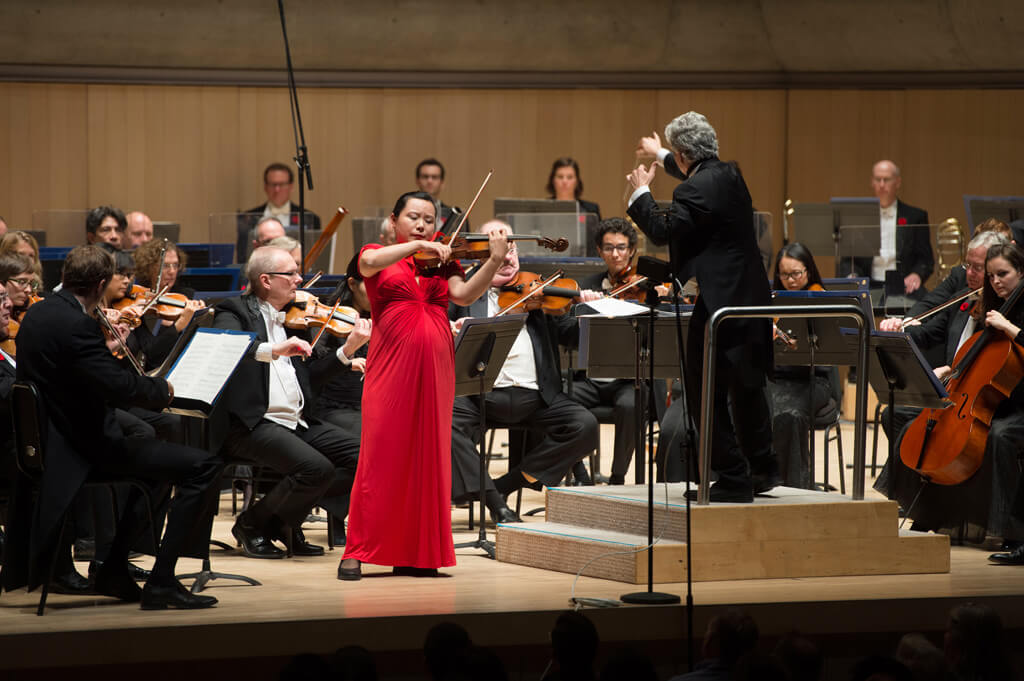
Concertmaster Jonathan Crow was our violin soloist in that laid-back favourite of the CBC Radio 2 playlist, The Lark Ascending. Technical matters were entirely in hand, and the tone was nicely poised between purity and ardour. Wielding a lively baton, Oundjian made the six-eight rhythm more apparent than in some impressionistic performances. Still, I must confess to finding this piece too long at 17 minutes.
Principal viola Teng Li took the solo role in Walton, and with authority. Double-stopping in the first movement vividly created the impression of two players. Intonation was impeccable. At a few densely orchestrated points the solo contribution was more visual than aural. A viola, after all, is a viola. And for all its incidental beauties, this three-movement score (which Li played from memory) does not make a coherent impression. Why the noisy brass in the finale?
The repeat concert (which I expect to be an improvement on this one) includes T. Patrick Carrabré’s Inuit Games with throat singers Inukshuk Aksalnik and Pauline Pemik as soloists. A footnote, almost literally: There were only five double basses on duty. Six are listed in the “orchestra members” page of the program. Eight is the big-orchestra norm. Or used to be.
#LUDWIGVAN
Want more updates on Toronto-centric classical music news and review before anyone else finds out? Follow us on Facebook or Twitter for all the latest.

- SCRUTINY | Toronto Symphony Orchestra’s Messiah Covers The Basics, But Misses On True Holiday Magic - December 17, 2025
- FEATURE | Canadian Pianist Élisabeth Pion Takes Honens Piano Gold In Calgary - October 27, 2025
- FEATURE | The Honens International Piano Competition Does Things A Little Differently - October 22, 2025