
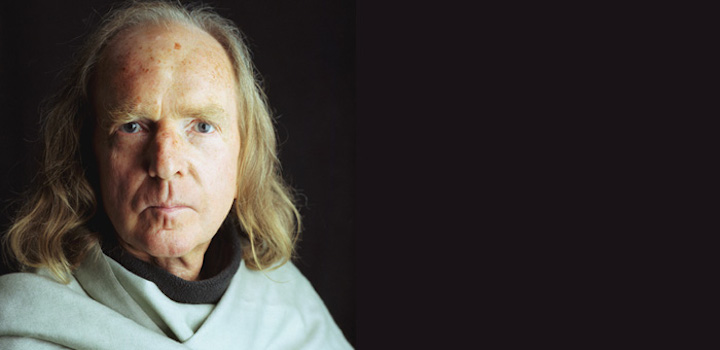
We all know that music is, in many ways, our everyday link to the eternal. But few moderns have been able to express this simple truth in music as ably as British composer John Tavener, who died today, aged 69.

- Classical Music 101: What Does A Conductor Do? - June 17, 2019
- Classical Music 101 | What Does Period Instrument Mean? - May 6, 2019
- CLASSICAL MUSIC 101 | What Does It Mean To Be In Tune? - April 23, 2019
Tavener was a deeply spiritual composer who saw God in many places and faces. Through trial and error, he discovered that it is sometimes through the simplest of means, not great eruptions of complexity or noise, that our souls make deeper connections.
Without a doubt, Tavener’s numerous struggles with his body helped refine his focus on the absolute essentials of musical communication. Marfan Syndrome, a deterioration of the body’s connective tissue, and heart disease were the source of numerous near-death experiences, and he was in constant pain.
Tavener was never fully embraced by academics, but the immediate connections his music makes grew him thousands of fans around the world — among audiences and performers alike.
Here are four samples of his powerful aesthetic, heavily influenced by the Russian Orthodox church tradition, which he embraced in the late 1970s:
1. A choral setting of “As One Who Has Slept,” taken from the Liturgy of St Basil, for Easter Saturday. A simple drone and a simple chant are held for so long that the sopranos/trebles either find a marathon-runner’s sense of peace, or collapse (sung here by the Winchester Cathedral Choir, which premiered it in 1997):
2. The opening section of one of his best-loved works, The Protecting Veil, which Tavener described as “an icon in sound for cello and strings,” heard here with Yo-Yo Ma the soloist and David Zinman conducting the Baltimore Symphony Orchestra (Steven Isserlis premiered it at the BBC Proms in 1989):
3. Tavener’s music for piano offers some clear perspectives on his musical thinking. Here is Dutch pianist Ralph van Raat playing Ypakoë, commissioned by the City of London Festival in 1999, for Dutch television in 2008:
4. Tavener, through William Blake, left us all with a few words to live by, in Eternity’s Sunrise, a 1997 setting of the poem “Eternity.” The text: He who binds to himself a joy/ Does the winged life destroy;/ But he who kisses the joy as it flies/ Lives in eternity’s sun rise. It is a fascinating piece of modern music written for a baroque ensemble, and dedicated to the late Diana, Princess of Wales. It is performed here by soprano Patricia Rosario and the choir and orchestra of the Academy of Ancient Music under Paul Goodwin:
You can read an excellent obituary by the Guardian here.
UPDATE: The Telegraph on Nov. 13 posted a final interview with John Tavener with Ivan Hewett here.
John Terauds
- Classical Music 101: What Does A Conductor Do? - June 17, 2019
- Classical Music 101 | What Does Period Instrument Mean? - May 6, 2019
- CLASSICAL MUSIC 101 | What Does It Mean To Be In Tune? - April 23, 2019