
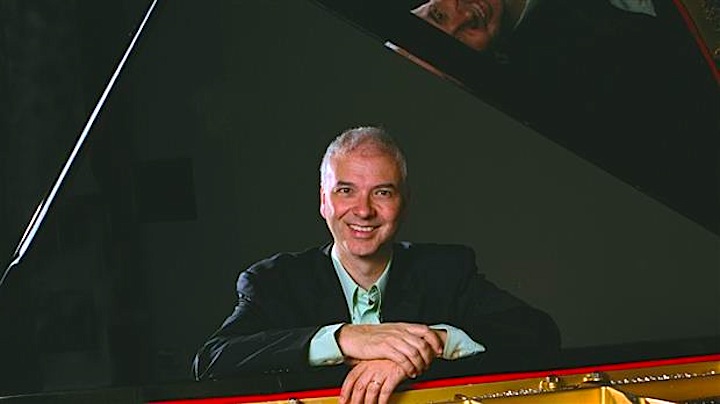
Canadian pianist Stéphane Lemelin plays with an ease, fluency and brightness bespoke-tailored to the music of Parisian composer Manuel Rosenthal, whose 98 years — 1904-2003 — spanned art music’s most turbulent century. Ten years after his death, he is nearly forgotten outside France, and Lemelin wants to change that.

- Classical Music 101: What Does A Conductor Do? - June 17, 2019
- Classical Music 101 | What Does Period Instrument Mean? - May 6, 2019
- CLASSICAL MUSIC 101 | What Does It Mean To Be In Tune? - April 23, 2019
Lemelin’s new album for Montreal’s ATMA Classique label includes all of Rosenthal’s music for solo piano — 29 pieces, all but one part of four collections, and all written between 1924 and 1934.
Rosenthal’s most famous creation is Gaîté parisienne, a ballet suite built on the music of Jacques Offenbach, from 1938. He was considered a master orchestrator. But he was, as far as his fundamental aesthetic is concerned, the same sort of bon vivant as Les Six, unafraid to experiment and to tappingly dip his toes into popular genres of music. Rosenthal was also highly respected as a conductor — especially of the Impressionists.
The composer must have been a phenomenal pianist, because the pieces are technically demanding. They are also beautifully wrought by a multitonal omnivore who clearly thought life was too short to be limited by a choice of a single key for a piece of music.
But is this music worth listening to and, better yet, considering for a spot on the virtual music shelf? I’m not convinced.
 It’s not because this music isn’t pretty; much of it is very engaging, and most of it sparkles like a drag queen’s party dress. But, ultimately, it is all cream puff when a bit of hearty bourguignon stew would help sustain interest.
It is all clever conversation, with little allocation for serious debate. Most entertaining are Six Caprices from 1928, each a musical parody of another composer. Most clever are the 10 pieces in Les Petits métiers (The Trades — like barber) from 1934, where Rosenthal’s deft pianistic sketches recall the swift characterizations found in the little baroque keyboard suites of Couperin.
Lemelin delivers the goods with the ease and gloss of a seasoned dinnertable raconteur. but the pieces themselves are carefully wrought curiosities that represent a specific place and time that, I think, are best mixed into a wider, more substantial musical feast as palate cleaners.
You can find all the details, including audio samples, here.
+++
To get a feel for where Rosenthal’s head was at while in his late 20s, here is Régine Crespin singing Chansons de Monsieur Bleu, a short, five-song cycle from 1934, in recital with John Wustman in New York City, in 1967 (it’s too bad we can’t see what the audience finds so funny):
John Terauds

- Classical Music 101: What Does A Conductor Do? - June 17, 2019
- Classical Music 101 | What Does Period Instrument Mean? - May 6, 2019
- CLASSICAL MUSIC 101 | What Does It Mean To Be In Tune? - April 23, 2019