
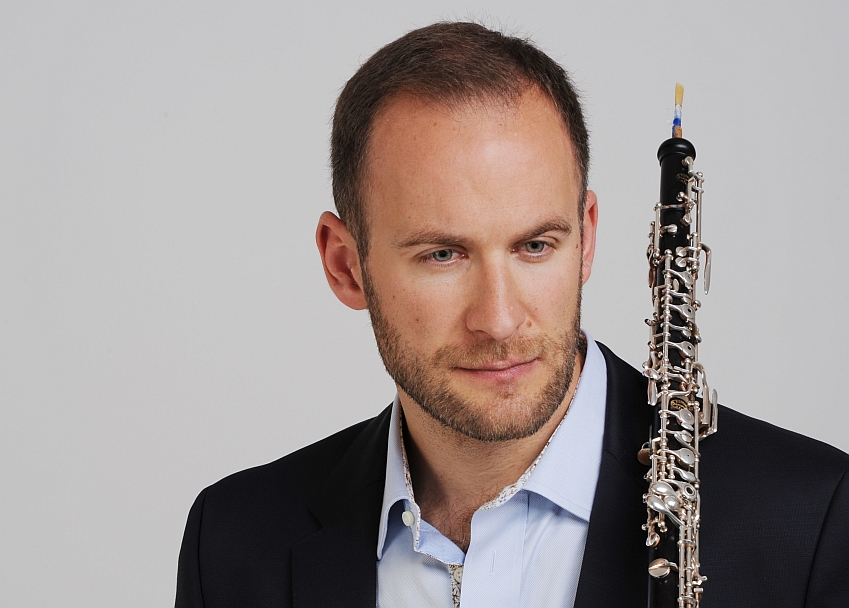
One of the most thrilling of my summer listens so far has been a new Supraphon album of solo Fantasias by Georg Philip Telemann and Six Metamorphoses after Ovid by Benjamin Britten, brilliantly played by younger Czech oboist Vilém Veverka.

- Classical Music 101: What Does A Conductor Do? - June 17, 2019
- Classical Music 101 | What Does Period Instrument Mean? - May 6, 2019
- CLASSICAL MUSIC 101 | What Does It Mean To Be In Tune? - April 23, 2019
Unlike a violin or a gamba, which can imitate a full harmonic instrument with some clever bowing, the oboe can only play one note at a time. But Telemann and Britten, each in their very, very different ways, manage to make more out of that single note than we could ever reasonably expect.
 It helps to have as fine an interpreter as Veverka doing the work, with a modern instrument with a beguiling timbre — with the discrcreet clickety-click of the instrument’s keys doing their tap dance in the background.
The Telemann pieces, which together make up nearly an hour of impressively layered moods and styles, were originally written for flute, but they suit the oboe well.
Veverka and his audio engineers chose the chapel at a Czech monastery for the recording, and the blooming sound helps give the single line of music an extra layer of depth.
The Britten suite, which has a watery theme, was written for an outdoor concert in 1951 — and has become a staple of the oboe repertoire.
You find much more detail about the album here.
Here is Veverka’s rather rough-hewn personal invitation:
John Terauds
+++
Veverka’s flawless work on the album belies all the fussing that this finicky woodwind demands, in and of itself and for its thin double reeds, which professional oboists learn to make themselves.
I like the Czech word for oboe: hoboj (pronounced hoboy). It pretty much describes it all, if said with the right inflection.
To explain what I mean, here is a very funny blog post by Aaron Cohen, director of programming operations at New York City’s classical radio station WQXR from November 2010 (you can find the original post here).
As a soundtrack, you may want to try this interpretation of Petr Eben’s 1964 Ordo modalis, with Veverka and harpist Katerina Englichová (the movements are set up in French baroque style: Intrada, Air, Rigaudon, Sarabande and Gigue):
Although many musicians won’t admit it, there are conversations that go on between an instrumentalist and their instrument. Making all that beautiful music together requires the cooperation of both parties and there is always a subtle negotiation that goes on between them. For some instruments, these conversations are fairly straight-forward. For example, violinists have conversations that go like this:
VIOLINIST: I’d like to practice my orchestral part.
VIOLIN: Sounds good. Which page should we start on?
VIOLINIST: Page 7.
VIOLIN: Ready whenever you are, pal.
There are also instruments whose capabilities are so great that they start making suggestions:
PIANIST: I’d like to practice some Chopin.
PIANO: Wonderful! Etude or Nocturne?
PIANIST: Nocturne.
PIANO: You know, we could also play Liszt or Brahms or Bach or Mozart or Tchaikovsky.
PIANIST: Let’s stick with Chopin
PIANO: Right, Chopin it is. Good call. How about some Schumann later?
And then there are those instruments that are just plain difficult. Before I moved to New York, I was a professional oboist. In many ways, an oboe player and their oboe are like a bad marriage. You put on a good face at parties and always appear to be in love when in public, but behind the scenes there is constant bickering and non-stop drama.
AARON: Shall we practice?
OBOE: Sorry, not now.
AARON: What? Why not?
OBOE: I don’t feel like it. Besides, it’s raining.
This is a typical scenario.
AARON: So what if it’s raining?
OBOE: Fine, we can practice, but you can’t play anything in E-flat major.
AARON: Why not?
OBOE: I can’t do E-flat major in this kind of moisture
The source of most problems between an oboist and their oboe comes from the reed. The tip of an oboe reed is much thinner than a sheet of paper and therefore extremely sensitive to temperature and weather changes.
AARON: Okay, it has stopped raining. Can we play now?
OBOE: Sorry, no. It’s too dry in here.
AARON: Too dry?
OBOE: Yes, do you have a humidifier? That would help.
Whatever the oboe wants, the oboe gets.
AARON: As you requested, the humidifier is on. Shall we make beautiful music?
OBOE: What? Now?
AARON: Yes.
OBOE: Oh no, definitely not. I can’t make music now.
AARON: Why not?
OBOE: Do you feel the draft in here? I can’t be expected to perform under these conditions.
An oboist quickly learns he cannot win.
AARON: I’d like to practice the solo from the Rossini overture I’m performing with the orchestra tonight.
OBOE: Sorry, no can do.
AARON: Why not?
OBOE: The tip of my reed is chipped so we can’t play anything staccato.
AARON: Well, then… (flipping pages)… How about we practice the solo from the Beethoven symphony?
OBOE: Nope, that’s in E-flat major.
And even if you do manage to practice in the afternoon, there is no guarantee things will be the same for the concert in the evening.
AARON: Are you ready? Our solo is coming up in eight bars.
OBOE: (Yawn)
AARON: Hello? The solo! The big solo!
OBOE: What do you want from me? We’re still in E-flat major and it started snowing thirty minutes ago.
AARON: Can you please, please work with me here? The conductor is looking at us now… (whimper)…
OBOE: What is with that conductor anyway? Is he giving a downbeat or making a surrealist painting? I can’t follow that.
It might sound like beautiful music when you hear an oboe play in the orchestra, but make no mistake, it is a temporary truce during an ongoing war. If the audience is listening, the oboist and their oboe will pretend to get along, perhaps even feign great affection, but watch out once the concert is done. The battle begins anew.
AARON: What happened? We were in tune for the overture but went sharp for the symphony.
OBOE: Can I help it if the concert hall is too hot? It messes with my pitch. Someone needs to talk to the janitor.
AARON: How am I supposed to make my living as a musician when you behave like this?!
OBOE: I always said you shouldn’t go into music.
Eventually I decided to change careers and get into radio. But back when I was a performing musician, I recorded two CDs of solo oboe repertoire. I’ll spare you details of the endless instrumental squabbles that took place during the making of these recordings, but I will let you hear some of the results.
Aaron Cohen
- Classical Music 101: What Does A Conductor Do? - June 17, 2019
- Classical Music 101 | What Does Period Instrument Mean? - May 6, 2019
- CLASSICAL MUSIC 101 | What Does It Mean To Be In Tune? - April 23, 2019