

Although we celebrated Franz Liszt’s 200th two years ago, the vast majority of pianists, orchestras and choirs paid little attention to his later compositions — the ones concerned with emotional and spiritual matters depicted in sound. This is music that often has little momentum and none of the surface dazzle of an opera reminiscence or a Hungarian dance.

- Classical Music 101: What Does A Conductor Do? - June 17, 2019
- Classical Music 101 | What Does Period Instrument Mean? - May 6, 2019
- CLASSICAL MUSIC 101 | What Does It Mean To Be In Tune? - April 23, 2019
Monégasque pianist Nicolas Horvath, pretty much unknown in Canada, is building a career out of making sense of the difficult — be it new music or the later works of Liszt.
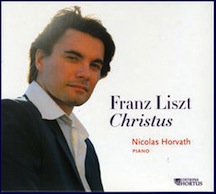 In his début album issued on the Éditions Hortus label, Horvath does a double-Liszt with the composer’s own piano-solo transcription of his massive oratorio Christus, published in 1872. The three-part, 14 movement beast is from the composer’s post-piano-rock-star devotion to sacred music (little of which ever gets heard now).
British pianist and Liszt expert Leslie Howard has researched, edited and recorded six of the eight movements Horvath assembled for this 70-minute CD.
Horvath went on his own sleuthing spree to find two more movements — “Die Grundung der Kirche” (The Founding of the Church) and “O Filii et Filiae” (O Sons and Daughters, a Medieval Easter chant) — which get their first-ever recording here.
These transcriptions essentially meld choral and instrumental parts into plenty of work for 10 fingers. There are gorgeous moments when Liszt reaches back to the simplicity of plainchant. There also are extravagant dramatic outbursts with crashing chords and and virtuosic runs.
But the bulk of the music is a quilt of meek-and-mild episodes sprung from the composer’s fertile imagination — more noodling than drama. The CD booklet helpfully supplies the original texts.
Horvath approaches the music with breathtaking dexterity and gives it momentum wherever he can find some. Here is a pianist with a powerful sense of where his interpretation needs to go, but I doubt that anyone not already devoted to the abstract emotional stylings of late-Romantic mysticism will get transported.
It doesn’t help that the overall sound of the piano, recorded at the Prince Ranier Academy in Monaco, is not terrible, but could have been more opportunity to bloom before hitting the microphone. It sounds too much like a dry studio recording.
The websites for both Éditions Hortus and Nicolas Horvath are badly out of date. Best check the album out at ArkivMusic here.
+++
Horvath has an affinity for abstruse music. You can sample his willpower in action in “Vers la flamme” (Towards the Flame) by Alexander Scriabin, also obsessed with translating metaphysics into sound, at the music festival in the priory of Chirens, in the Alpine foothills near Grenoble:
Here is “O Filii et Filiae” from Christus, with the narrator reading out the 15th century text:
And here is a fine, larger-scale introduction to what Horvath can do, in a 2011 performance of all 14 stations of Liszt’s Via Crucis at Albert Long Hall in Istanbul:
John Terauds
- Classical Music 101: What Does A Conductor Do? - June 17, 2019
- Classical Music 101 | What Does Period Instrument Mean? - May 6, 2019
- CLASSICAL MUSIC 101 | What Does It Mean To Be In Tune? - April 23, 2019