

Does the world need another set of recorded Beethoven piano sonatas? Definitely not. No. Probably not. Or, well, um, after listening to young American Jonathan Biss’s latest installment, maybe just one more.

- Classical Music 101: What Does A Conductor Do? - June 17, 2019
- Classical Music 101 | What Does Period Instrument Mean? - May 6, 2019
- CLASSICAL MUSIC 101 | What Does It Mean To Be In Tune? - April 23, 2019
That’s the problem, isn’t it? We know the composer and we’ve heard his pieces so many times that many of them are as comfortably familiar as Ellen’s daytime TV dancing interludes. But when an interpreter with strong personality and skill comes around, the pieces take on a special glow or force.
Biss — who is presenting a solo recital at Koerner Hall on Sunday afternoon — is one of those great interpreters.
This isn’t because he wields wild colours and dynamics (like Canada’s Stewart Goodyear) or an almost supernatural elegance (like Richard Goode) or even a remarkable sense of spontaneiety (like the great Irish pianist John O’Conor).
It is because he has an overall sense of proportion and balance, can tap into Beethoven’s fiery changes of pace and mood, and render with an absolute sense of control — think of a less icy-cold Andras Schiff or, better yet, a new-generation heir to the Shaker-simple creations of Alfred Brendel.
I don’t usually like describing by endless simile, but we really have heard Beethoven’s sonatas done so many times by so many different great artists, that you can almost define your own personality as a listener by pianistic preference.
So, my assessment of Biss’ Beethoven is that it is perfect for a listener who tilts towards the intellectual side of the music-appreciation spectrum, who doesn’t look for daring acts of extroversion, and who loves a fine show of flawless technique.
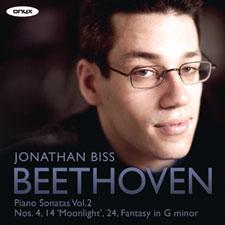 On this Onyx disc, Biss has assembled the large-scale early Op. 7 Sonata, Op. 14 (the Moonlight) and the two-movement Op. 78, which is paired with the Op. 77 Fantasy.
Each one represents a different twist on the classical notion of what a sonata is supposed to be — in terms of how the material is presented and themes developed.
Biss treats each movement of each work as a self-contained entity. The more I listen, the more respect I have for his controlled boldness.
You can find out more about the album here.
+++
There is no Beethoven on Sunday’s programme at Koerner Hall. Instead, Biss is taking us on a series of colourful voyages courtesy of Robert Schumann (some Op. 12 Fantasy Pieces and the Davidsbündler Dances) and Leos Janácek (On the Overgrown Path) punctuated by the coolly stylized structures of Alban Berg’s awe-inspiring Op. 1 Piano Sonata (think of a late Lawren Harris painting rendered in sound).
For more details on Sunday’s recital, click here.
John Terauds
- Classical Music 101: What Does A Conductor Do? - June 17, 2019
- Classical Music 101 | What Does Period Instrument Mean? - May 6, 2019
- CLASSICAL MUSIC 101 | What Does It Mean To Be In Tune? - April 23, 2019