

It’s hard for us to imagine sitting down around a big, crackling fireplace after dinner with a group of friends to sing devotional songs for an hour or two. But that is what composer Heinrich Schütz (1585-1672) intended for his Cantiones Sacrae.

- Classical Music 101: What Does A Conductor Do? - June 17, 2019
- Classical Music 101 | What Does Period Instrument Mean? - May 6, 2019
- CLASSICAL MUSIC 101 | What Does It Mean To Be In Tune? - April 23, 2019
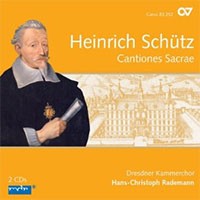 The 40 motets of the Cantiones Sacrae, completed in 1625, are fascinating studies on the state of a choral art mixing polyphony and counterpoint. An excellent, new 2-CD album by the Dresdner Kammerchor issued by the Carus label lays out this beautiful and complex music with utter clarity and impeccable balance under director Hans-Christoph Rademann.
The overall sound is far more smooth and homogeneous than what we would have heard in real life, or when there is just one voice per part (the Dresdeners have the luxury of 18 choristers).
It adds meaning that this group hails from the same place where Schütz had worked nearly four centuries earlier.
The Dresden composer and music director had the unenviable task of navigating an uneasy religious balance in 17th century Saxon court. Although he was officially serving a Lutheran boss who would have wanted his church music sung in German, he also had to please Roman Catholics, who sang in Latin.
Because they would not have been sung in church, Schutz was able to set Latin texts for the Cantiones Sacrae. The motets are made up of prayers, Psalms, passages of Scripture and mediations by people like St Augustine.
Like much music of the time (John Dowland died a year after Schütz completed these pieces), the overall mood is melancholy and introverted. The singers, sometimes unaccompanied, were meant to reflect on man’s sinful state.
It’s fascinating to listen to how Schütz comes up with a multitude of ways to express different emotions with consonance and dissonance, tight versus wider harmonies, and abrupt virtual changes of tempo caused by shifting note values and rhythms.
One can listen to this music on several different levels — from pure, eyes-closed meditation to an analysis of a composer’s full paint- and toolbox at a tumultuous point in Western history. It’s rich stuff that never grows stale.
There is more information (in German only) as well as audio samples on the Carus website, here.
This is the first of the 40 Cantiones Sacrae, “O bone, o dulcis, o benigne Jesu,” as sung (with only one voice to a part) by the Cappella Augustana under Matteo Messori:
John Terauds
- Classical Music 101: What Does A Conductor Do? - June 17, 2019
- Classical Music 101 | What Does Period Instrument Mean? - May 6, 2019
- CLASSICAL MUSIC 101 | What Does It Mean To Be In Tune? - April 23, 2019