

Toronto’s parade of Christmas concerts featuring children culminates in a two-night residency by St Michael’s Choir School at Massey Hall this weekend. It’s a years-old tradition that masks serious winds of change.

- Classical Music 101: What Does A Conductor Do? - June 17, 2019
- Classical Music 101 | What Does Period Instrument Mean? - May 6, 2019
- CLASSICAL MUSIC 101 | What Does It Mean To Be In Tune? - April 23, 2019
Even young people’s ensembles can’t escape the professionalization of the music biz.
No longer just collections of children who sing after school one or two days a week and who present two concerts every year with the help of long-suffering mother-chaperones, more and more of the city’s youth choirs are taking on the look and feel of grown-up arts organizations.
 Three years ago, the Canadian Children’s Opera Chorus renamed itself the Canadian Children’s Opera Company. Two weeks ago, the venerable High Park Choirs of Toronto announced that they are changing their name to Young Voices Toronto in the hope of underscoring their pan-urban mission.
Both organizations have boards that don’t just double as parent chaperones and cheerleaders. These are people actively looking for corporate sponsorships and private donors — as is the case with any other professional arts organization.
Changing the name, in both cases, was meant to help the groups raise their public standing — to come up with a solid brand identity, as marketing gurus would say.
Even 75-year-old St Michael’s Choir School, which owes its existence to a creative collaboration between the Toronto Catholic District School Board and the Archdiocese of Toronto, has come to the realisation that it needs to become more professional in managing its enviable reputation.
The Choir School’s new director Stephen Handrigan has only been on the job for a couple of months, but he sees change — and the need for change — everywhere.
Walking down the Bond St sidewalk, I hear the school well before I see the vaguely Gothic main door. The boys — some 240 out of the school’s total enrollment of 271 — are singing their way through the “Hallelujah Chorus” in the auditorium, which looks out onto the street.
St Mike’s artistic director, Jerzy Cichocki, stands in the middle of the congested space, successfully guiding the young sopranos, altos, tenors and basses to within a few measures of the end.
There is a three-beat rest before the final Hallelujah that has caught unwary singers for two-and-a-half centuries. And, wouldn’t you know it, a handful of trebles let rip two beats too soon, sending the whole room into an explosion of youthful mirth so wild that Cichocki gives in for a few minutes before re-marshalling the forces for another go — this one nearly flawless.
Handrigan has been standing in the doorway the whole time, clearly enjoying the rehearsal.
He grew up going to a segregated boys’ Catholic school in St. John’s, Nfld. He was a boy soprano at the Basilica in St John’s, and would have been sent to St Michael’s in Toronto had the school not abandoned its boarding programme in the 1960s. He taught music at Upper Canada College and, most recently, was vice principal at Loretto Abbey Catholic Secondary School — an all-girl institution — before coming to St Michael’s in early October.
“I feel I’ve come home, like it was meant to be that way,” says Handrigan as he guides me towards his office. “Everything has come full circle in a weird and wonderful way 40 years later.”
As much as he loves his new work home, it has already become painfully clear to him how much it is in need of expansion. The auditorium is actually not big enough to comfortably hold all 271 boys currently enrolled at the school, much less an actual audience. Also, suprisingly given the institution’s golden list of alumni, there is no endowment fund.
Each boy’s family pays a tuition of approximately $5,000 — that is if the boy hasn’t been admitted on scholarship. But there hasn’t been any systematic follow-up with alumni, even though informal networks maintain a tradition of old boys showing up to sing at funerals of graduates.
This means that paying for school trips becomes a massive undertaking.
Handrigan proudly announces that the boys of St Mike’s have been invited to sing High Mass at St Peter’s Basilica as well as a series of other concerts in Rome this summer, in honour of the school’s 75th anniversary. Cardinal Collins is leading the group, which is going to number about 300 people. The 12-day trip is expected to cost about $4,000 per person.
“You do the math,” smiles Handrigan.
“That’s why I want to reconnect with alumni in a direct way,” he declares.
Fortunately, the cause is getting some high-profile help, as tenor Michael Schade and singer Matt Dusk — both graduates of St Mike’s — have volunteered their voices in an all-star gala being organized at Roy Thomson Hall for Jan. 21. But there’s still a lot of work to do.
Debra Chandler, president of the board of High Park Choirs/Young Voices Toronto, admits that it’s very difficult to raise enough money every year to keep activities up and costs down for all the children involved. This summer, their choristers are scheduled to tour Germany. It just doesn’t happen by itself.
St Mike’s and the new non-denominational Toronto District School Board vocal academies at Ryerson Community School in the Kensington Market neighbourhood and Heather Heights Junior P.S. in Scarborough are integrated into each child’s academic life.
For after-school, there are the 14 well-established children’s choirs that operate in the GTA, as well as dozens more church and school choirs. All together, they provide a creative outlet for several thousand children.
It’s wonderful that there are so many choirs, but Chandler gently suggests that everyone is competing for the same scarce sponsorship and donation opportunities — hence the need for worries about seemingly trivial image issues such as names and branding.
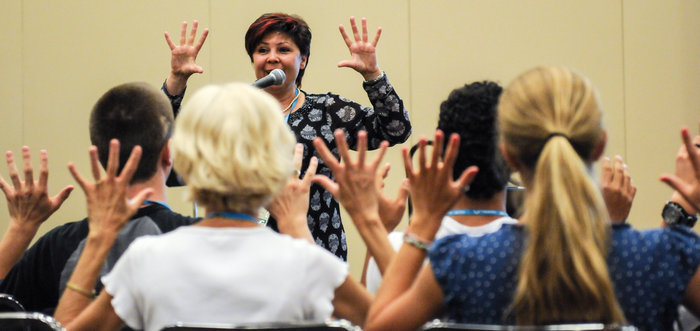
Meanwhile, High Park/Young Voices artistic director Zimfira Poloz — and her peers — simply go on doing what they know and love best, instilling the love of singing, teamwork and creative expression in their young charges.
Poloz, just back from China where she led a group of kids at an international choir competition in Guangzhou, says there were supposed to be 7,000 choristers competing for the grand prize, but 9,000 showed up.
“One of the girls was interviewed by a reporter, who asked if she was hoping her choir would win,” Poloz recalls. “She said no, we’re not here to win but to enjoy the experience of singing.”
The veteran music teacher, pedagogue and conductor continues: “Fun is when you’re working together and sharing something on stage; it’s not about sitting with a video game.” If children are exposed to this, they realise this very quickly — without having to be told.
+++
The best place to check up on this season’s Christmas concerts is in WhoteNote magazine’s concert listings.
For details on St Michael’s Choir School’s Christmas concerts at Massey Hall, click here.
Here’s a clip of the senior contingent of the High Park Choirs singing at Roy Thomson hall a couple of years ago, with Poloz conducting:
And here is a video clip from last year’s Massey Hall concert by the tenors and basses of St Michael’s Choir School:
John Terauds
- Classical Music 101: What Does A Conductor Do? - June 17, 2019
- Classical Music 101 | What Does Period Instrument Mean? - May 6, 2019
- CLASSICAL MUSIC 101 | What Does It Mean To Be In Tune? - April 23, 2019