
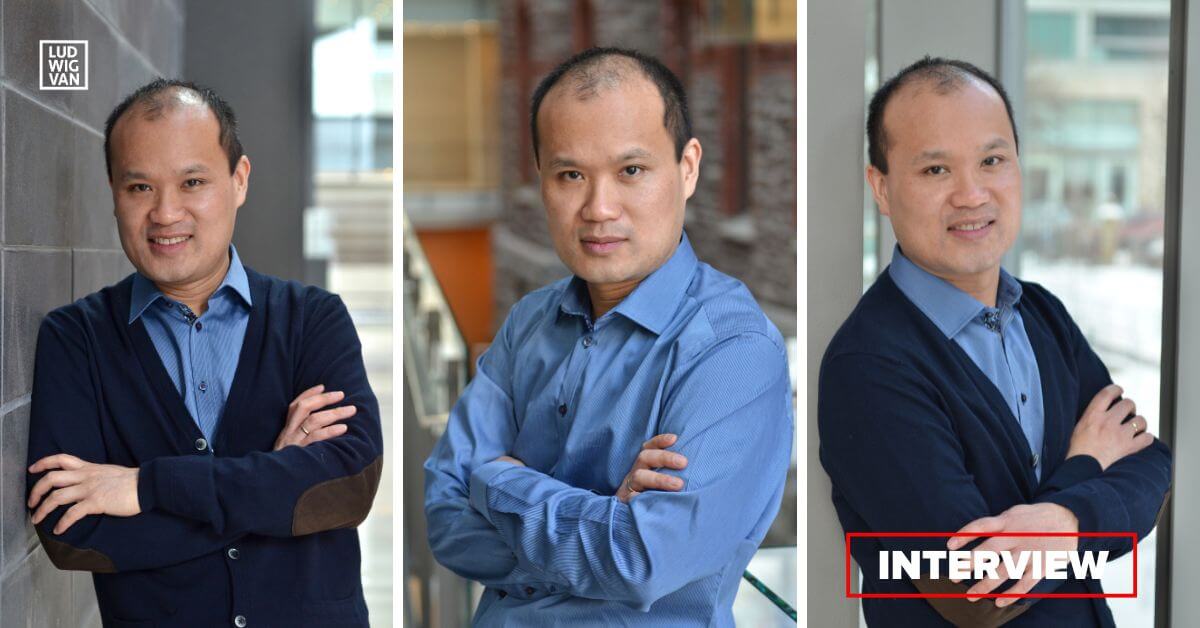
David Louie is a keyboard player simply put, known for his technical and interpretive skills at both the piano and the harpsichord. He’ll be performing a recital of Bach’s Partitas for keyboard on November 3.
To maintain a career as soloist with both instruments is a rare feat today, and David combines that with a position as an influential teacher of keyboard and historical practice.
David was born in Prince George, British Columbia. He came to Toronto to study music, and graduated with a degree from the Royal Conservatory, followed by a postgraduate degree from the University of Southern California in Los Angeles. He’s a laureate of the CBC Radio Competition and other international competitions.
Along with his career as a performer, Louie is a member of the faculty at the Glenn Gould School and the Taylor Academy of the Royal Conservatory. There, he teaches piano, chamber music, and historical performance practices, and some of his students are carrying on his winning tradition — including Eric Guo, winner of the second International Chopin Competition on Period Instruments.
We spoke to David about keyboards and Bach partitas.
He performs the Scarlatti Sonata K. 104 in G major:

David Louie, the Interview
For David, there was never really any question of focusing on anything else. “I was just like most kids who were introduced to piano at a young age,” he recalls. “I was endlessly fascinated, as a kid. I was five years old.”
The piano came first, other keyboards later. “I discovered early keyboards later, when I was in college,” he says.
As to the repertoire of his recital, J.S. Bach’s Keyboard Partitas Nos. 2, 4, and 6, that’s a no-brainer as well.
“Every pianist is forced, whether they like it or not, to play music by J.S. Bach,” he notes. “I was no different.”
Perhaps because of the arbitrary nature of his early exposure to it as a piano student, the music at first held little appeal. “I did it because it was necessary, but I never quite took to it until I discovered the early keyboard instruments,” he says.
Then, everything changed, and today, Bach’s keyboard works form a large part of his repertoire — but not as performed on the modern piano.
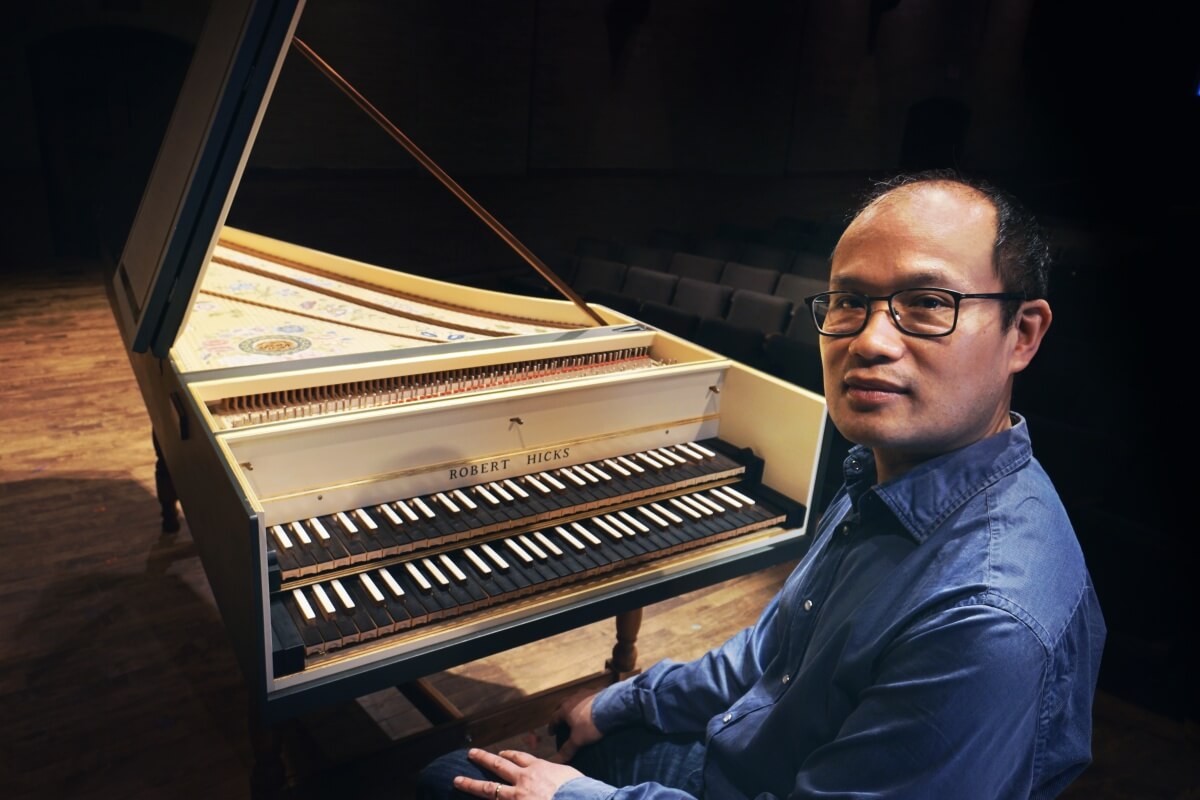
At the RCM, Michael & Sonia Koerner have donated the collection of historical instruments displayed under glass in the lower level. Louie maintains those instruments. “They’re in playable condition,” he says. “People are amazed at the sound. This instrument was built while Bach and Handel were still alive.”
He explains, “It’s a different technique and different approach. What I love about the harpsichord is the democracy of the voicing.”
Bach’s music is written in using counterpoint, as Louie points out, a compositional technique that works with two or more independent voices, each with what he calls a democratic role in the music. Performing Bach on the harpsichord or organ allow for that kind of democratic voicing. The dynamic ranges that the modern piano introduces into the mix complicate the issue.
“You can suppress certain voices, [but] the whole interplay and the soul of counterpoint — the equality of the voices is lost,” he says. “It was the instrument that Bach had,” he adds.

The Bach Keyboard Partitas
“I wanted to showcase the partitas,” David says. “It shows the sheer range that Bach was able to encompass within this one volume.”
When programming a concert, it’s necessary to look for a mix of pieces with variety and contrast, and it’s possible to find that within the Partitas. “It’s an enormously difficult program,” he acknowledges.
“The partitas — these are special pieces even for Bach, and he wrote a lot of music.”
As he points out, while the Baroque master is revered today, in his own time, success was not a foregoe conclusion, and he was competing against several other organist/composers even in his native Germany alone. He composed a great deal of music simply because he had to as a working musician. Publishing music was prohibitively expensive in the 18th century, and Bach didn’t have the kind of deep pocketed patrons that some other composers enjoyed.
“At his own expense, he decided to self-publish some of his music,” David says. He published the collected book of Partitas, titled Clavier-Übung I, (labelled “Opus 1” by Bach), in 1731.
“It’s like a business card,” Louie says, a way, in other words, of showcasing as well as distributing his music. “He put his best in it, and also his most daring. It’s music that’s designed to make an impression on people.” Since Bach couldn’t travel much himself, he let the music do the traveling for him. Aside from a couple that are more accessible, the composer didn’t cater much to amateur abilities when he wrote them.
Louie cites the “wide ranging colours, endless possibilities within the standard baroque suite”. “It’s what he does with it that is pretty remarkable.”
The gamble on self-publication had the desired effect, selling hundreds of copies. Bach’s reputation began to grow among his contemporaries. “I don’t think he could have possibly imagined where his fame could have gone after his death,” Louie says. “This music is really the catalyst.”
- David Louie’s concert is presented as part of the Mazzoleni Masters series at Koerner Hall; find more details about the performance, and ticket [HERE].
Are you looking to promote an event? Have a news tip? Need to know the best events happening this weekend? Send us a note.
#LUDWIGVAN
Get the daily arts news straight to your inbox.