
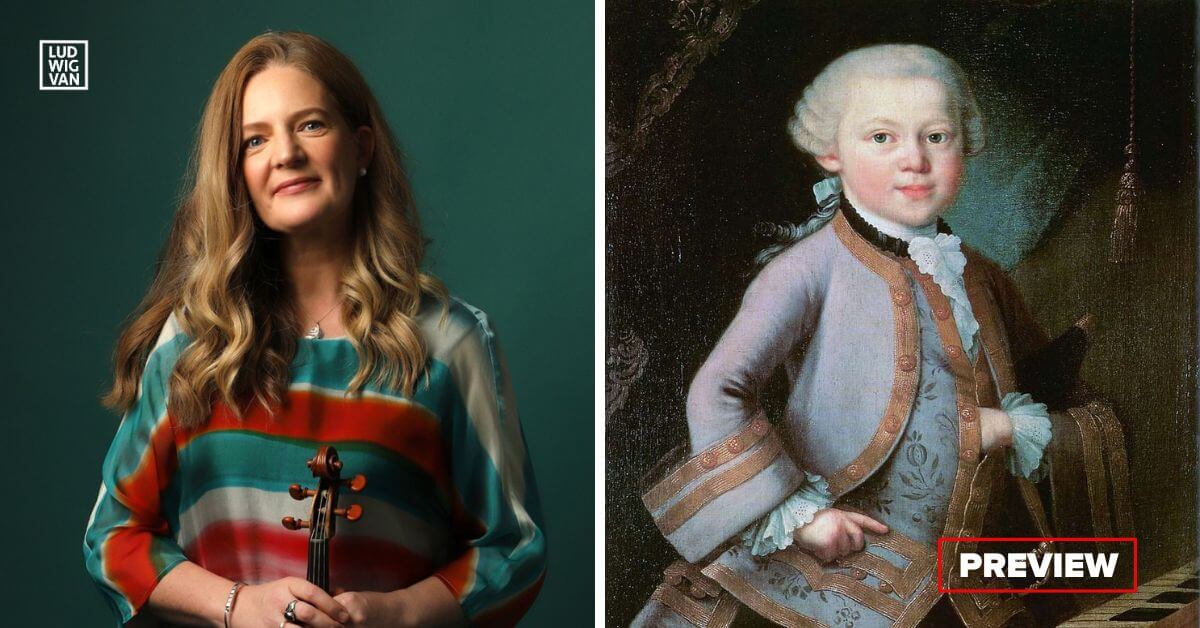
Violinist Rachel Podger, the new Principal Guest Director for Tafelmusik, will lead the orchestra in all-Mozart concert to open the 2024/25 season. The program will be presented on September 27, 28, and 29.
British violinist Rachel Podger is a noted specialist in baroque and classical music. She was the winner of 2023 BBC Music Magazine Awards in two categories: Instrumental Recording and Recording of the Year, and was the first woman to be awarded the prestigious Royal Academy of Music/Kohn Foundation Bach Prize in October 2015, among many other honours and awards.
The concert’s program delves into Mozart’s catalogue to find a rarely heard gem, along with beloved favourites.
All-Mozart: The Music
The incidental music for Thamos, King of Egypt, is a new work for both Podger and Tafelmusik, a piece that’s not often heard or recorded.
Tobias Philipp von Gebler, a famous playwright of the era, wrote the five-act drama Thamos, King of Egypt (Thamos, König in Ägypten), which premiered in 1774. He asked Mozart to write incidental music (K.345/336a), which he did between 1773, in order to replace the original music Gebler had commissioned for the work.
Mozart was only able to compose the first two choruses for that first performance in 1774. He wrote more music for Thamos when the play was remounted in Salzburg in 1776 and 1779, but it never caught on with the public, and the composer allowed Johann Heinrich Böhm’s company to reuse it for another production in 1783.
It’s the only incidental music that Mozart ever wrote for theatre, and many experts hear foreshadowing of The Magic Flute in the work.
Mozart composed his Violin Concerto No. 2 in D major, K. 211 in 1775. During the 2023/24 season, Podger performed his Violin Concert No. 1.
The heart of the concert is Mozart’s Symphony No. 41 in C major, K. 551. His last symphony, his longest, and considered by many to be his greatest, it was completed in August 1788. The symphony has been nicknamed The Jupiter, although that’s not a name Mozart himself chose; (the first use in print comes from a program dated 1821). It’s uncertain whether he ever heard it performed during his lifetime.
Unlike most of his other works, which Mozart catalogued in his own writings, the last three symphonies remain a bit of a mystery. Undocumented in the composer’s usual way, they do not appear to have been commissioned or requested by patrons or others, and it’s not clear what he intended for them. They were not published until well after his death in 1791.
Symphony No. 41 is the grandest of Mozart’s symphonies in terms of its scope, and many scholars believe it foreshadows the Romantic works of Beethoven. Haydn used Mozart’s work as a model for his own Symphonies Nos. 95 and 98.
- Find more details about the concert and Rachel Podger [HERE].
Are you looking to promote an event? Have a news tip? Need to know the best events happening this weekend? Send us a note.
#LUDWIGVAN
Get the daily arts news straight to your inbox.