

4th Line Theatre/Schoolhouse, written by Leanna Brodie, directed and choreographed by Monica Dottor, Winslow Farm, Millbrook ON, closes Jul. 25. Tickets here.
What makes 4th Line Theatre so very special is that it transforms local history into theatre that feels rooted in the community while speaking to universal themes.
Background of the Play
Leanna Brodie’s warmly engaging play Schoolhouse grew out of interviews with area residents and is, as she describes it, “a work of fiction based on actual events.”
Beneath its humour lies a profoundly moving story about education, compassion and the transformative power of a teacher who refuses to give up on a troubled child.
Developed by 4th Line, it premiered indoors at the Blyth Festival in 2006 before moving to 4th Line in 2007, returning by popular demand the following season.
Having first admired the play at Blyth, I can say without hesitation that this revival is an absolute triumph.
What was a delightful period drama on an indoor stage in 2006, this 2026 Schoolhouse blossoms magnificently into a more epic production utilizing both 4th Line’s barnyard stage and the sweeping fields of Winslow Farm, all under natural light.


The Retelling
What makes this revival so distinctive, however, is 4th Line’s inspired choice of director and choreographer, Monica Dottor. I have long admired Dottor’s work as both a dancer and choreographer, but she has brought something genuinely original to Schoolhouse as a choreographer/director.
Set in 1938, the play follows 18-year-old Melita Linton, fresh out of Normal School, as she begins teaching in the one-room Jericho Public School No. 1, built in 1887.
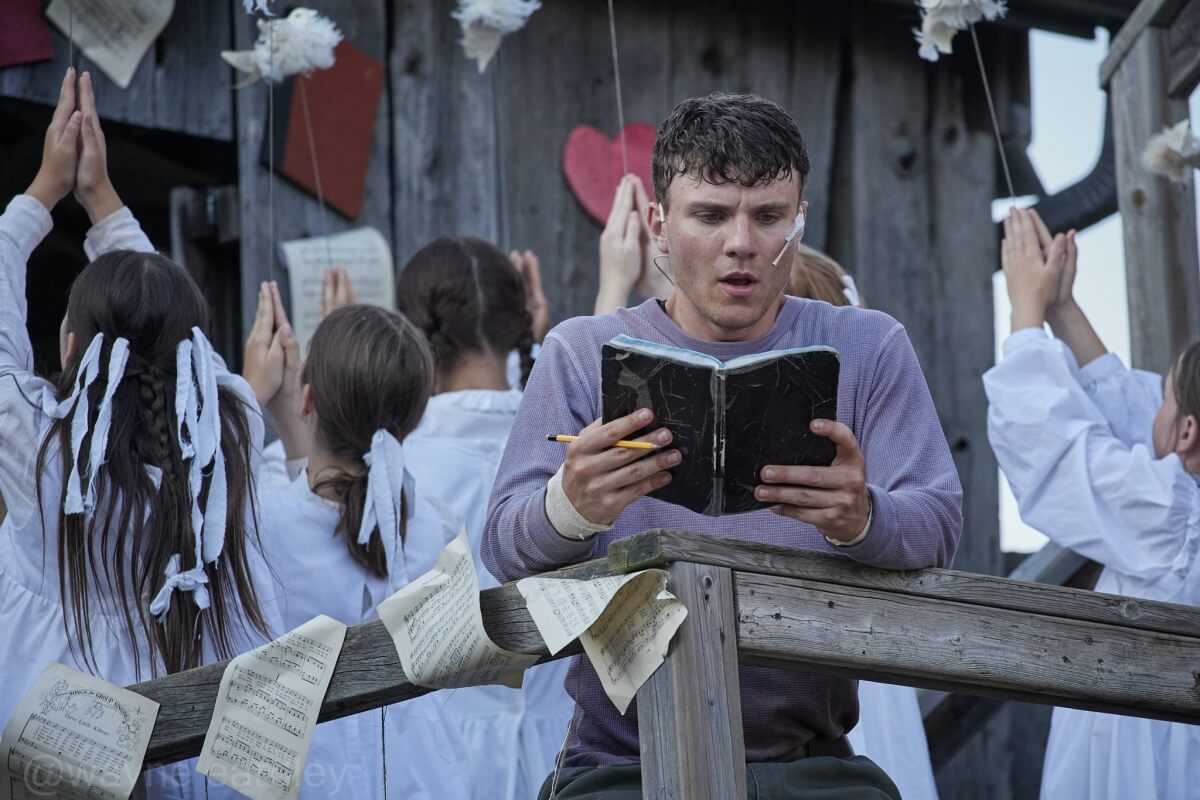
Dottor has added what she calls a “Ghost Chorus”— eight children who represent the spirits of pupils from generations past. Beautifully costumed in white by Chelsea Day, their dress evokes the children of the late 19th century, while their movement becomes the emotional heartbeat of the production.
They do not simply decorate the action, like carrying Halloween lanterns to denote time, or comment upon it, like surrounding a schoolyard fight.
Instead, through exquisitely choreographed movement that run throughout the play, they embody the hopes, fears, joys and sorrows unfolding in the lives of the 1938 students and their young teacher, creating a poignant bridge between the generations that have passed through the little schoolhouse.
The Teacher
Another inspired decision is the casting of the teacher.
Rather than an experienced actor, 4th Line has entrusted the role of Melita Linton to Alex Pearce, who is making her professional debut before entering her fourth year in the acting program at Toronto Metropolitan University. The result is remarkably affecting.
Pearce possesses precisely the youthful openness, uncertainty and quiet determination that an 18-year-old fresh out of Normal School would have brought to her first teaching post.
As they say, Pearce hits it out of the ballpark. The role is written both as narration and intra-scene, and the young actor moves effortlessly through these transitions while never losing sight of the dramatic threshold.
The production therefore achieves something quite rare.
Just as the Ghost Chorus gives physical form to the emotional life of the story, Pierce’s own youth lends an authenticity that cannot be manufactured. Together they create the beating heart of this deeply moving revival.
The Students
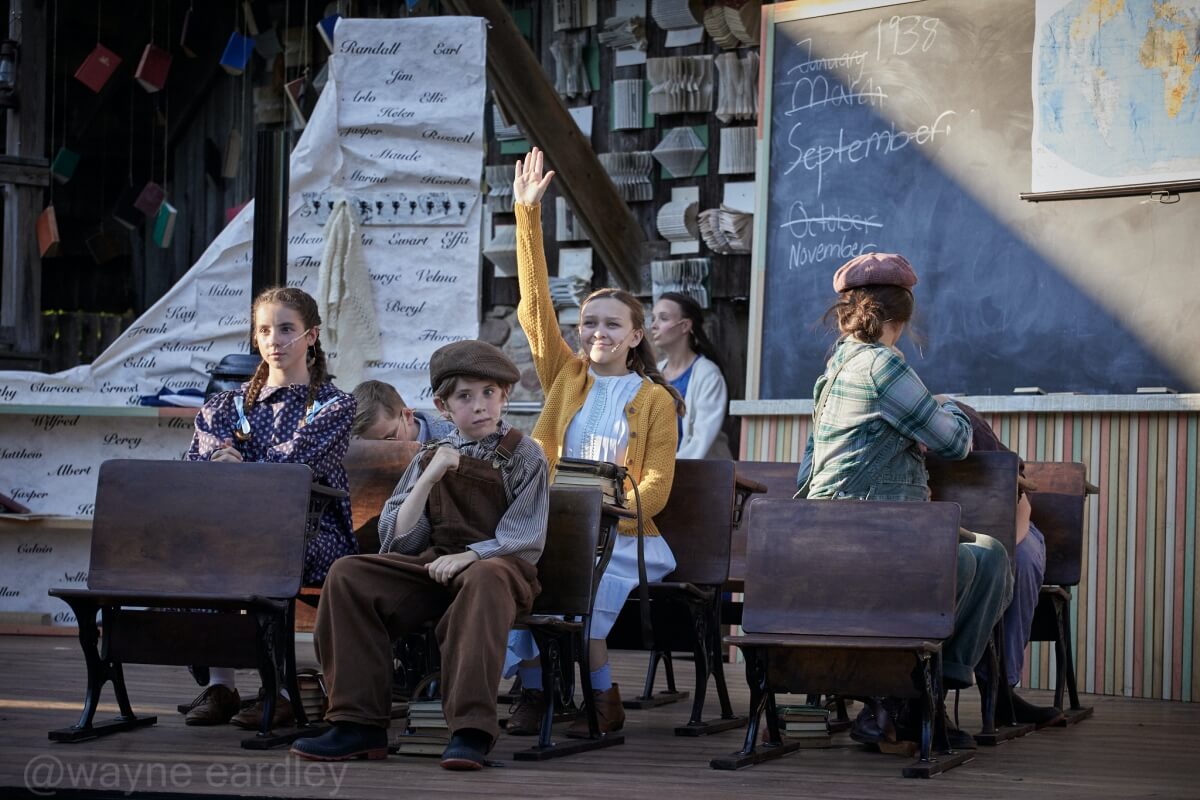
The seven pupils in Miss Linton’s care are vividly drawn, each with a distinct personality that quickly establishes the social order of the one-room schoolhouse.
There is the annoyingly bright and overly capable Beryl Baptie (Indigo Chesser), contrasted with her less academically gifted and more timid younger sister Effa (Evie Wallace). The youngest pupil, seven-year-old Milton Coyte (Jasper Chesser), proves to be not only astonishingly intelligent, but proud of it.
On the other side of the classroom are the bullies. Dwight Varnum (Padrick Wilson), aided by his loyal lieutenant Russell Yellowlees (Darragh O’Connell) and the irrepressibly tough Flossie Needler (Iris Muir), who defiantly favours overalls over dresses, delight in disrupting both lessons and classmates.
Into this already combustible mix comes Russell’s younger brother, Vern (Aengus O’Reilly), deposited at the school by his father who determines he is ready to learn with a “He’s yours now!”
This early scene demonstrates that Miss Linton is not afraid to be a disciplinarian. Faced with Vern’s relentless crying, she administers a dose of cod liver oil and calmly warns that more will follow if he does not settle down. The strategy works instantly.
These pupils are on stage for most of the play and it is their realistic portrayal of their characters that brings the schoolhouse to life.
The Troubled Child
There is an eighth student.
The play’s emotional core belongs to Ewart Rokosh, played with remarkable depth by Alexei DeLuca, a recent graduate from York University.
At 14, Ewart is physically imposing, and his troubled past — he has just been released from training school — leads everyone to expect the worst from him.
Beneath Ewart’s intimidating exterior is an intelligent, deeply wounded young man who reads Emily Dickinson, struggles with profound emotional pain and quietly harms himself.
Miss Linton recognizes the promise that others have overlooked, and the relationship between teacher and student becomes the heart of the drama.
Her greatest challenge is not controlling the classroom, but finding a way to reach and save the one child whom everyone else has already given up on.
As Ewart, DeLuca is simply superb.
The Key Adults
Rainbow Kester is an absolute delight as fellow teacher Evie Bothwell, who is everything Miss Linton is not — a rapid fire talker with a salty tongue, irrepressible confidence and an infectious zest for life. Brodie gives her some of the play’s sharpest, funniest dialogue, and Kester delivers every line with impeccable comic timing.
Equally engaging is Kyle Orzech as Clinton Cochrane, the university-educated engineer whom the townspeople are determined to match with Miss Linton. Clinton’s quiet persistence repeatedly collides with Miss Linton’s determination to keep him at arm’s length, and Orzech brings warmth and understated humour to a man who simply cannot understand why every advance ends with another figurative door slammed in his face.
Robert Winslow generates laughs as Colonel Burnett, the school inspector whose mission is to instil fear into the students with his rapid fire questions. Off duty, he shows a rather charming self-deprecating side in private conversation with Miss Linton.
Together with Ewart’s story, these relationships reveal that Schoolhouse is far more than a nostalgic look back at rural education.
The Coytes
Kester and Winslow as Mr. and Mrs. Coyte, the parents of young Milton, also provide a perfect example of Dottor’s use of directorial choreography.
Miss Linton’s visit to their home in an effort to persuade them to support Ewart’s continued place at the school is an exquisitely rendered comic scene.
Winslow’s downtrodden Mr. Coyte barely has an opportunity to speak or even move before his domineering wife physically puts him back in his place.
It is a brilliantly orchestrated piece of physical theatre.
Throughout the conversation, Kester literally manipulates Winslow like a puppet, and the contradiction between the serious dialogue and the ridiculousness of the physicality is what makes the scene so screamingly funny.
The Community
No review of a 4th Line production would be complete without acknowledging the remarkable community ensemble.
Composer of the incidental music, Justin Hiscox, set designer Michelle Chesser, and costume designer Chelsea Day are all from the local area, as are the 15 children and the seven adults playing their parents and townsfolk.
This rich community support, along with a strong community theatre tradition, allow 4th Line to field a large cast of 27. Few companies can call upon such a deep reservoir of local talent.
End Note
Nearly two decades after its premiere, Monica Dottor’s reimagining of Schoolhouse is not merely a successful revival; it is the reaffirmation of a modern Canadian classic.
The play is an absolute must-see.
Are you looking to promote an event? Have a news tip? Need to know the best events happening this weekend? Send us a note.
#LUDWIGVAN
Get the daily arts news straight to your inbox.