

Spiritillo Mediterraneo is the name of the new album by Toronto- and London-based violinist Cristina Prats Costa. It was released on the Pentatone label on May 1, and has garnered stellar reviews on the likes of BBC Radio 3, the BBC Music Magazine, and Opus Klassiek magazine in the Netherlands.
It was selected as Gramophone’s Video of the Day and featured as an ABC Classic Featured Album in Australia.
Prats Costa is an active member of the Toronto music community, performing with Tafelmusik as well as in the Harmony Is In Our Hands, the concert series she co-founded.
LV caught up with the busy artist to talk about the new release.
Fandango:

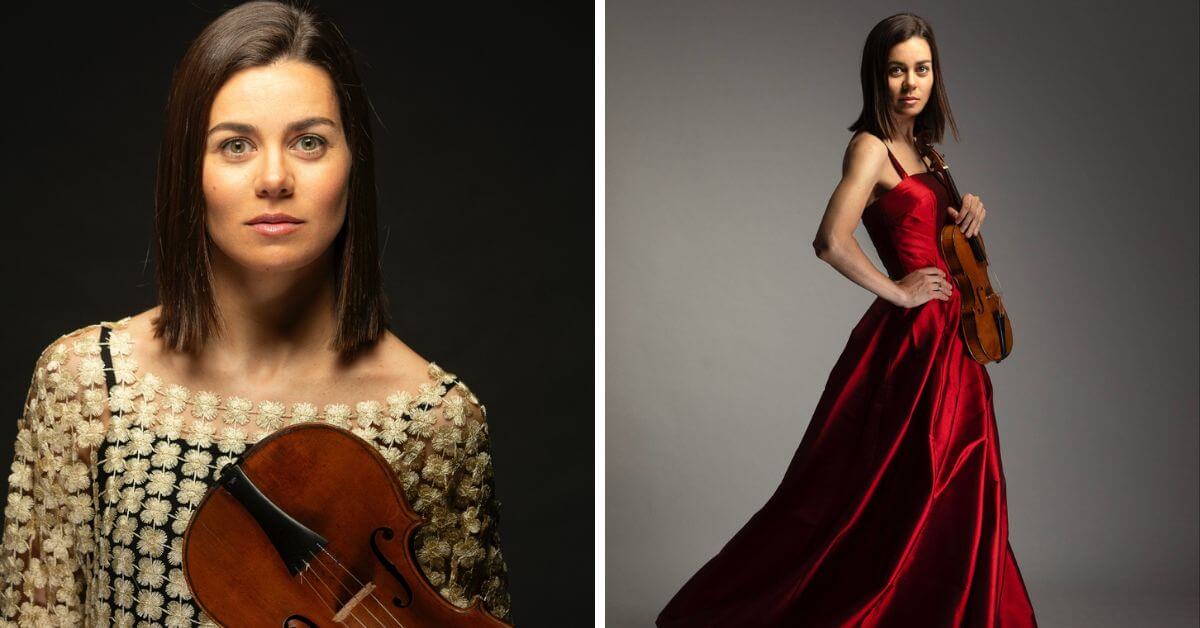
Cristina Prats Costa
Cristina Prats Costa specializes in Baroque violin performance and creative collaborations. She routinely performs with prominent ensembles across North America and Europe, including The English Concert, Il Pomo d’Oro, Irish Baroque Orchestra, Arcangelo, Orchestra of the Eighteenth Century, and Toronto’s Tafelmusik Baroque Orchestra.
Cristina studied at the Guildhall School of Music and Drama, as well as Royal Academy of Music, and The Juilliard School. She is currently pursuing a DMA at the University of Toronto with a focus on ornamentation.
Her performance excellence has garnered several international awards, including the Manhattan International Music Competition Baroque Music Prize and Special Award, the Christopher Hogwood Award, and the Shalom Ben-Uri Doctorate Recital Prize. She was elected Associate of the Royal Academy of Music (ARAM) in 2019.
Along with co-founding Harmony Is in Our Hands, a concert series that combines music performance with social impact, she is a founding member of the Alauda Quartet.
The Album: Spiritillo Mediterraneo
While her contributions have appeared on several other releases, Spiritillo Mediterraneo is Cristina Prats Costa’s solo recording debut. In it, she dives into 17th- and early 18th-century music, as filtered through Mediterranean cultures, a region where Italian, Spanish, and French traditions converge. The name takes its inspiration from Andrea Falconieri’s Il Spiritillo Brando, a dance work by the early 17th century composer. The spiritillo is a sprite or imp, a mischievous spirit. Cristina takes it as a kind of metaphor for the Baroque imagination.
Along with Cristina Prats Costa, the album features Lucas Harris, Charlotte Nediger, Michael Unterman, Joseph Phillips, Naghmeh Farahmand, and Spanish dance expert Esmeralda Enrique.
Composers on the album include Andrea Falconieri, Heinrich Ignaz Franz von Biber, Nicola Matteis, Santiago de Murcia, Gaspar Sanz, Antonio Vivaldi, Johann Schop, José de Nebra, and Jean-Féry Rebel.
Prats Costa created her own arrangements of the works for the album.
Il Spiritillo Brando:

Cristina Prats Costa: The Interview
Cristina has performed with many ensembles and her work is part of several albums. Why come out with a solo debut now?
“I always wanted to record something with Baroque violin,” says Prats Cost. “I started I think five years ago to discover this music.”
After studied in New York and London, she fell in love with the music. The album began with the idea of recording just three or four pieces, but that quickly escalated.
“I thought, maybe I could record ten pieces. Maybe I could record 12 pieces…” she laughs.
While she played with many ensembles, it often involved more modern music and playing techniques. “For the love of having something of my sound as a Baroque violinist,” she continues. “I would have something for myself that showcases me as a Baroque violinist.”
The Music
“I wanted to record initially music that I really love and that really resonates with me,” Cristina says.
She’s originally from Spain, Ibiza, and the music stretches back to her roots. “My grandfather used to play the castanets all the time.” She explains that the castanets he used were bigger, creating a deeper and darker sound, quite unlike what many people on this side of the Atlantic may be used to in flamenco music.
“I had this type of folkloric music in my head as I grew up.”
As a student, she found herself rediscovering the sames kinds of music and rhythmic patterns in the music she was playing. “There’s a lot of similarities of rhythmic patterns,” she explains. It reminded her of the dance music of Ibiza. It led her to wonder, “Which connections do they all have together?”
Italian culture of the Renaissance and Baroque eras was heavily influenced by that of Spain. Spain ruled much of Italy from the 13th to the early 18th centuries, as she points out. Throughout the Mediterranean region, there were both cultural and trade exchanges that spread musical and other elements throughout the area.
“That’s how it all started to make sense.”
In her performance, Prats Costa makes ornamentation part of the expressive nature of her interpretation. It’s part of what makes her work distinctive.
“It’s part of a my research,” she says. In working towards her doctoral degree, she’s focusing on Italian ornamentation. Composers of the Baroque era created scores that were essentially the bare bones of the music, leaving decisions about ornamentation to the performers. “I was interested in […] the freedom they had when playing,” she says. “[Composers were] trying to enhance the music, [but] not trying to do it in a specific way. I think Matteis does it well,” she adds. As such, the music showcases the possibilities available on the violin.
As she explains, prior to the Baroque era, the violin was seen largely as an instrument suitable for dance music, not virtuosic art music. “They all leave a lot of room for ornamentation, your own expression,” she says. It meant each performance could be different. “They would play the pieces in many different ways.”
Matteis’ Diverse Bizarrie:

Arrangements & Musicians
Prats Costa created the arrangements for all the pieces on the album herself. “I made the arrangements for the Spanish pieces, and also the ornamentation for the other pieces,” she explains.
“I was exploring sonorities with different players,” she adds. She considered how the mix of instruments would affect the expression of each piece. During the recording process, sometimes spontaneous and improvised elements made it to the final mix.
She wanted to capture the original spirit of the music.
”Maybe on another day, I would have played it differently,” she says. At the album release concert, she mentions, some of the works were performed differently than on the recording.
As she points out, that’s how the music was originally performed. “I think that’s one of the things I like the most about Baroque music.”
She enjoyed putting together an ensemble of musicians from different backgrounds for the project. It’s what makes her passionate about chamber music. “I gain a lot from that, from the conversation,” Cristina explains.
Along with the musicians, she’s added Spanish dancer and choreographer Esmeralda Enrique, whose been running her own dance company and presenting shows in the city for decades. “The castanet master!” Prats Costa explains. The recording has led to other collaborations with Enrique, including an improvised performance in her studio. “They were making it on the spot. It felt really Baroque, but in a different way,” she says. “It was a beautiful challenge for me.”
The album had led to other possibilities. “It created a lot of these beautiful collaborations.”
Listeners
What is she hoping that listeners will take away from the album?
“I would just love if they enjoy the CD as if it was a live concert, if it was a live performance,” she says. “
If it brings them this kind of spirit.” The spiritillo. “This mischievous [spirit], in each piece, it makes you smile.”
It’s a way of taking listeners away from the tensions of the world today. “Something that brings a bit of peace in this world,” she says, “because it’s not that it’s just happy music.” She points out some of the tracks are quite dramatic, and written in minor keys. That’s where it began, in fact, but also what led to the theme. “That’s when I started doing the arrangements of the Spanish pieces,” she says. “The music was so dramatic that I felt I have to add a little lighter music.”
She like it if listeners could hear the music the way it was intended centuries ago.
“It brings many different emotions, and they enjoy listening as if it was a chamber concert in their own house.”
Españoleta:

Listen to the Music
- You can find Spiritillo Mediterraneo at Pentatone Records [HERE].
- Stream it on Spotify [HERE].
- Find it on Apple Music [HERE].
Are you looking to promote an event? Have a news tip? Need to know the best events happening this weekend? Send us a note.
#LUDWIGVAN
Get the daily arts news straight to your inbox.