
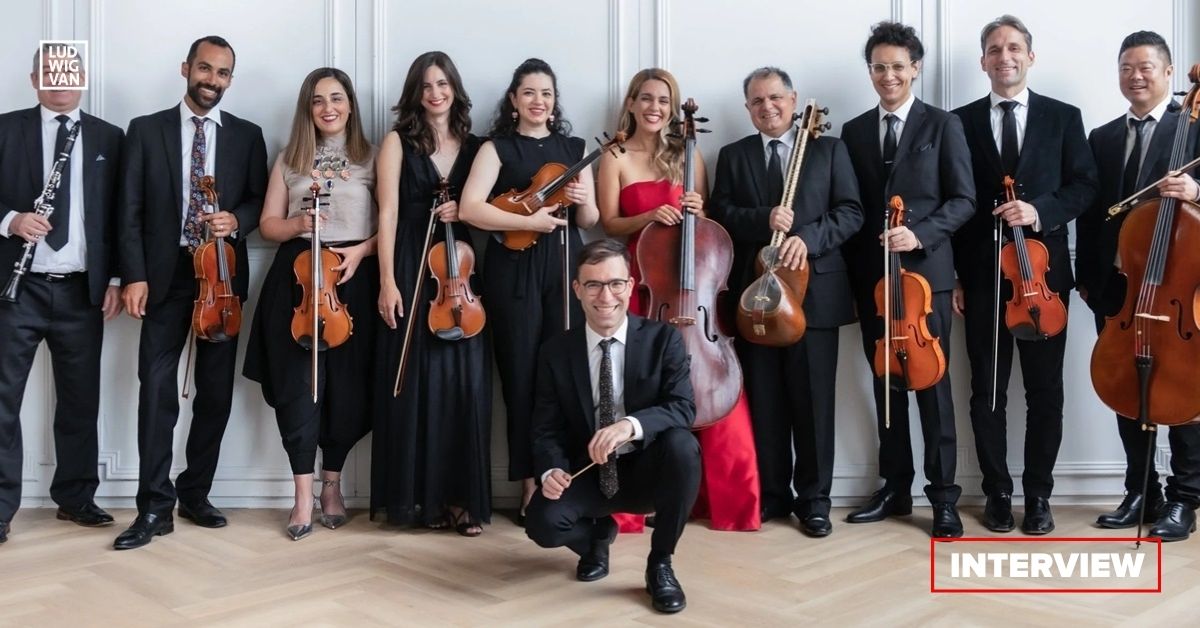
The Canadian Golha Orchestra (CGO) presents Hamnavā: A Musical Evening of Togetherness. Hamnavā means “in tune” or “together in song”, and the concert features vocalists Ava Rostamian and Habib Hoseini, and a special appearance by the DeloJaan Choir of Kitchener-Waterloo.
Hamnavā: A Musical Evening of Togetherness takes place on June 5, 2026.
CGO was founded in 2022, and is based on an Iranian tradition that dates back to the mid-twentieth century.
The Golha Tradition
In the mid-1900s, Radio Tehran’s Golha Program looked to expand the range of Persian music, and bring it to listeners across Iran.
The first broadcast took place on March 21, 1956, and began with a discussion of poetry, and songs performed live on radio. The music was traditional, but played with modern orchestral instruments such as the violin and clarinet. The broadcasts were immediately popular, and the Golha Orchestra was formed.
The musical range came to include not only classical Persian music, but modern songs and other compositions. The Golha Orchestra likewise incorporated both traditional Iranian instruments like the tar and tonbak along with orchestral strings and woodwinds.
After the 1979 revolution, however, the Golha Orchestra’s music fell out of favour, and the radio show was discontinued.
Since then, interest has grown in the music both in Iran and well beyond, and young musicians are now taking up the unique musical style.
The Canadian Golha Orchestra performs a folk melody from the regions of Ramian and Katul, arranged by Rouhollah Khaleghi:

Canadian Golha Orchestra
Canadian Golha Orchestra takes up the challenge of reviving this style of music, and introducing it to Canadian audiences. The ensemble’s goal is to present and perform both new music and rarely performed Golha works. CGO works with both Iranian and Canadian musicians trained in both Persian and Western classical music who share a passion for expanding their artistic horizons.
Artistic Director Kousha Nakhaei has worked in the worlds of both Iranian traditional music and Western classical music for more than two decades. A violinist, kamanche player, educator, and arranger, Nakhaei also leads the Sarv Music Academy, a music education centre he co-founded in 2013, and routinely organizes and curates concerts, community and educational events.
As an instrumentalist, he has performed with artists such as Dariuosh Eghbali, Sepideh Raissadat, Ali Rostamian, Naser Masoudi, and Loreena McKennitt, and toured throughout North America with Sarv Ensemble and Canadian Arabic Orchestra.
LV spoke to The Canadian Golha Orchestra’s artistic director Kousha Nakhaei about the music, and the concert.
The Canadian Golha Orchestra and vocalist Ava Rostamian لاله خونین – روح الله خالقی – گروه گلها و آوا رستمیان perform Lāle-ye Khūnin لاله ی خونین

Kousha Nakhaei: The Interview
The Golha tradition stretches back farther than that first radio broadcast.
“It kind of goes back the roots of it go back to the first decades of the 20th century,” says Nakhaei, “from the 1920s on.” He points out that it was part of a larger global movement in music and culture. “All over the world in a way, cultures with [longstanding] traditions were dealing with how to define those traditions in the modern world,” he adds.
“This is one of the directions that a number of musicians took. For a long time, from the 1950s to the end of 1970s, it was quite prominent. Vocalists and traditional musicians worked within that genre.”
Interestingly, the tradition used Western orchestral instruments to perform Iranian music, which incorporates modal music, classical Persian intervals, and other elements endemic to the genre.
“The essence is traditional music, but the presentation is to use the more modern language of the time,” he explains. “This what we call the Golha tradition — it is really not fusion or world music. It’s as authentic as it gets.”
From its roots in Iran in the 20th century, musicians and composers adapted Western performance techniques and elements to Iranian norms. In some cases, it wasn’t difficult.
“The violin was used at that time, then and before, to play Iranian music,” he points out. “It’s versatile, you can play any interval or scale.”
The Western-trained musicians of the Canadian Golha Orchestra take on those challenges. “There’s a tradition that we’re following. But when we reapply it to music today, of course the people we have in the orchestra, many of whom we have introduced to this music, they have to learn these new intervals, modes, and ornamentation,” Kousha says.
“Luckily we’ve had musicians who are really into and curious about the material.” CGO is in its third season of live concerts. “I think we [now] have a group of people who are very familiar with the intervals and the ornamentation.”
Nakhaei began with playing the classical violin, and subsequently learned the kamanche, the Persian spiked fiddle that is a forerunner of the modern violin. “I’m familiar with both styles.” As he notes, it makes it easier for him to explain the differences and adjustments that are required. “There are a lot of little adjustments that make it very exciting for us,” he says.
Unlike string instruments, woodwinds can be a little sticky when it comes to adjusting. “I’ve worked together with the musicians to see what is workable, what is not workable.”
The Canadian Golha Orchestra and vocalist Ava Rostamian لاله خونین – روح الله خالقی – گروه گلها و آوا رستمیان perform Shive-ye Noushin Labān شیوه ی نوشین لبان

The Concert
CGO looks to present both traditional and new Iranian music inspired by those traditions, and the June 5 concert will include a range of music. Naturally, current events are on everyone’s mind.
“The general scope of this event is related to what has been going on over the last few months in Toronto, and more widely in Iran,” Nakhaei says. He cites not only the current war, but the protests of early 2026, which were followed by a violent crackdown by Iranian security forces. Thousands of people have been killed over the last several months, from the protesters to, now, the execution of dissidents.
“It’s been a very, very difficult time for our community,” Kousha says. “We want to come together with the music we love.”
Along with music from the classic, older Golha repertoire, there is one premiere. “We have a new piece that is collaboratively composed with the DeloJaan Choir, an Iranian choir in Kitchener,” he says. “They worked with the composer Saman Shahi.” Toronto-based Saman Shahi is a JUNO nominated composer, pianist, conductor, and Instructor, Faculty of Music at Wilfrid Laurier University.
The choir created the melodies and lyrics to Shahi’s music. The song reflects on the protests, and the massacre of so many of the protesters. It’s titled Lullaby. “It’s a sweet lullaby for the fallen. A lot of the other music is related to what has been going on.”
The communal experience of a concert can serve to offer hope and solace. “That’s our hope,” he says.
“I think if people would like to come in a way to support the Iranian community, the Iranian music community in Toronto, it would mean a lot to us.”
As he points out, when such events take place, it’s often artists and art workers who are among the most affected. Many Toronto based Iranian groups cancelled events earlier in the year.
“Of course the music is welcoming in that, while it is new an interesting, it is familiar because of the instruments.” The program is presented not as an exotic experience, in other words. It’s music that speaks to a wider audience. “We try to include explanation and guidance in the program notes,” he adds.
“I think it’s going to be very touching, and a special evening, and I’m excited to share it with more people.”
- Find tickets for Canadian Golha Orchestra Hamnavā: A Musical Evening of Togetherness on June 5, 2026 at Grace Church on-the-hill [HERE].
Are you looking to promote an event? Have a news tip? Need to know the best events happening this weekend? Send us a note.
#LUDWIGVAN
Get the daily arts news straight to your inbox.