
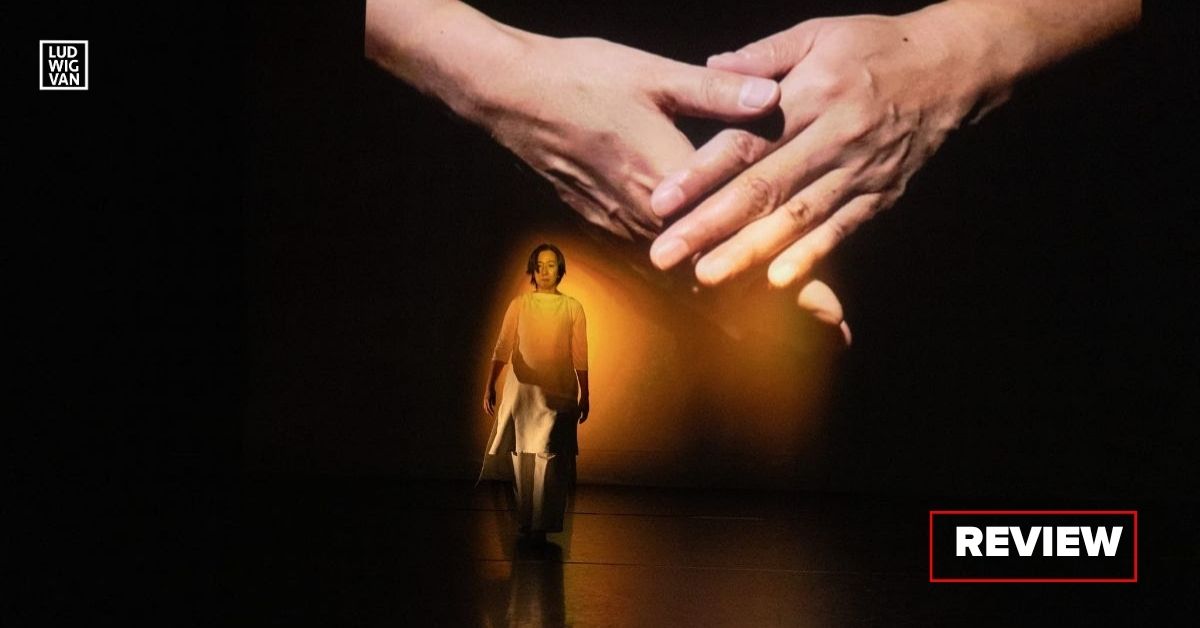
A Theatre Passe Muraille presentation of a Chisato Minamimura production London, England: Mark of a Woman by Chisato Minamimura. Artistic Director and Performer: Chisato Minamimura; Animation: Dan Chambers; Interviewees: Sonia Zambakides and Shuko Fujita. Theatre Passe Muraille Mainspace, May 22 & 23, 2026.
Before Mark of a Woman begins, production manager and lighting designer Jon Armstrong explained two things to the audience seated in Theatre Passe Muraille’s Mainspace.
The first was the purpose of the Woojer belts on our chairs, which, as the program notes, are haptic devices “designed to bring immersive, physical sensations to audio-driven experiences.” There was a track, Armstrong explained, that accompanied the one-woman show, so we would collectively feel subtle vibrations along the way, providing an additional sensorial dimension.
Having secured them around our waists or chests and successfully passing through a test run, Armstrong then instructs us how to say tattoo in sign language: by holding up a hand and using the index of the other to point to three different points on the backside of your forearm.
This gesture was integral to the show, he said, one that would recur over the next hour.
Addressing The Audience
That sense of directly addressing the audience continued when performer Chisato Minamimura arrived on stage in a flowy white outfit designed by Sophie Donaldson and — with a British-accented voiceover translating her sign — self-identifies as a “deaf Japanese woman” who herself has no tattoos, but suddenly became interested in them during COVID.
Her curiosity, she explains, led her to archives of the Wellcome Collection in London, where she encountered patches of skin with tattoos on them, a pile of which, under a glass display case, Armstong’s focused lighting draws our attention towards. It caused her to wonder “what they are, what they mean, and their origins.” Her findings make up the bulk of Mark of a Woman.
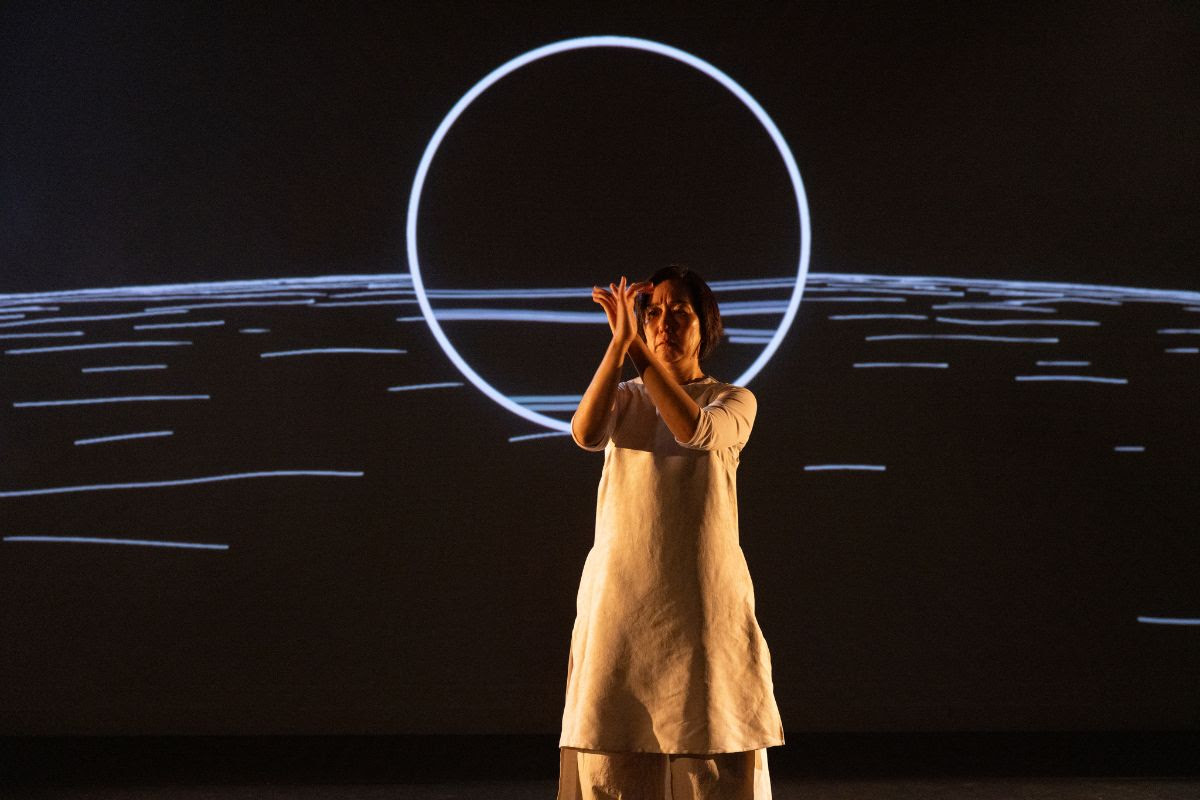
As well as the initially jolting but quickly distracting effect of the Woojer belts, which stir awake after the prologue, Minamimura primarily uses Visual Vernacular — a form of performance that mixes sign language, bodily expression and mime — to tell her century-spanning tales, which are accompanied by Dan Chamber’s animation projected on a white screen behind her.
The Tales
In one sequence, she depicts an 18th century colonizer’s journey at sea, animatedly looking through a telescope, walking in circles, the sun and moon rapidly switching places before finding Indigenous women whose tattoos intrigue them enough to be severed for the archives, the vicious horror translated through the belt’s vibrations.
Another re-imagines how the 19th century American circus performer Maud Stevens Wagner became the first Woman tattoo artist. The flickering title cards evoke silent films, and she paints a picture of the scene: a child lapping up an ice cream cone, smoke billowing from a pipe, and the plight of a woman pursuing her dreams.
A final section, rather than continue in this pattern of showing not telling, makes space for two different women’s perspectives on tattoos to be projected: Shuko Fujita, who honoured her ancestry by tattooing her hands in the indigenous Okinawa style, and Sonia Zambakides, who used tattoos to turn her body “from shame to a sense of pride” after surviving breast cancer.

Tattoos from a Feminist Lens
Within the container of the show, then, and using these various forms of technology, Minamimura creates a unique experience that views tattoos through a feminist lens, one that touches upon colonization and trailblazers before bringing us back to the contemporary world; to see the way that it continues to progress and provide different meanings for different people.
Yet, there was something about the execution of these intentions, so explicitly stated, that failed to make for a compelling, if not rare, show.
When Minamimura mimed, it was difficult to keep track of everything that she hurriedly attempted to bring to life, the various details less interesting than the whole. And, with such a niche subject, one would expect some depth beyond what can easily be found online, that the show might bear more insights to its subject than it does.
Final Thoughts
What it does is allow Minamimura to perform — as she reminds us again at the end — as a deaf Japanese woman, whose deafness, Japanese identity and womanhood is not equally as plumbed for us to understand, to actually feel her emotional investment in the subject at hand beyond the metaphor that it gestures towards. As when Fujita’s interview plays, she sits on a chair with her back to the audience and watches the footage with them: a witness but never a participant.
“This is my mark,” she says of the show. “Here in this performance I have created for you.”
If it leaves a mark, it is one that is faint and fades fast. Like tattoos, it is of the temporary kind.
By Nirris Nagendrarajah or Ludwig-Van
Are you looking to promote an event? Have a news tip? Need to know the best events happening this weekend? Send us a note.
#LUDWIGVAN
Get the daily arts news straight to your inbox.