
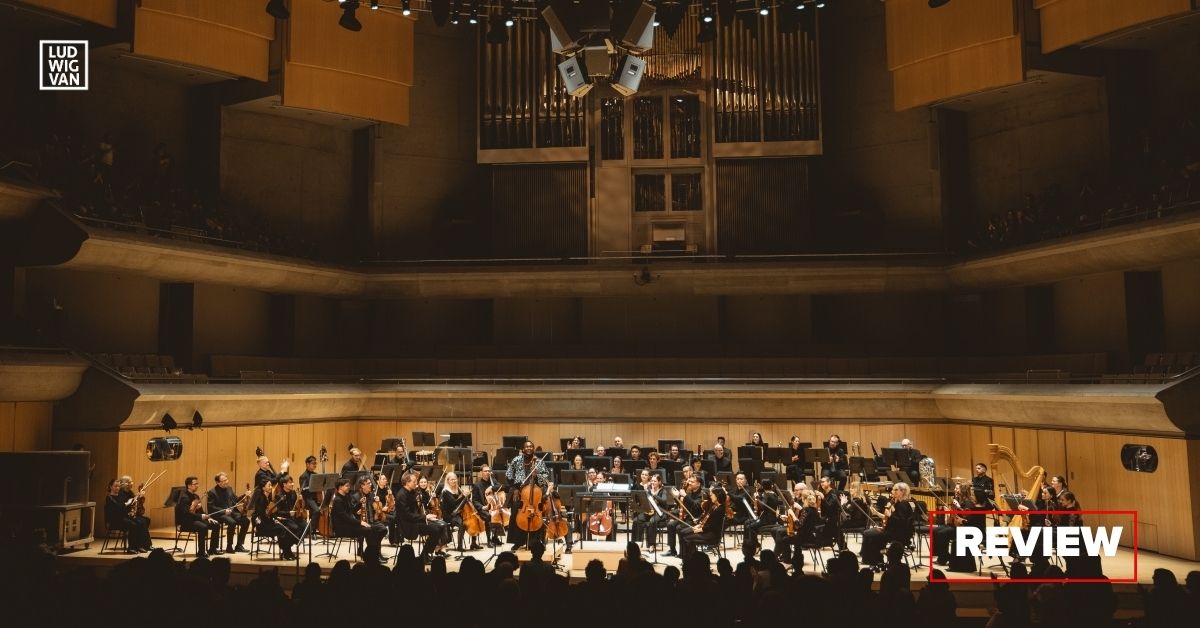
Toronto Symphony Orchestra: Epic Wagner — Legends & Lore. Jessie Montgomery: These Righteous Paths (North American Première/TSO Co-commission); Wagner: Overture to The Flying Dutchman; Wagner: Suite from Götterdämmerung, with Gustavo Gimeno, conductor & Abel Selaocoe, cello.May 14 to 16, 2026, Roy Thomson Hall.
“The spirit of listening is what we need,” the South African singer-cellist declared from the stage, greeting his Toronto audience with warmth and disarming sincerity.
Listening to his music-making was certainly a thrill; but we listened no less avidly to the message behind the music. This may have been Abel Selaocoe’s debut with the Toronto Symphony Orchestra, but it will surely not be his last appearance in the city.

Jessie Montgomery: These Righteous Paths
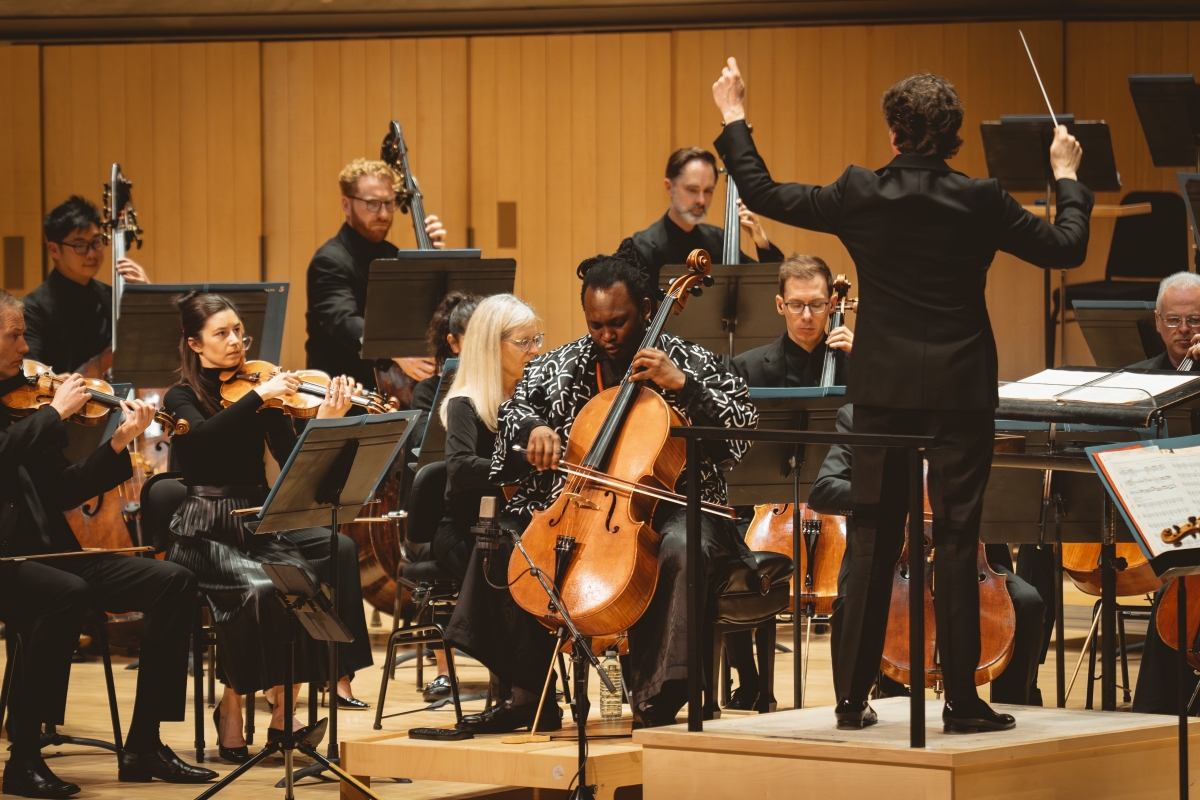
The evening opened with the North American premiere of Jessie Montgomery’s These Righteous Paths, a three-movement work for cello and orchestra, written for Selaocoe and probably not performable by anyone on earth other than him.
To all appearances a concerto, that term would be too restrictive for what unfolded. Inspired by the poetry of the composer’s mother, Robbie McCauley, who died in 2021, the work also draws upon the Ghanaian concept of Sankofa — the necessity of looking backward in order to move forward. It does so with the persuasive force of an oratorio.
Montgomery introduced the work herself, reciting fragments of the poetry that shaped it. Yet no contextual framing could truly prepare the audience for the experience of the piece. These Righteous Paths feels less like a work merely performed than one born through the soloist — a living organism that gradually absorbs orchestra and audience alike into its breathing body.
The first movement begins deceptively conventionally, with a passionate cello soliloquy that could almost belong to a late-Romantic or mid-20th-century concerto. But, the music soon slips the surly bonds of inherited genres into something more fluid and hypnotic. Selaocoe begins to sing simultaneously with his cello line, his voice shadowing and extending the instrument’s timbre, while delicate xylophone punctuations lend the texture an almost suspended, weightless quality. The music never pursues ecstasy for its own sake; rather, it unfolds as a kind of elevated stream of consciousness, inward and searching.
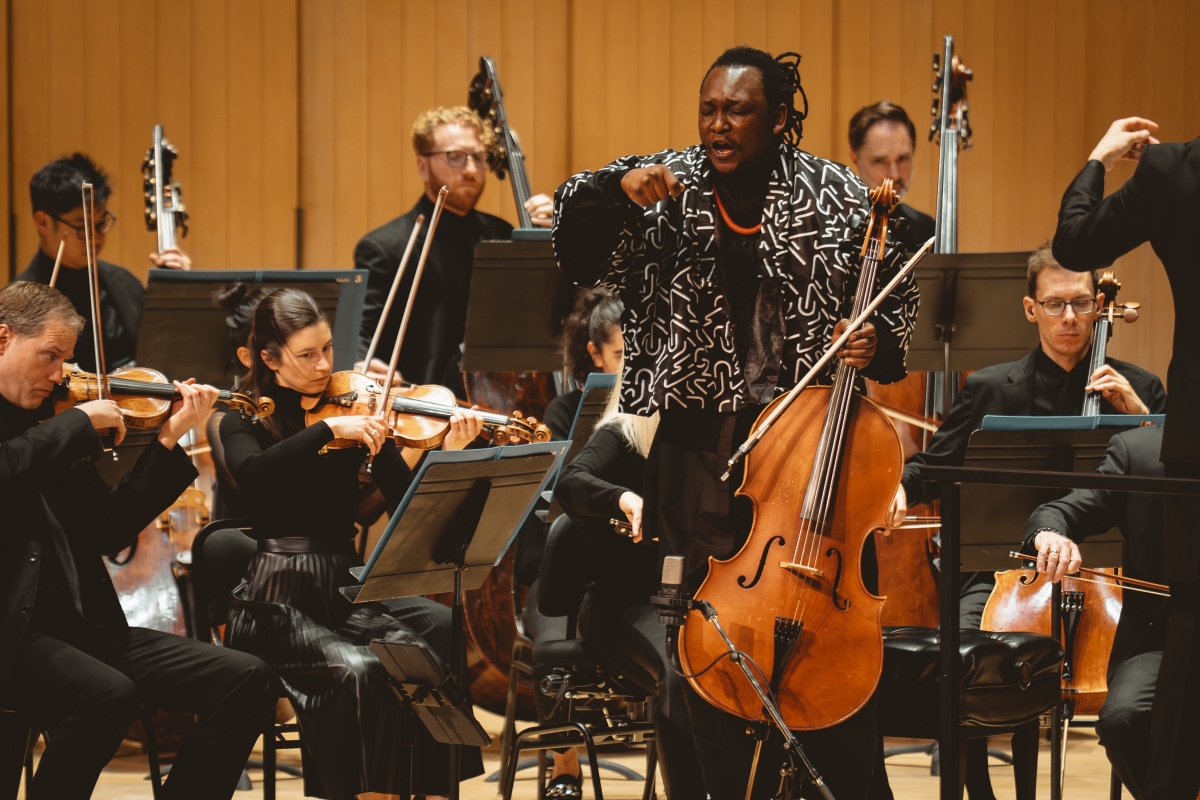
The second movement introduces ritualistic rhythmic energy. Here Selaocoe’s physical presence became inseparable from the music itself: scat-like vocalizations, percussive bow strokes, and an almost dance-like embodiment of rhythm transformed the music into a total body experience. A cadenza-like passage formed a bridge to the final movement, “A New Song,” fittingly described by Montgomery as the emotional heart of the work.
At first, the finale’s stillness suggested a Bachian sarabande, refracted through the meditative soundworlds of a Jan Garbarek or a Bobby McFerrin. But, gradually another force emerged: prophetic, elemental, deeply spiritual.
The orchestra began to breathe as though animated by a single lung. Selaocoe’s throat singing — guttural, primal, seemingly drawn from some ancient collective memory — dissolved the distinction between ritual and performance, and between geographical boundaries. By the end, only his voice remained. Selaocoe rose from his chair and simply invited us to listen.
This is an astonishingly open-hearted work, elevated by a musician who increasingly seems less an “artist” in the conventional sense than a conduit or prophet. Sincerity, as any follower of new music will attest, can all too easily miss its mark. But Montgomery and Selaocoe’s collaboration hits the bull’s-eye.
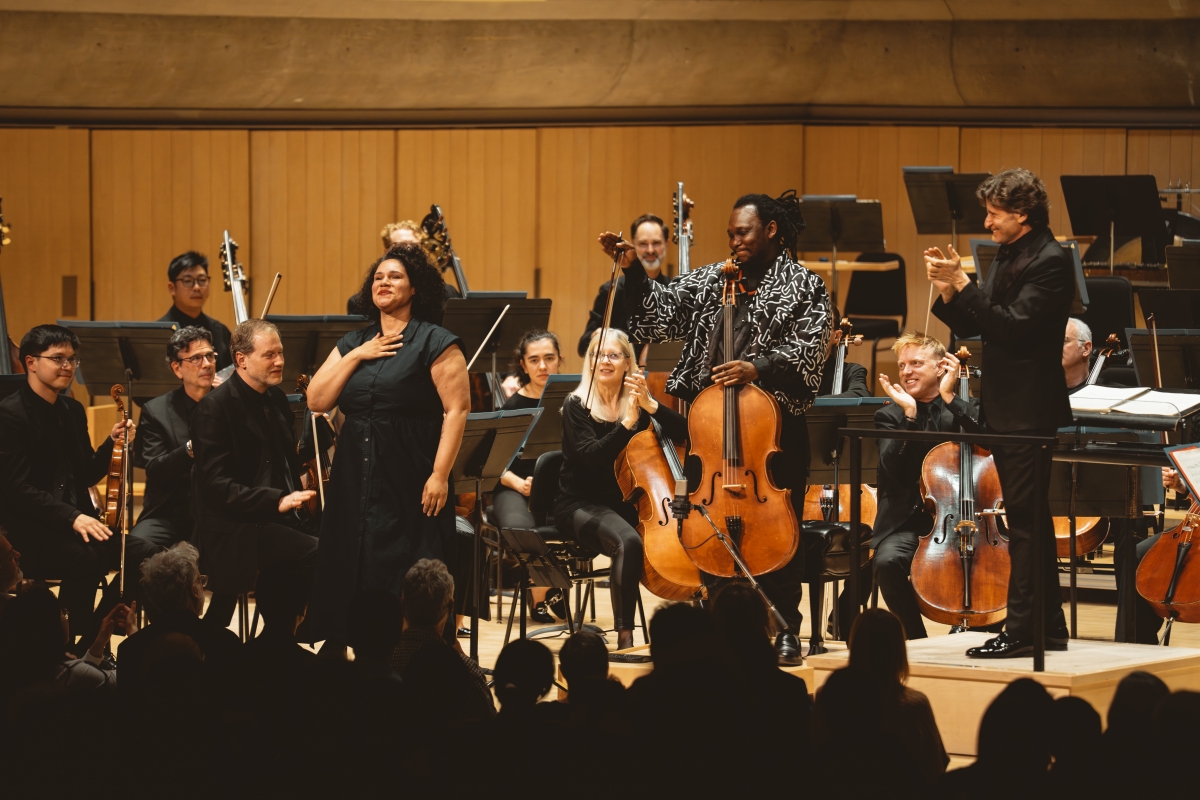
Selaocoe’s encore extended his communion with the audience and orchestra still further. In a semi-free improvisation, we found ourselves singing together, intoning words half-heard, perhaps even unknowable. Their literal meaning seemed irrelevant. They felt like and invocation of freedom, or perhaps of something beyond language altogether.
The Toronto audience listened intently and — to judge from its ovation — received the message gratefully.
Wagner
It was difficult to imagine how even Wagner could follow such a transformative experience. Yet as Gustavo Gimeno launched into the storm-tossed opening of the Flying Dutchman Overture, the connection gradually became clear.
If Montgomery’s work was in some sense a concerto with words, then the evening’s final offering — Lorin Maazel’s orchestral distillation of Götterdämmerung from his Ring Without Words — became, conversely, an opera without them.
The enlarged orchestra itself was already visually imposing: nine horns, four of them doubling Wagner tubas, alongside four harps and the rest to match, contributed to a stage picture of almost overwhelming abundance.
But, for all the sonic grandeur available to him, Gimeno resisted empty spectacle. Instead, he sustained dramatic tension masterfully across the work’s symphonic arc, shaping the 30-minute architecture with remarkable clarity and patience. What emerged was not merely volume or orchestral excess, but an immersive experience: music that penetrated the body, vibrating through every nerve and cell and thus stirring the soul.
As Valhalla burned, the soaring redemption theme emerged not as triumph but as transfiguration.
Final Thoughts
After the spiritual intensity of Selaocoe and Montgomery’s work, Wagner’s final pages felt startlingly human: music not of power, but of surrender and reconciliation. On this evening the Twilight of the Gods went hand-in-hand with the Dawn of Humanity.
Are you looking to promote an event? Have a news tip? Need to know the best events happening this weekend? Send us a note.
#LUDWIGVAN
Get the daily arts news straight to your inbox.