
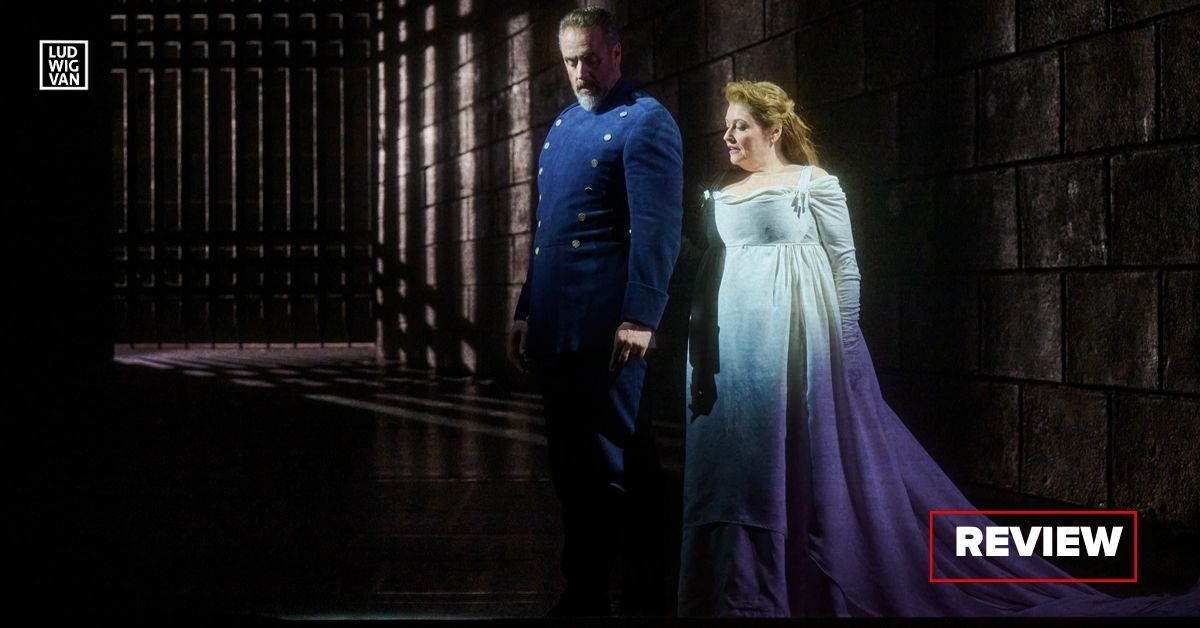
Canadian Opera Company: Bluebeard’s Castle by Béla Bartók & Erwartung by Arnold Schoenberg. Johannes Debus, Conductor, the Canadian Opera Company Orchestra; Robert Lepage, Original Director; François Racine, Revival Director; Michael Levine, Set & Costume Designer. With: Christian Van Horn, Bluebeard; Karen Cargill, Judith; Anna Gabler, The Woman. April 29, 2026, Four Seasons Centre for the Arts. Continues until May 16; tickets here.
Note: Bag checks and metal detector screening is now in effect, so give yourself ample time.
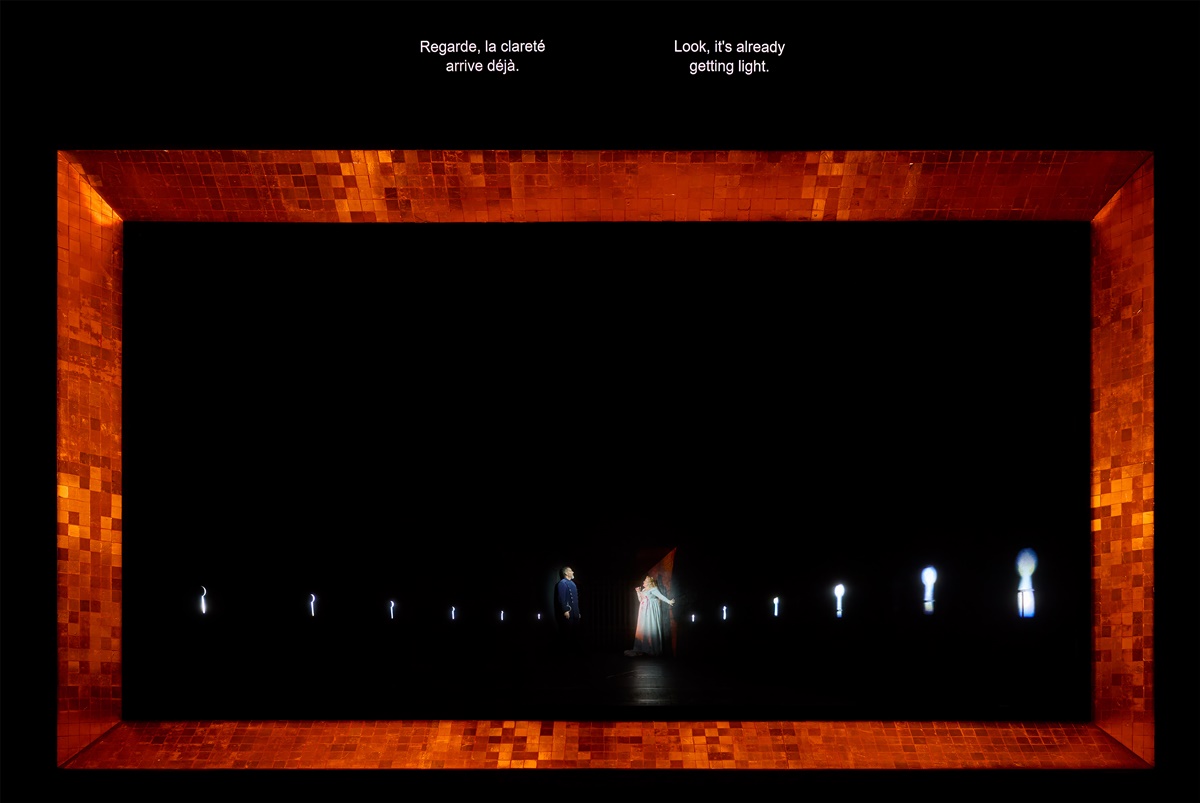
A golden frame greets the audience upon entry of the auditorium for the Canadian Opera Company’s double bill of Bartók’s Bluebeard’s Castle and Schoenberg’s Erwartung.
It serves as a striking visual metaphor for what is about to unfold. We are about to delve into the psyche of the characters on stage.
This pairing, directed in revival by François Racine from Robert Lepage’s original conception, presents itself as a cinematic exploration of psychology. If Bluebeard explores the dangers of probing another’s inner world, Erwartung traps us inside a world that is unravelling.
The connection between the two is compelling. The execution of this link, however, is less convincing.

Bluebeard’s Castle
Bluebeard’s Castle is a clear triumph.
Christian van Horn brings commanding gravitas as Duke Bluebeard. His voice is anchored and resonant, projecting authority and mystery. Opposite him, Karen Cargill’s Judith is gripping in her insistence. She navigates Bartók’s vocal lines with assurance, particularly when cutting through the orchestra’s denser textures.
Visually, the production is simply exceptional. It achieves a great deal with deceptively economical means. Robert Thomson’s lighting design functions as both architecture and psychology. As Judith unlocks and opens each of the seven doors, the light that floods into the cavernous hallway reveals the secrets: the metallic glint of the armoury to the glimmering of the treasury. An overwhelming blaze of the fifth door reveals the kingdom, supported by Johannes Debus and the orchestra, whose brass delivers a moment of glorious radiance.
The later scenes are especially effective. The lake of tears is rendered through shadow and reflection, with Judith’s shadow multiplied, a subtle foreshadowing of the final door.
By the end of this journey, the once-pristine gold frame has taken on green and teal hues, as though it has tarnished. This is a production where music, staging, and design operate in complete alignment, creating a unified and deeply affecting experience.

Erwartung (Expectation)
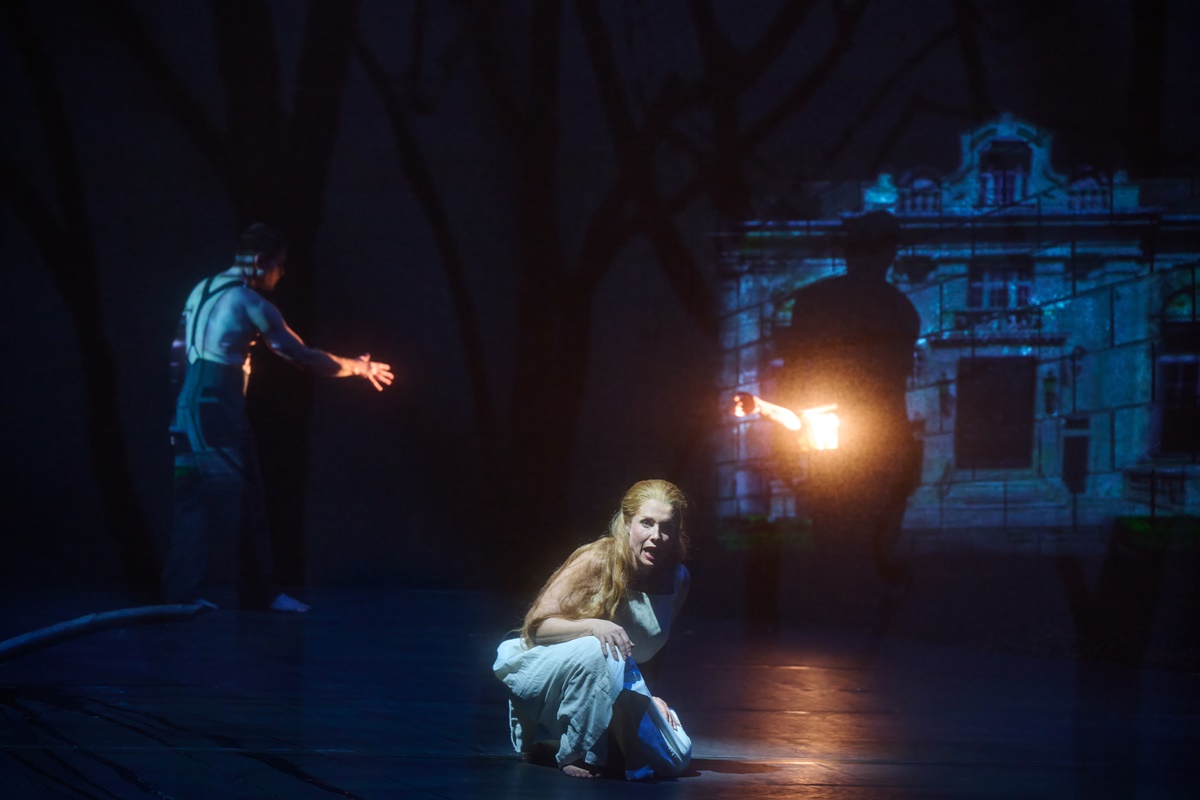
Schoenberg’s Erwartung shifts the focus inward. Anna Gabler, as the un-named woman, delivers a committed and convincing performance, navigating the challenging vocal writing while exploring the character’s psychological state.
The staging, however, complicates the balance. Three actors move through the space with striking physicality. Their movement is mesmerizing at times, but, for me, it pulls attention away from the singing.
In a piece where the musical language is challenging, the visual elements of this production made the score feel secondary. I wondered whether a more minimalist approach might have allowed the music, and subsequently Gabler’s performance, to carry greater weight. Alternatively, this may have been the point. A visual psychodrama that deliberately bypasses the music as the primary narrative force.
It is interesting to note that the program lists Erwartung as a monodrama in one act, as opposed to Bluebeard’s Castle as being an opera in one act.

A Pairing That Almost Connects
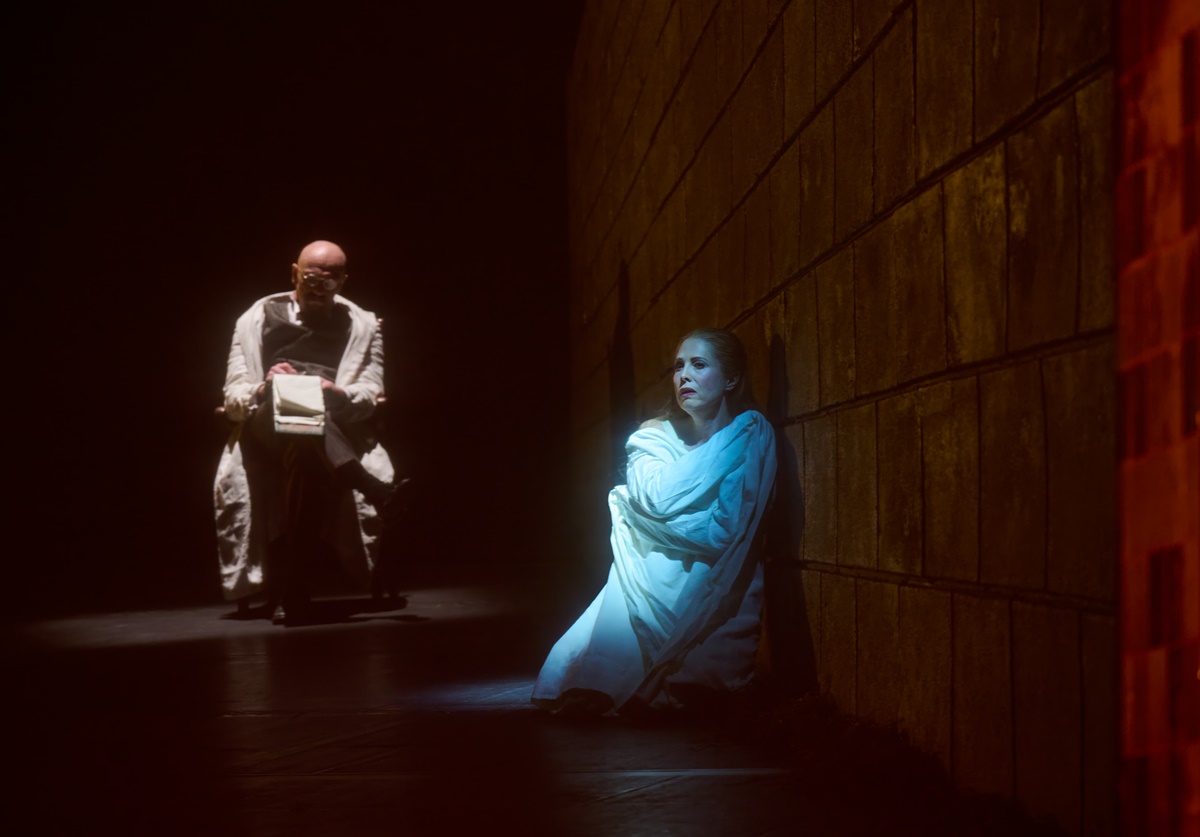
As a pairing, the two works make conceptual sense. Shared visual elements, the interplay of shadow and colour, the recurring image of the woman in white, all lead us to see these two as part of a single continuum. And yet, the dramatic arc does not land fully.
Placed after Bluebeard, Erwartung struggles to maintain the same level of theatrical delivery. It raises an intriguing question: what if the order were reversed?
Even so, the ambition of the evening is undeniable. At its best, it achieves a rare synthesis of music, staging, and design, drawing the audience into a physical and psychological landscape that is as riveting as it is unsettling.
By Albert Wong for Ludwig-Van.
Are you looking to promote an event? Have a news tip? Need to know the best events happening this weekend? Send us a note.
#LUDWIGVAN
Get the daily arts news straight to your inbox.