
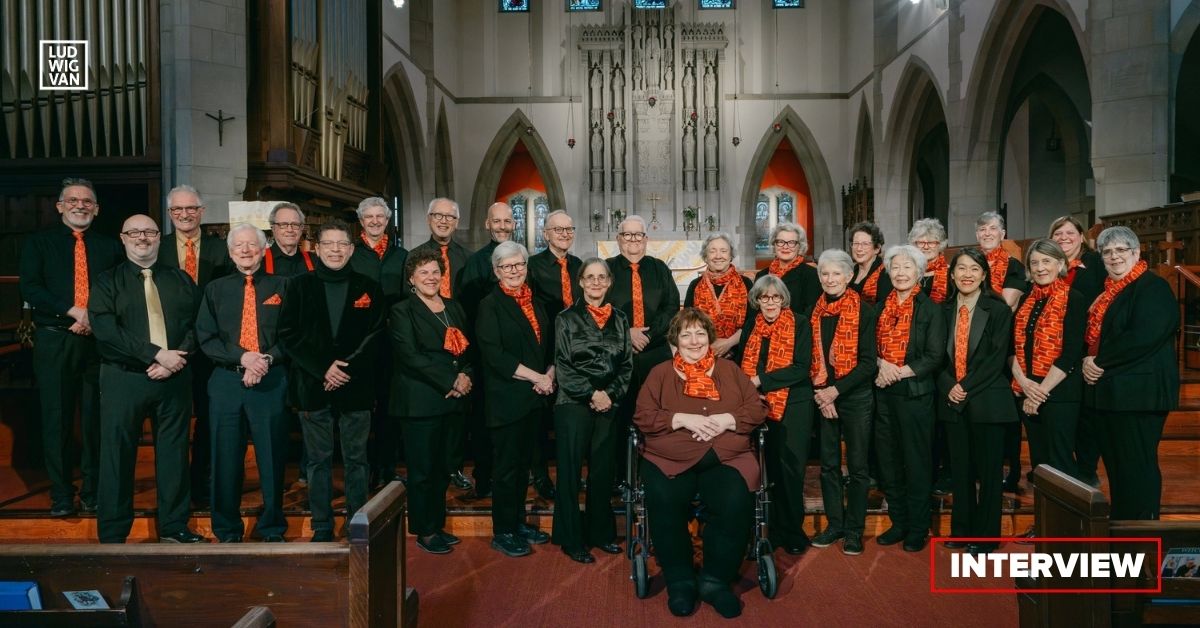
The Upper Canada Choristers will premiere a work by Artistic Director Laurie Evan Fraser at their next event. Common Ground is a six-movement work that Fraser wrote for the choir, and it’s the centrepiece of their spring concert.
Finding Common Ground: Where Music & Love Meet takes place on May 8 at Grace Church on-the-Hill. The choir’s Latin ensemble, Cantemos, is also featured in the program, with accompaniment by pianist (and Ludwig-Van contributor) pianist Hye Won (Cecilia) Lee, and guest oboist Karen Ages. Matthew Secaur and Ayako Ochi will conduct.
Along with Common Ground, rounding out the May 8 concert will be songs on the theme of empathy and understanding by Broadway composers Richard Rodgers, Lerner and Lowe, and others. Cantemos will perform Venezuela’s unofficial national anthem, Alma llanera (Soul of the Plains).
LV spoke to Laurie Evan Fraser and Jacqui Atkin, the choir’s Founding President, and one of the lyricists for Fraser’s Common Ground.
Laurie Evan Fraser & Jacqui Atkin: The Interview
Laurie Evan Fraser’s composition Common Ground was inspired by the writings of U.S. historian Dr. Heather Cox Richardson. Richardson is known for advocating for art as joyful resistance. Fraser dedicated the piece to Professor Richardson “for helping to keep us sane and hopeful in trying times”.
Evan Fraser comments in the introduction to the opening song of the collection, Seeking Empathy:
“Survival at its essence is meeting the basics to ensure life. Sometimes that is all we can manage but, if we can, we help those we love and those our loved ones love. The care ripples out. Then we don’t just survive, we thrive.”
Fraser strongly connected with Richardson’s message about art as an antidote to the troubled world we live in.
“I don’t know anybody who has not been very concerned with the world situation that’s going on,” Fraser says. “We started following some of her work. I found it very illuminating and helpful,” she adds.
What resonated in particular was the way Professor Richardson connects her message, and the current state of world affairs, with a historical context. Seeing how the dire situations of the past have improved over time offers hope.
“But then there’s this growing group of people who are saying, what is it that we can do about it?” Laurie asks.
Richardson’s words offered more than hope; they offer a way forward. “It will be the artists among us who make progress first,” she says. Playwrights, poets, musicians, visuals arts and others can play a crucial role by offering inspiration.
“So then, I started thinking, what does it mean personally to me?” Fraser wondered. “I’ve got two poets in the choir that I can work with.”
Jacqui Atkin, who co-founded the choir with Fraser, is a regular collaborator.
“We’re very much in accord philosophically,” Fraser says. A member of Cantemos, Venezuelan-Canadian tenor Jacinto Salcedo, is also a poet. “I started talking to them, the end of June, the beginning of July,” she recalls. “I said, I think we need to write a multi-movement work.”
Fraser says that, after that discussion, Salcedo wrote two complete poems in a single night.
Six Movements
The piece begins with an evocation of the struggles of life. “I can’t work any harder, I can’t give anymore. What can I do?” Fraser details. “I particularly drew my inspiration from my father, who had been involved with the coal mines in Pennsylvania,” she says.
Her father had told her horrific stories about the dangerous working conditions he’d had to endure just to survive and get through life. But, improvement is always possible.
The opening movement is modelled in terms of form after a type of French song. The idea builds with the addition of each voice. “The basses are just focused on work,” Fraser explains. The tenors come in, offering a more hopeful message. “It seems like a really good place to start with it.”
Salcedo wrote the lyrics for the second movement. “He was inspired by a picture of the children of Gaza at play,” Laurie says. It’s titled Niño de nadie, Niño de todos (Nobody’s Child, Everyone’s Child). “It’s a very poignant and visceral movement about the reality of innocents caught in wartime.”
Fraser wrote the music for those lyrics for the Cantemos basses and tenors to sing against an oboe obligato.
“The third movement, also in Spanish, was inspired by the story of a man, a non-registered immigrant in the United States, who wanted to attend his daughter’s graduation,” Fraser says. It’s titled Sin Fronteras (Borderless).
“The Latin American culture is so different form ours,” Fraser says. “They celebrate life, no matter what is going on. They retain that spark of life.”
The movement is written in the form of a waltz. “I was clearly inspired by Jacinto’s text, but it’s the man and his wife dancing together.” It’s an a cappella movement where all the singers join in.
“The fourth movement is Come As You Are,” Laurie says. She notes that, as a common colloquial expression, we don’t always think about what the meaning behind it. “The choir is very diverse, so it’s sung in several languages,” Fraser adds. That includes English, Spanish, French, Tagalog, Japanese, and Swedish. “[The phrase] could be translated to other languages,” she says.
“One of the interesting things was, I wanted an Indigenous perspective, so I reached out to Indigenous [artists], and they said, ‘we don’t have a translation for that’.” The idea of not coming as you are, in other words, is completely foreign to Indigenous cultures. “It’s what they fundamentally believe, not a slogan.”
It underscored the realities of trying to connect with Indigenous communities. “A lot of work needs to be done to understand what we’re all saying.,” she says. “It’s a rich and rewarding work, but you have to want it, and you have to listen carefully.”
The fifth movement revolves around the theme, Joy Commeth in the Morning. It’s a non-denominational concept, but Fraser says that many choristers recognized Buddhist and other spiritual beliefs in it. “There are more things that we share than separate us,” she notes.
That, of course, is the underlying theme that runs throughout Common Ground. “Hopefully it makes it more accessible to everybody. The message is, underneath it all, we all want the same things. We all want a good life.”
Fraser says that the fifth movement is a musical expression of what makes people happy, and includes some solo passages, some highly rhythmic passages, and some spoken parts.
The final and sixth movement, Bless the Day – a Reflection, refers back to the previous movements. It begins with the basses, and has a reflective character, but not like a hymn per se, in keeping with the overall message of the work.
“And then at the very end, there’s a quote from the oboe from the second movement,” she says.
Choir As Community
The English-language movements feature poetry by Jacqui Atkin, who was equally inspired by the theme.
“I firmly believe that if we can all stop and listen to each other — [while] we might not all agree — we have a better chance of going forward without a lot of the incredible stuff that’s going on right now,” Atkin says. “We started this choir to do community work, but the community is hurting right now.”
“Jacqui and I have written several things, and the intent was to help the issues, whatever they might be, and encourage healing,” Fraser adds. “And it’s been remarkably successful. Responses from singers and audience members to previous works like this — the response has been really gratifying,” she says.
Even within the choir, music was used to bridge gaps.
“Music has incredible healing powers,” Fraser says.
She notes that the Upper Canada Choristers often perform at a Ukrainian long term care home in Toronto. After the war in Ukraine began, the choir added a Ukrainian piece to their repertoire.
“As we sing it, we can hear them singing in their rooms and down the hall. There’s a connection there, and a feeling of deepened understanding.”
In the modern era, however, new and renewed conflicts seem to spring up almost every day.
“We’ve gone form one conflict to another. It seems like there isn’t a part of the world that isn’t affected,” Laurie says. “It inspired what we do.”
Concert Details
Finding Common Ground: Where Music & Love Meet takes place May 8 at Grace Church on-the-Hill (300 Lonsdale Road). Tickets can be purchased to attend in-person, and children aged 16 and under are admitted free when accompanied by an adult.
The concert also streams live via the choir’s website. While there is no charge, donations are gratefully welcomed.
- Find show details and tickets [HERE].
- The concert can be streamed on the choir’s YouTube channel [HERE].
Are you looking to promote an event? Have a news tip? Need to know the best events happening this weekend? Send us a note.
#LUDWIGVAN
Get the daily arts news straight to your inbox.