
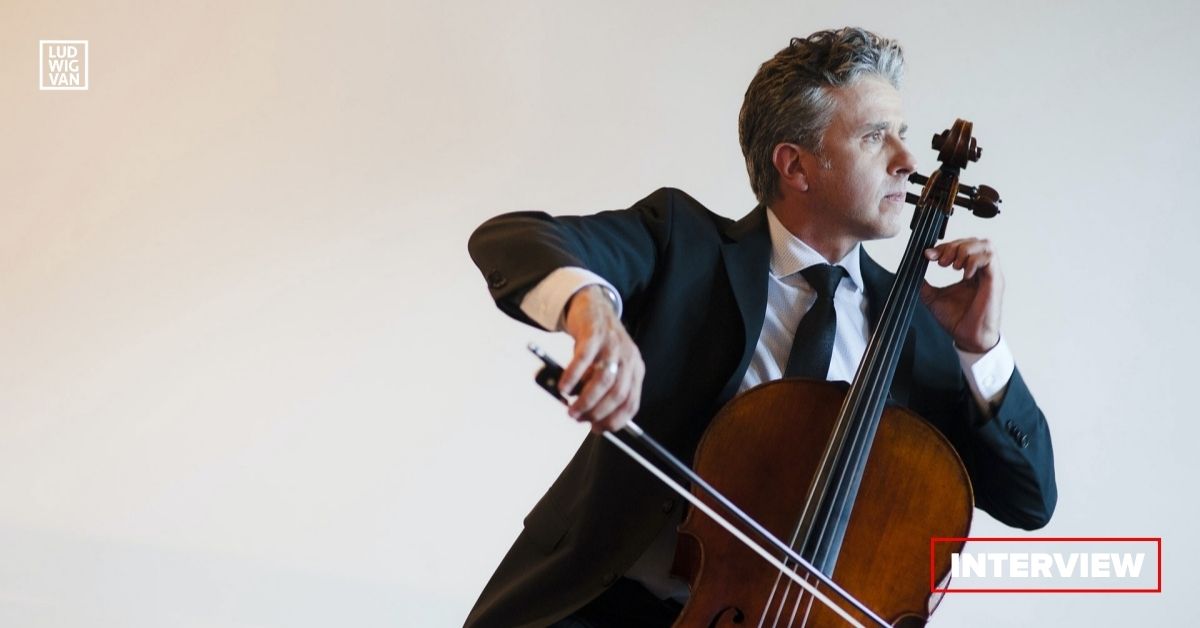
The artistic and executive director of Music Toronto since 2024, Roman Borys is an award-winning cellist and producer.
Borys is a founding member of the Gryphon Trio, a three-time JUNO winner for Best Classical Album. As the artistic director of the Ottawa Chamber Music Society from 2007 to 2020, he organized the highly successful Ottawa Chamberfest every summer as well as year round concerts, educational and community initiatives.
At Music Toronto he and the Gryphon Trio are involved in a multitude of cultural events and multi-disciplinary activities.
One of Borys’s early initiatives at Music Toronto is COSE (Celebration of Small Ensembles), which is now in its third year. He shared his thoughts about the new edition of COSE with Ludwig Van.
RB: Roman Borys
LV: Ludwig Van writer Marc Glassman
LV: Roman, let’s talk about COSE (Celebration of Small Ensembles). What is it and what do you want to achieve?
RB: COSE is an opportunity to introduce newcomers in the music business to Toronto audiences. I choose people in early career ensembles, who are starting to play works professionally, having finished with school.
The idea is to present two ensembles, each in 45-minute sets, on a Saturday afternoon. The invitation to them comes with some direction from me, and that is that they’re supposed to curate a program of short works. I am presenting an opportunity for them to create a mash-up of things, to tell a story, come up with a musical arc. It gives them a chance for artistic growth.
LV: What’s the room like where COSE takes place?
RB: The venue for COSE is very beautiful and really unknown to most audiences. It’s called the Aperture Room, and it’s the top floor of the Thornton Smith building, which used to be the home of Toronto Camera. For a long time, if you’re from the city, you knew where that was. It had a classic yellow sign with black letters, which was part of the landscape of downtown Toronto. It’s just a couple of blocks north of Yonge and Dundas, near TMU.
The room is fantastic. It has restored brick walls, beautiful oak floors, huge skylights, and it’s quiet. It has a beautiful acoustic and gorgeous skylights. You look to the east and see a row of windows. You know that Yonge Street is down three floors, but you rarely hear it at all.
The venue has stackable chairs. We can get as many as 120 people in the room for our concerts. There’s a bar where people can get wine. It’s very sociable. I bring in a smaller Steinway for concerts, which fits in the elevator. And I encourage the audience to talk to each other. The room has a comfortable atmosphere.
The building’s owner is Ken Rutherford, who inherited it from his dad, the owner of Toronto Camera. Ken has spent a lot renovating that building. He cares deeply about life in the core of the city and wants to generate momentum behind the idea of making the whole culture and streetscape economically viable and positive.
LV: Are you trying to achieve something with the audience as well as the players on these Saturday afternoons?
RB: Many people don’t realize is that we’re using the same formula for COSE that caused the foundation for chamber music in the first place. It’s a salon. The only difference is that there isn’t anybody from the audience jumping up, grabbing a cello and saying, ‘Okay, let me play this Haydn piece with you right now.’
I like the fact that Salad King, the Thai restaurant, is just one floor down. After the concert, inevitably a whole crowd goes downstairs to take over a couple of those tables, have a nice meal, and continue their conversations. Other people head off to other concerts.
LV: COSE 2026 kicks off on May 2. What can we expect to hear and see?
RB: We’re going to start with Trio Timia, which consists of June Lee, violin; Francois Lamontagne, cello; and Itamar Prag, piano. They’re from the Schulich School of Music in Montreal and have been playing together for quite some time. Trio Timia have been chosen to compete in the Osaka Chamber Music Competition later in May so their entire program will consist of movements from the pieces they’ll perform in Japan.
We’re calling their program On the Way to Osaka, and it will feature works by Schubert, Mendelssohn, Beethoven, Martinu, Kagel and Takemitsu. I’ve heard them recently and they’re in excellent form. Some of the pieces are quite unique, especially the Takemitsu.
LV: You’re going to follow up with Duo Chromatika (Julia Mirzoev, violin and Russel Iceberg, violin and guitar). Their program is called Off the Page, which you call “a genre-blurring program of reimagined works, contemporary pieces, and improvisations that move freely across classical and jazz traditions.” Can you tell me more about the musicians and the program?
RB: I’ve been hearing positive things about Julia over the course of her years as a student at the GGS (Glen Gould School) and, Russell, I’ve learned about through Julia. He’s also a GGS graduate.
You know, I have my channels! I pay attention to what’s going on — which students are coming through the Rebanks (Family Fellowship and International Performance Residency Program at The Royal Conservatory’s Glenn Gould School) program. Those are the kind of people that really need as many stepping stones as we can offer them. When I was at Banff, we had a program there that was called Evolution Classical, which was designed specifically with the needs of the early career artist in mind.
I’m just painfully aware of what happens to young musicians: they go to the conservatory, they go to the universities, they make your way through programs, and they kind of get on that classical music conveyor belt. But, nobody along the way is actually really talking to them about audiences.
Everything outside those classical music institutions is changing at such an impossibly fast rate. Eventually, young musicians have to come out into the world. They start looking around and increasingly, they’re discovering that they have to be entrepreneurial. They begin to realize that being a hustler is a good thing. That’s true even in chamber music. They have to go out there and make things happen using digital media and promotion. To be successful, they need to develop audiences.
LV: What can we expect from Off the Page?
RB: I was sitting in earlier today as Tom Allen was working with him. Tom is a great mentor for these groups. He focuses on what are they’re playing and they relate to each other in a program. What I heard were jazzier pieces that were riffing of Django Reinhardt and Stephane Grappelli, the great guitar and violin duo from pre-WW2 France. Russell plays violin and guitar, and Julia is, of course, the main violinist. Her father studied at the Moscow Conservatory. So, she comes from a very formal training background. Their material is quite varied. We’ll be hearing compositions from Bach to Bologne to Oscar Peterson.
COSE 2026 continues with concerts on May 30 and June 27, both at 4 p.m. at the Aperture Room. The May 30 event focuses on cellist Joanne Yesol Choi, who recently won the Canada Council for the Arts Virginia Parker Prize. She will be presenting A Voice Becoming: A Journey in Music and Words, which features narration and music on her own life and artistic development. Choi will be accompanied by Chris Au, pianist, and the Dior Quartet (Noa Sarid, Astrid Nakamura, violins; Ronen Shifron, viola; Joanne Yesol Choi, cello).
On June 27, Gentileschi Baroque (Christina Prats-Costa, violin; Lucas Harris and Jonathan Stuchbery, lutes; Nagmeh Farahmand, percussion) present A Journey Through Iberian Baroque, which surveys Spanish music from the 16th through the 18th centuries. From the Baroque the event moves to contemporary times, concluding with Echo Chamber (Aaron Schwebel, violin; Leanna Rutt, cello; Dakota Scott-Digout, piano) accompanying mime Trevor Cop in Five Postcards from Canada, a combination of music and physical theatre.
Tickets & Details
Music Toronto presents COSE (Celebration of Small Ensembles). May 2, May 30, & June 272026, 4-6 p.m. at the Aperture Room (3rd Floor, 340 Yonge Street).
May 2 Program:
Trio Timia (June Lee, violin; François Lamontagne, cello; Itamar Prag, piano) playing movements from: Beethoven’s Piano Trio in E-flat major, Op 1 No. 3; Kagel’s Trio No.2; Martinu’s Piano Trio No. 2; Schubert’s Piano Trio in B-flat major, D. 898; Mendelssohn’s Piano Trio in C minor, Op. 66; Toru Takemitsu’s Between Tides.
Duo Chromatika (Julia Mirzoev, violin; Russell Iceberg, guitar, violin) playing Bach’s Partita in E major; Bach’s Gavotte: Joseph Bologne’s Sonata No. 3 in A Major for Two Violins; Lila Wildy Quillin’s Calligraphy for Violin Duo; Tamas Ittzes’s Selections from 12 Jazz Violin Duos; Reinhardt and Grappelli’s Django’s Tiger; Reinhardt’s Nuages; Oscar Peterson’s Why Think About Tomorrow?; Reinhardt’s Minor Swing.
- Find concert details [HERE].
- For tickets, email tickets@music-toronto.com
- Find out about Music Toronto’s 2026/27 season [HERE].
By Marc Glassman for Ludwig Van.
Are you looking to promote an event? Have a news tip? Need to know the best events happening this weekend? Send us a note.
#LUDWIGVAN
Get the daily arts news straight to your inbox.