
Alex Pauk, the music director and conductor of Esprit Orchestra consistently comes up with fresh compositions for his audience of contemporary devotees.
This Thursday’s concert at Koerner Hall (April 23, 2026) combines pieces by top European composers Paul Ruders — most famous for his opera The Handmaid’s Tale — and the late Tristan Keuris, with works by Canadian Chris Paul Harman and the young British songwriter Ben Nobuto.
Harman and Nobuto have written multiple pieces that respond to the sounds and issues of modern times: pop tunes, the Internet and video games. Both have sophisticated musical educations in the UK, Harman from Birmingham and Nobuto from Cambridge, and know how to use their knowledge of classical structures and forms into the creation of groundbreaking new works.
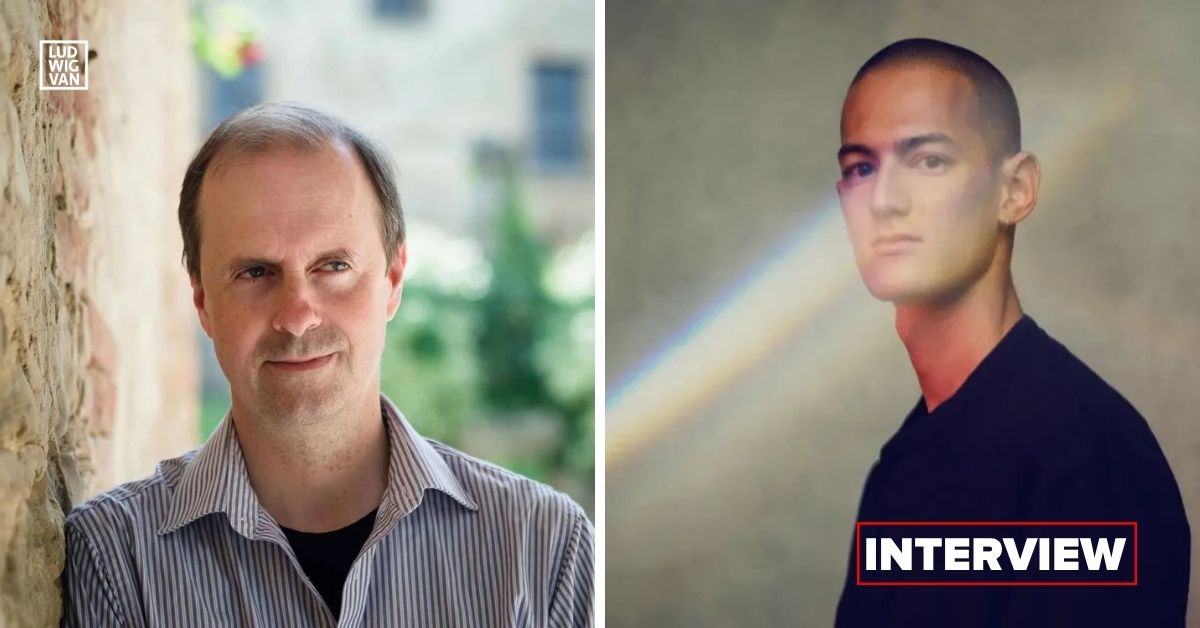
Ludwig Van interviewed Nobuto and Harman separately during the week preceding the concert.
Ben Nobuto’s Hallelujah Sim at Royal Albert Hall in 2024:

Ben Nobuto: The Interview
Ben Nobuto is a 30-year-old British/Japanese composer who first achieved acclaim in 2021 for Serenity 2.0, a piece which combine J-pop, Ted Talks and Vlogs with Baroque music.
In 2024, he hit the British stratosphere in terms of recognition with Hallelujah Sim, which premiered on the Opening Night of the Proms. Esprit will be performing that piece on Thursday, in its first appearance in Canada, with the Elmer Iseler Singers & Concreamus replacing the BBC singers as the vocalists.
Nobuto was happy to recall what it was like to create Hallelujah Sim, an extraordinary piece that combines the structure and sounds of video games with vocal celebrations.
“It’s probably the biggest commission you could ask for as a British composer. It’s a special occasion in the sense that while most of the people in the Royal Albert Hall on the first night of the Proms do listen to a lot of classical music, some just turn up. I felt that I needed to find a way to speak to lots of different people.
“I think a lot about making music accessible and enjoyable. I find myself seeking that balance between being completely uncompromising and achieving everything I want musically but also helping the listener along — to take them through something that by the end feels really meaningful. Not just, what the hell was that? It was very stressful actually putting Hallelujah Sim together.
“They were doing a piece by Bruckner on the program. I was thinking about that and the hallelujahs, the amens — that sense of occasion and grandness. Trying to work with the cultural baggage of that but filtered through the things that I enjoy in music. So, seeing that tradition through a lens of modern fragmentation and technology.
“Initially the idea was that I would just write a piece for chorus and something else. So, like choir and electronics or choir and percussion and [the Proms commissioners] kind of left it quite open. I think they were just expecting a fairly short piece. And then I asked whether I could add strings, and they said, sure. And I asked whether I could add percussion and they’re like, yeah, that’s fine. One by one I just kept adding until it turned into a piece for the whole orchestra. I realized they would all be on stage anyway.”
Ludwig Van asked him he decided to use video games in the piece. Nobuto replied, “It’s a structure that everyone knows now. In Mozart’s day, you had the sonata form, you had theme and variations — pre-made structures for music that composers used and listeners would have been familiar with, as well. There would have been a shared understanding of where the musical direction is going.
“In modern music, we don’t have those structures anymore. So, we have to find our own ways of creating expectation. Using video game levels is a really simple idea, which even a child can understand while gradually progressing the complexity of the piece.
“When I compose, I start with a broad concept. For Hallelujah Sim, I started with the sound of choirs and video games. I used a collage style which is endlessly rearrangeable. It’s like Lego blocks only with musical scores.”
Ben Nobuto will only meet Alex Pauk and the Esprit Orchestra this week. Chris Paul Harman, on the other hand, has known Pauk and the Orchestra for decades.
Esprit Orchestra and soprano Shannon Mercer perform the world premiere of Chris Paul Harman’s …with silver bells and cockle shells.. in 2020:

Chris Paul Harman: The Interview
“I met Alex Pauk in the late 1980s in Toronto after attending an Esprit concert,” he recalls. “Our first extended conversation took place while seated together (by happenstance) at a New Music Concerts event in early 1990 at what was then the Premiere Dance Theatre.”
He’s very happy to work with Esprit. “There are many musicians in Esprit with whom I have worked for many years (in some cases, more than 30 years). These musicians know my music quite well and believe in what I do. This familiarity creates mutual trust when we rehearse. Additionally, Esprit Orchestra, through the broadmindedness of its artistic director Alex Pauk, has given me the flexibility (more than any other orchestra) to work with unusual instrumentations, thereby allowing for a considerable degree of experimentation.”
One of Harman’s most popular pieces, Coyote Soul, is a reconsideration of Burt Bacharach’s pop classic Close to You, most famously performed by The Carpenters.
He recalls about his composition, “Bacharach was a classically-trained composer who wrote songs that challenge conventions of tonal music (conventions of melody and harmony and temporal organization). The main melody of Bacharach’s Close to You is very angular and emphasizes predominantly upward motion. This itself is a radical reconsideration of the archetypical well-balanced, goal-oriented Classical melody. You might say that I sought to transfer these elements of Bacharach’s melody-writing to the melodic and textural contours of Coyote Soul.”
Harman, who teaches at the Schulich School of Music at McGill University is pleased to talk about his compositional style and how it has changed over the decades.
“I often start with music by other composers (e.g., Bach chorales, concert music, popular music) and extract essential elements (melodic material, harmony) that I can transform. Some of this is worked out mentally, some of it at the piano, and some of it at the computer (particularly if the rhythmic elements are complex).
“In the late 1980s and early 1990s, I wrote derivative music based on works by composers such as Lutosławski, Penderecki, Ligeti, Schnittke, and spectral composers such as Gérard Grisey or Tristan Murail. In the mid 1990s, my friend James Rolfe introduced to me the idea of transforming other composers’ music; whereas James’s approach relied on chance operations, my approach was more intentional. For the next ten years, through to the mid-2000s, I sought to transform tonal music into atonal (or serial) music, and at the same time, moved away from a continuous music flow to something more segmented.
“Since the 2010s, my music privileges tonal-music derivates and musical flows that are alternately continuous or discontinuous. Beginning in the late 2010s, a series of solo or chamber works emerged that might be broadly considered “neo-classical.” And in the last years, I have begun to work more conceptually with extra-musical topics in interdisciplinary musical frameworks as in …we no longer worship at the alter [sic] of Beethoven…, a piece that explores the contemporary reception of Beethoven’s music using text, pre-recorded fixed media audio files, and a diverse array of percussion and keyboard instruments.”
The works of Ben Nobuto and Chris Paul Harman are as different in their own ways as are the pieces by Tristan Keuris and Paul Ruders. What holds them together is a desire to experiment while creating new music for contemporary listeners. Esprit’s goals fit snugly into the disparate pieces by these exciting composers. Once again, Alex Pauk has created an exciting program for Toronto audiences.
Concert Details
Esprit Orchestra presents Hallelujah Sim on Thursday, April 23, 2026 at Koerner Hall.
Program: Chris Paul Harman: Coyote Soul (2011); Chris Paul Harman: Blur (1997, rev. 2017); Tristan Keuris: Sinfonia (1974); Ben Nobuto: Hallelujah Sim. * (2024) (Elmer Iseler Singers & Concreamus, vocal ensembles); Poul Ruders: Tundra* (1990); *North American premiere
- Find tickets and concert details [HERE].
By Marc Glassman for Ludwig Van.
Are you looking to promote an event? Have a news tip? Need to know the best events happening this weekend? Send us a note.
#LUDWIGVAN
Get the daily arts news straight to your inbox.