

David and Hannah Mirvish & Roast Productions/Cyrano by Virginia Gay, directed by Clare Watson, CAA Theatre, closes Apr. 5. Tickets here.
In the hands of Australian writer Virginia Gay, the French classic tragedy Cyrano de Bergerac has been turned into a romantic comedy with a gender twist and overall, it works.
The Original
Cyrano de Bergerac, written by Edmond Rostand in 1897, is a sweeping epic in Alexandrine verse with more than one hundred speaking roles. It feels as though it belongs in the company of Racine and Corneille, yet it is in fact a late 19th century triumph written in classical style.
In essence, Cyrano, burdened by an overlong nose, compensates for what he believes are ugly looks with brilliance of language and skill as a swordsman.
He loves his cousin Roxanne, but she loves the handsome soldier Christian, who lacks the words to woo her. Cyrano becomes Christian’s ghostwriter. When Christian dies in battle, Roxanne mourns for years, and only at the end, when Cyrano is dying, does she realize that the letters she treasured were Cyrano’s. It is one of the great sorrows of the theatre.


The Update
Gay takes that kernel and reshapes it.
We still have Roxanne (Madeline Charlemagne), still have the handsome beloved, now called Yan (George Ioannides), and still have Cyrano as the wordsmith.
But here, Cyrano is a woman, and a gay woman at that (Eryn Jean Norvill).
The nose remains, though no prosthetic is used. It is spoken into existence. Gay even writes a modern equivalent of Rostand’s famous nose soliloquy, cataloguing all the ways one might mock such a feature. It is clever and very funny.
While Gay’s script is not in verse, the rapier wit remains. If you delight in words, you will be drawn in to the language of the play. The heart of Rostand’s original is preserved — the intoxicating exchange of words between Cyrano and Roxanne, and the tragic beauty of borrowed speech.
This adaptation compresses the epic scale into six performers and a 90 minute structure, but it does not lose the spirit of the original. The central device of Cyrano supplying Yan’s words, and the sparring brilliance between Cyrano and Roxanne, remains intact.
The Chorus
The structure introduces a three person chorus whose members function as narrators and commentators — two are seasoned figures who know Cyrano well (1 and 2, Mona Goodwin and David Tarkenter), while the third (3, Mackenzie Gilbert) is a new recruit who asks logical questions and often acts as audience surrogate.
Gay cleverly folds aspects of Rostand’s secondary characters such as De Guiche, Le Bret and Ragueneau into this trio.
At times they speak together, steering the story; at other moments they splinter into distinct personalities. It is an economical and intelligent device.
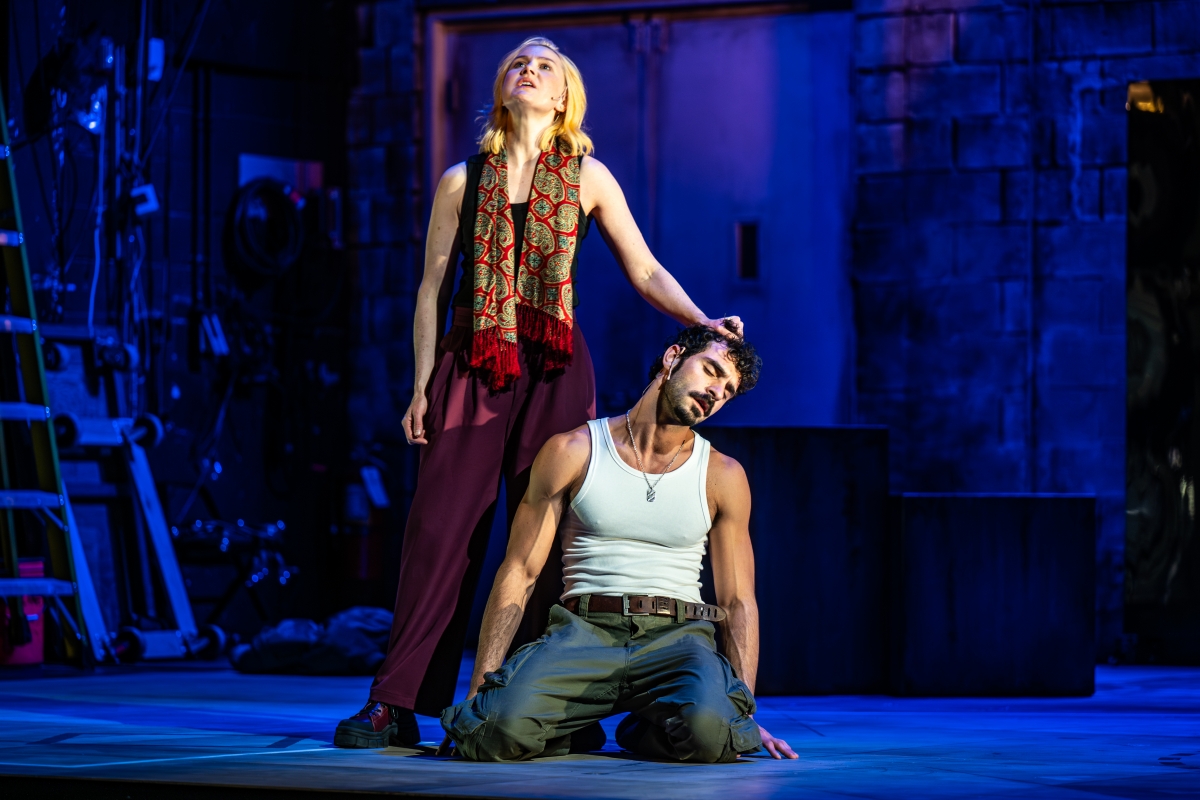
The Cast
The production begins slowly, with the chorus addressing the audience directly, and acknowledging the theatre itself and its important role.
It is a halting start and the only real misstep of the evening. Once Cyrano makes her entrance, however, the play finds its rhythm and never looks back.
Norvill gives a superb performance as Cyrano.
She is swaggering and overconfident in public, alpha male in her dealings with Yan, yet utterly vulnerable in the presence of Roxanne. The shifts are precise and deeply felt. She manages to be comic and tragic at once, and her delivery of the nose speech is a highlight.
Charlemagne’s Roxanne is elegant, intelligent and warm. She is witty and perceptive, though perhaps flawed in her insistence that physical beauty must be matched by eloquence.
Ioannidis as Yan is genuinely funny, initially playing the handsome cipher before revealing unexpected spirit and depth. His scenes with Cyrano, especially when he resists surrendering to her words, are among the evening’s most entertaining.
The chorus performers add texture.
Tarkenter brings dry realism and sharp humour. Goodwin offers warmth and steadiness while Gilbert, as the newcomer, injects curiosity and clarity. Together they provide momentum and commentary without overwhelming the central trio.
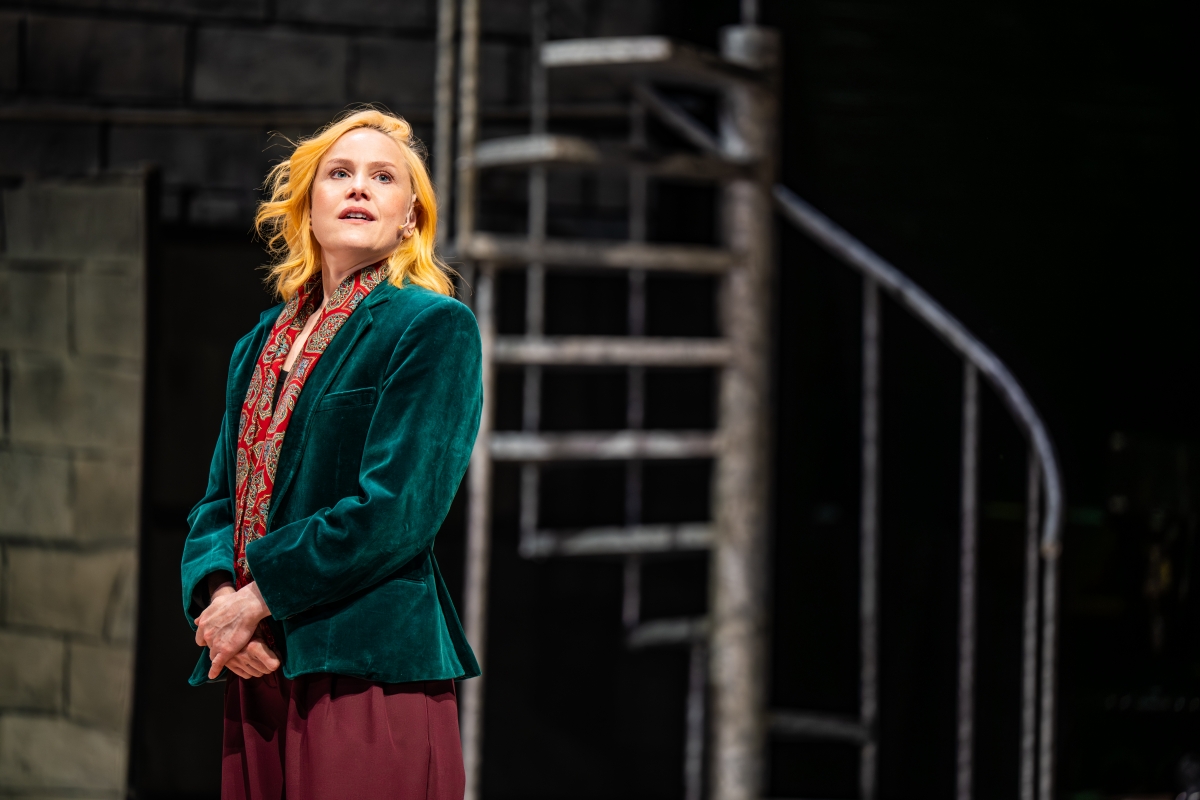
The Production
Staging is stripped back. A bare stage, mirrored panels, three numbered boxes for the chorus, and a curved ladder for Roxanne’s balcony suffice.
Costumes, also by Amanda Stoodley, are contemporary and unobtrusive. Lighting and sound are restrained.
The simplicity allows the language to dominate. There is even a playful immersive moment near the
end that involves the audience, though it is best left undisclosed.
Final Thoughts
If this is a romantic comedy, it is one that honours its source.
While Gay does not replicate Rostand’s tragic ending, she does preserve his devotion to language and longing. Her play is an homage rather than a parody. It proves that Cyrano can be reimagined without losing its beating heart.
It begins uncertainly, but once it takes flight, it soars on words. For lovers of language and intelligent adaptation, this Cyrano is well worth the visit.
Are you looking to promote an event? Have a news tip? Need to know the best events happening this weekend? Send us a note.
#LUDWIGVAN
Get the daily arts news straight to your inbox.