
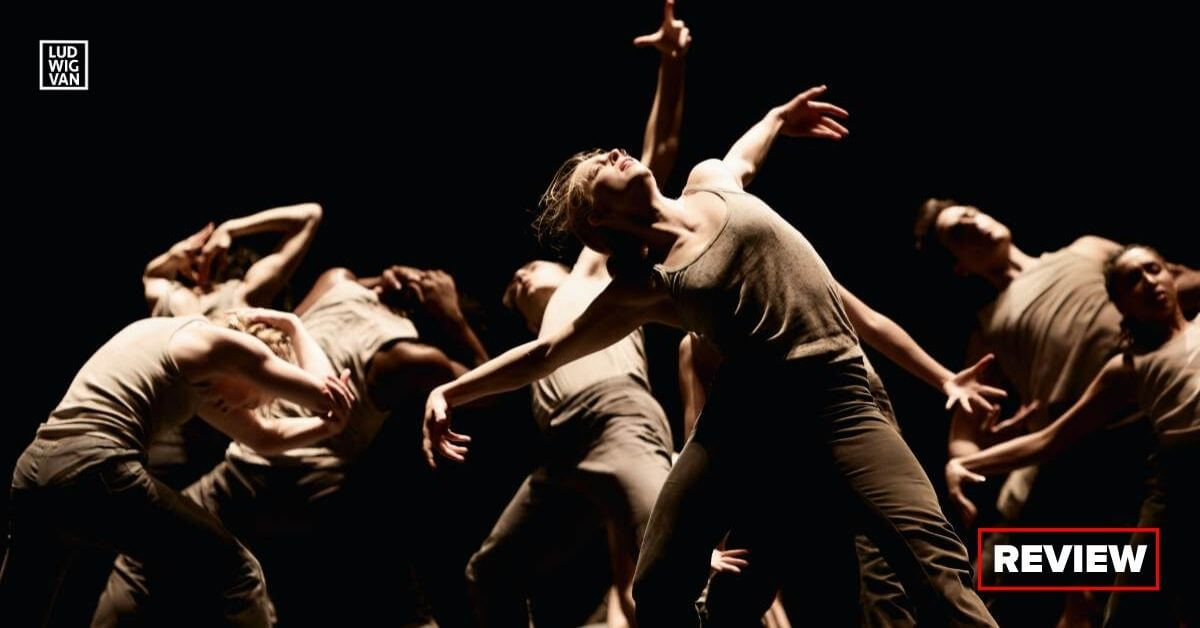
The National Ballet of Canada: Flight Pattern / Suite en blanc. Choreographers Crystal Pite (Flight Pattern) & Serge Lifar (Suite en blanc). February 27, 2026, Four Seasons Centre for the Performing Arts. Continues until March 6; tickets here.
The National Ballet of Canada’s first program of the winter season is an absolute knockout.
Pairing the do-rigueur classical showpiece with a major contemporary work, the company demonstrates both its stylistic purity and its emotional range. It is the kind of program that reminds you why this remains one of the finest ballet companies in the world.

Suite en Blanc
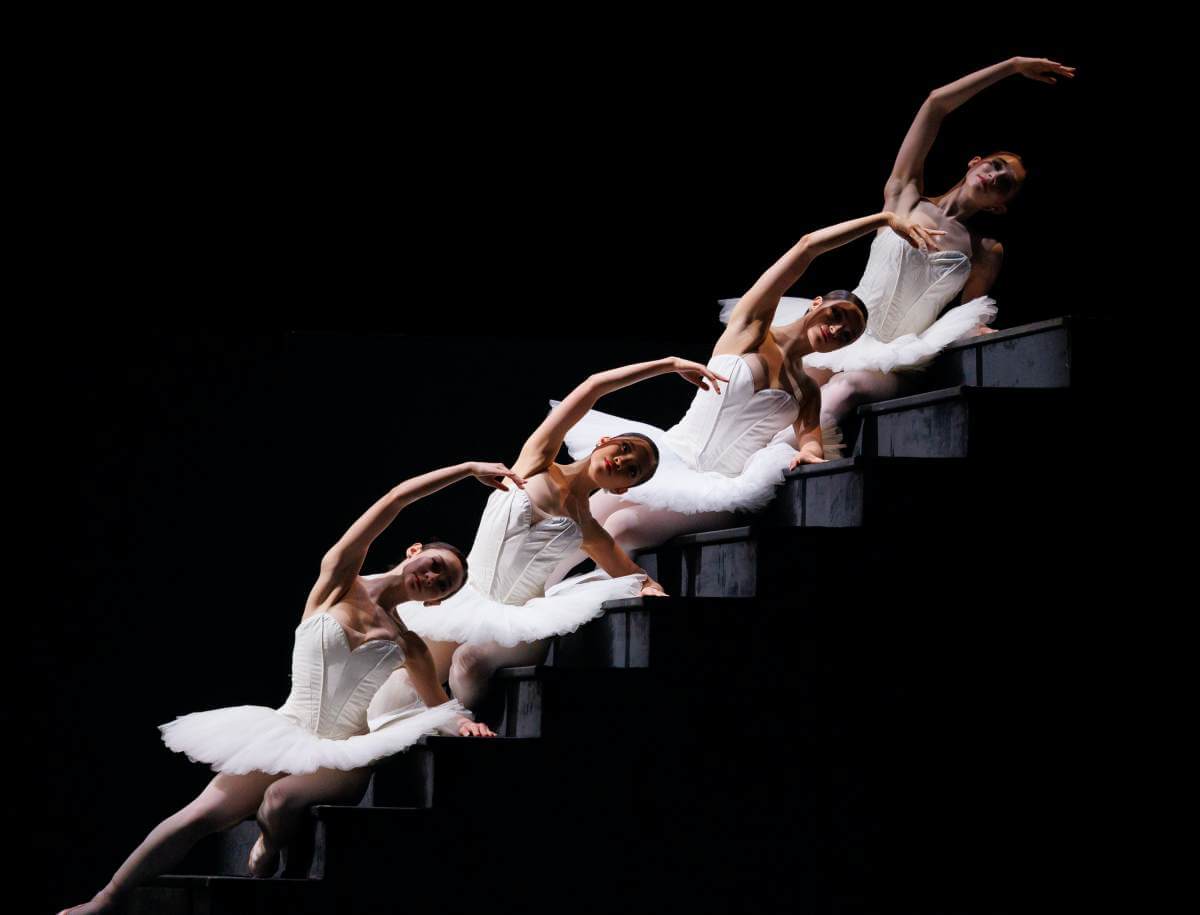
The evening opens with Serge Lifar’s Suite en Blanc, which entered the company’s repertoire in 2024. Two years on, the dancers have grown into it magnificently. Lifar famously said he created the work for no other consideration than pure technique, and it shows. This is naked classical ballet. There is nowhere to hide. One slip would be glaring.
Using music from Édouard Lalo’s 1882 ballet Namouna, Suite en Blanc is structured as a series of named variations — Mazurka, La Flûte, Serenade, Presto, La Cigarette — drawn from the original ballet. Yet nothing about it feels narrative. Instead, it is an architectural exploration of placement, pattern and technical brilliance.
On second viewing, the eccentricity of Lifar’s staging becomes striking. A raised platform dominates the stage, with staircases descending on either side. Dancers appear from above, from below, from the wings, sometimes running through an ongoing variation or crossing the upper level while another group performs below.
The ballet even begins with its final tableau, which slowly dissolves, leaving us to wonder how Lifar will reassemble it by the end. The unpredictability of entrances and exits gives the work a restless energy beneath its pristine white surface.

The music itself is surprisingly strange for ballet. Lalo’s score often sounds operatic — pompous, exotic, at times almost Asian in colour. There are martial rhythms, hints of distant steppes, echoes of Russian and Eastern inflections. It does not always sound like lyrical ballet music.
Under David Briskin, the orchestra delivered a sumptuous overture in darkness before the curtain rose, earning a strong ovation. At moments you feel you are about to witness grand opera rather than delicate classical choreography.
The dancers rose magnificently to the challenge. Agnès Su, one of the company’s new principals from Stuttgart, made a striking impression. Her duet with Christopher Gerty was beautifully controlled, her solo finely etched, and her partnering both secure and generous. With long, elegant lines and remarkable stillness en pointe, she revealed why she was such a prized addition to the roster.
Kota Ishihara never disappoints, dancing with refinement and assurance. Geneviève Penn Nabity and Isabella Kinch brought luminous precision to their variations. Beckanne Sisk and Chase O’Connell, both new principals from Houston, danced a trio with Peng-Fei Jiang that offered a welcome opportunity to see the newcomers alongside a dancer of Jiang’s charismatic presence.
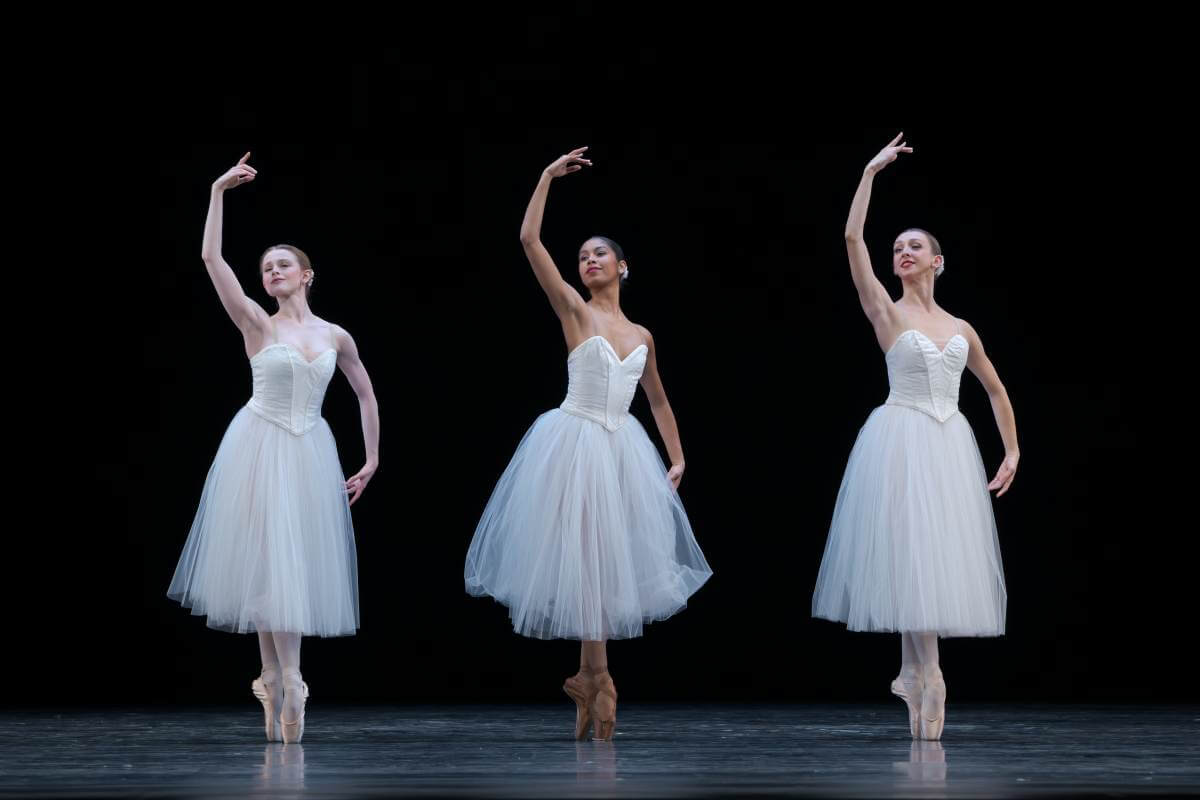
Three ensemble dancers — Kira Sanford, Tene Ward and Monica Haskewitz — performed a delicate trio in long, French-style skirts, Lifar’s homage to earlier ballet traditions before the shift to short Russian tutus.
Throughout, the corps was impressively in sync. The collective exactitude — particularly in passages where difficult steps were executed simultaneously — underscored how far the company has grown into this demanding work.
Flight Pattern
If Suite en Blanc showcases classical purity, Crystal Pite’s Flight Pattern reveals the company’s contemporary power. Created in 2017 for The Royal Ballet and now making its National Ballet debut and North American premiere, the one-act work is set to the first movement of Henryk Górecki’s Symphony No. 3, Symphony of Sorrowful Songs. The music’s lamenting melancholy provides an emotional undertow that is difficult to escape.
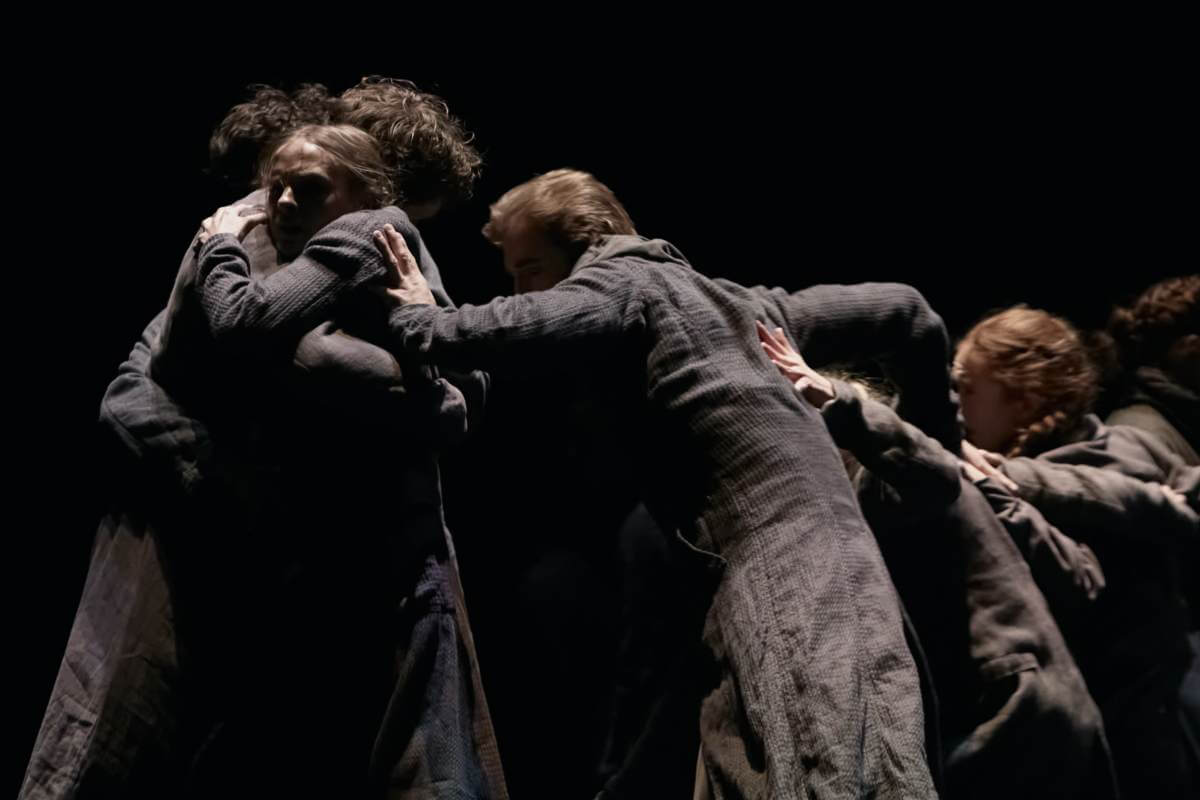
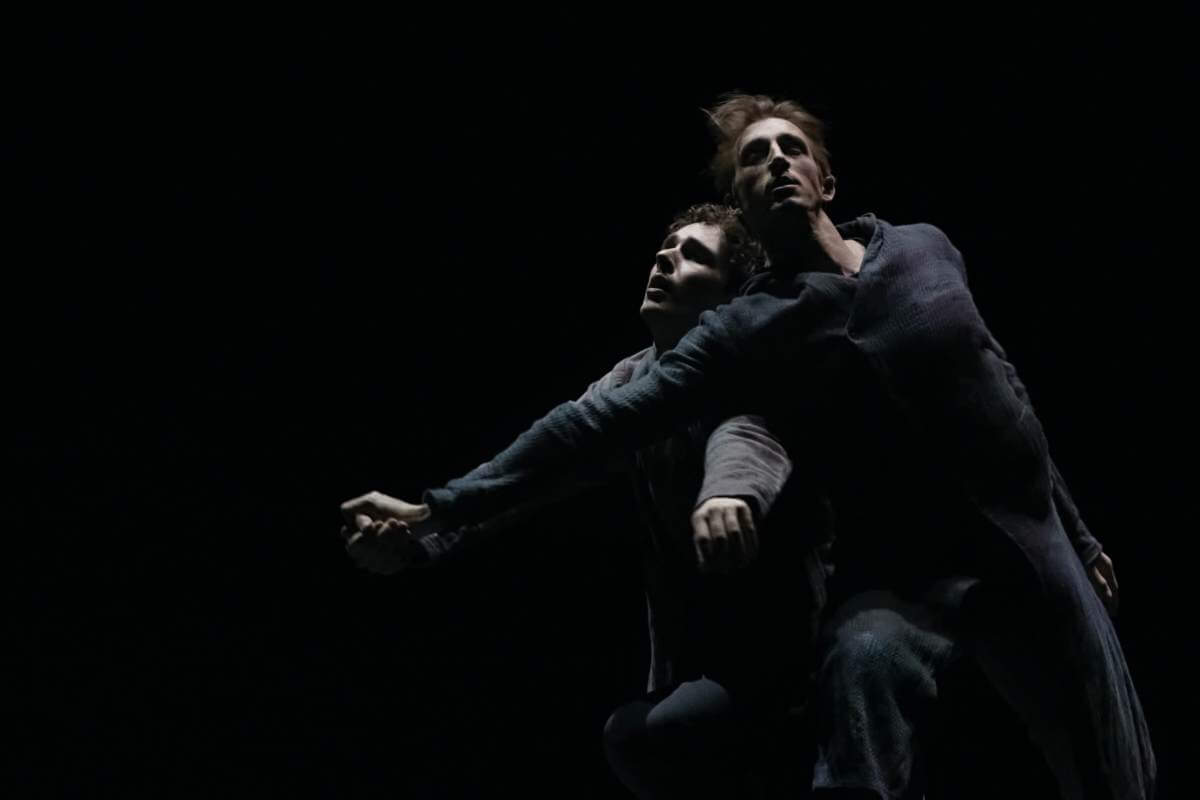
Pite’s title is deeply ironic. Instead of birds in coordinated migration, we see people in desperate flight. The ballet begins with a tightly woven mass of bodies moving in unified formation. As the lighting brightens, we see tattered coats and high enclosing walls. Gradually the formations fracture. Individuals break away. Coats become bundles. The group clusters, separates, regroups in broken patterns that mirror the brokenness of displacement.
Smaller ensembles emerge — Hannah Galway with Naoya Ebe, Ben Rudisin with Aidan Tolle, Christopher Gerty with Alexandra MacDonald, Geneviève Penn Nabity with Ben Rudisin — supporting, resisting and clinging to one another before being torn apart again.
Ultimately, the walls open and the larger group advances, leaving two behind. Galway sits with her back to the audience, shoulders shaking in silent sobs. Ebe’s final solo is ferocious, his body crashing and rising repeatedly until he simply reaches to touch her shoulder. The last image — two figures isolated before a narrow crack of light between towering walls — is heartbreaking.
The audience response was extraordinary. Cheers mingled with tears. One patron in the lobby was still openly sobbing after the curtain call. While I watched with more intellectual distance than emotional surrender, there is no denying the work’s power or Pite’s ability to capture the anguish of refugees and the displaced.
It is worth noting that Flight Pattern proved such a success in London that Pite later expanded it into a full-length work in 2022. The National Ballet has chosen to stage the original one-act version. Given the impact of this premiere, one wonders whether we might one day see the full-length incarnation here as well.
Final Thoughts
Together, these two works form a compelling statement. Suite en Blanc affirms the company’s classical strength and stylistic discipline. Flight Pattern demonstrates its emotional and contemporary reach. Hope Muir can take genuine pride in the depth and versatility of her dancers.
It is a winter program that begins the season with authority and leaves the audience both dazzled and deeply moved.
Are you looking to promote an event? Have a news tip? Need to know the best events happening this weekend? Send us a note.
#LUDWIGVAN
Get the daily arts news straight to your inbox.