

Soulpepper Theatre & NAC English Theatre co-production: Copperbelt, by Natasha Mumba. Directed by Nina Lee Aquino, with Eric Miracle (Musolo); Natasha Mumba (Eden); Rick Roberts (Peter); Warona Setshwaelo (Harriet); Makambe K. Simamba (Lombe); Kapembwa Wanjelani (Chimfwembe); Kondwani Elliott Zulu (Dalitso). February 10, 2026, Soulpepper Theatre. Continues until March 1; tickets here.
Ambition — the lack or abundance of it — is a dramatist’s goldmine.
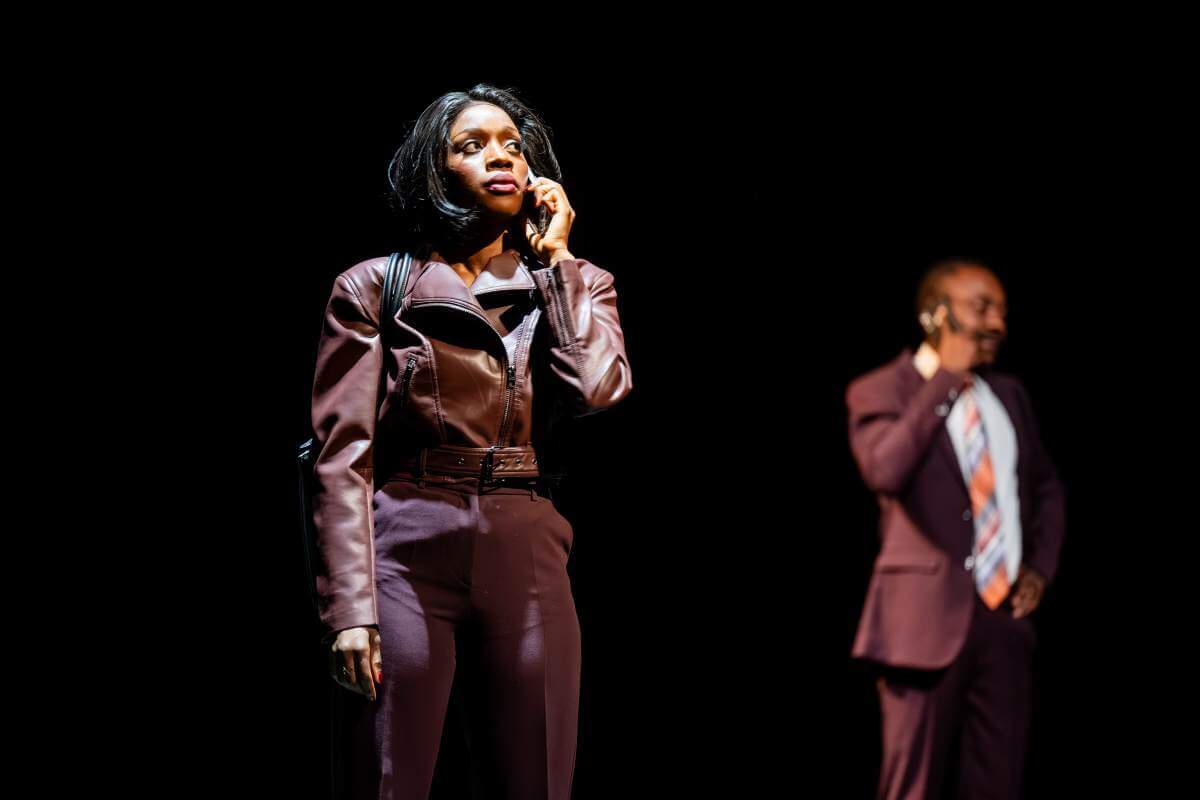
In Copperbelt, directed by Nina Lee Aquino and written by and starring Natasha Mumba, Eden (Mumba), a junior manager at an international mining firm, has been trying to make something of herself despite the systemic roadblocks in her way.

Story & Characters
When her father, mining tycoon Chimfwembe Kasuba (Kapembwa Wanjelani), suffers a heart attack, Eden is summoned back to the titular Copperbelt and the orbit of her estranged family. There, the play offers insight into the person she’s always been — going away for school, taking internships every summer, and fleeing to Toronto at the first chance, her private life kept hidden.
Part of that private life is Peter (the dashing Rick Roberts), Eden’s white boyfriend of three years. Their relationship is complicated by the fact that he’s her senior at the same firm, and doesn’t understand the difference between the support that she needs and he can provide.
At the end of Act I, his uninvited arrival in Zambia thickens the plot and destabilizes Eden’s already precarious balancing act, control over her life remaining forever out of reach.
It is their anxious-avoidant dynamic that opens and closes the play. As Eden stresses over whether a potential deal with “The Rising Sun” will materialize, Peter does everything in his powers to assure her that everything will be fine. When he pulls off her wig — eliciting the first of many gasps of the night — and nuzzles her neck, it’s the only time Eden lets her guard down.
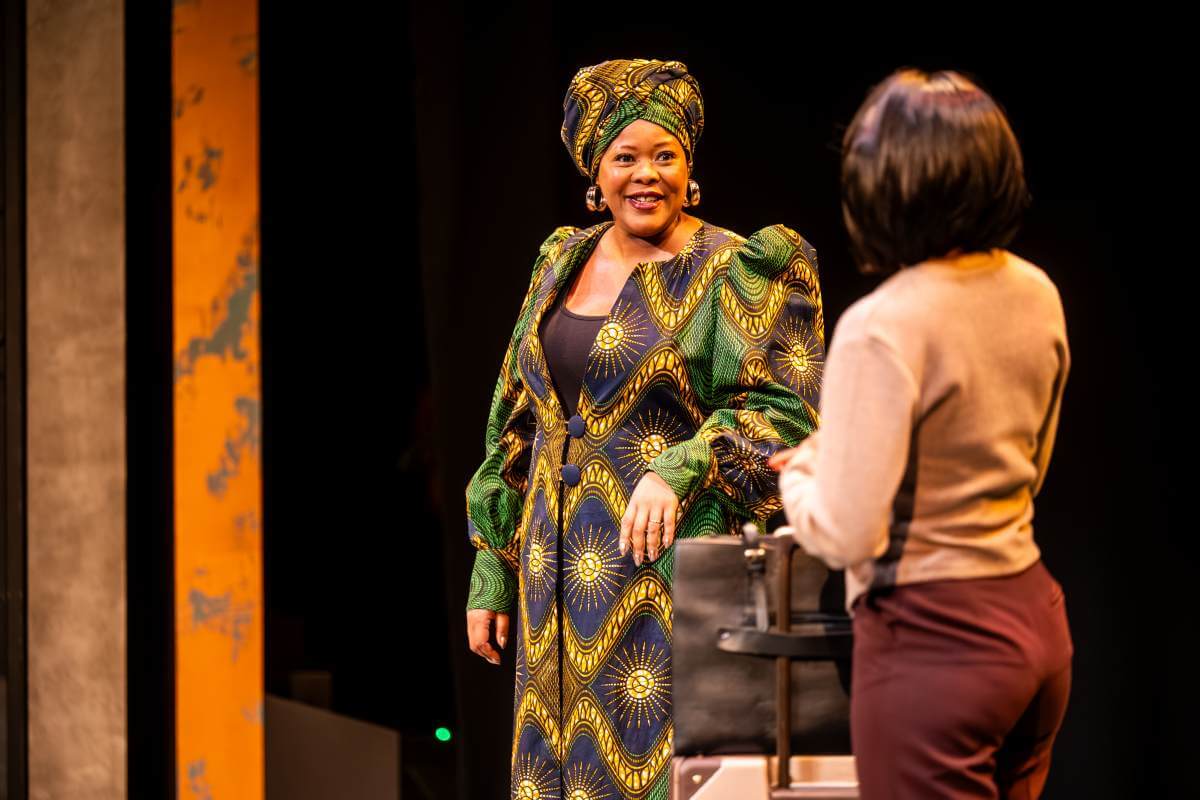
Otherwise, she wears her ambition like a shield against the world and the extreme privilege of the Kasuba dynasty she was born into. That clan includes the matriarch Harriet (Warona Setshwaelo), a closeted son Musolo (Eric Miracle), an influencer daughter Lombe (the hilarious Makambe K. Simamba) and her subservient husband Dalitso (a standout Kondwani Elliott Zulu).

Set and Themes
Rachel Forbes’ economical set design leaves the right half of the stage conspicuously empty. A series of sliding, rust-coloured doors and frames signal shifts in continents, rooms and, early on, flashbacks in Peter’s consciousness, amplified by Michelle Ramsay’s atmospheric lighting and Romeo Candido’s contemporary sound design.
The vacant spaces creates depth within any given scene, allowing Aquino to stage contrasts between Eden’s world and the world of her father — the only man who can make or break her, but whose love comes at a cost she refuses pay.
It is a burden she shares with her siblings: Musolo, whose uncontrollable shaking in a confrontation with the patriarch is genuinely concerning, and Lombe, whose internalized inability to leave the continent, whose culture she wishes to revitalize, brings her to tears.
No matter the lives they’ve made for themselves they cannot escape the patriarch’s chokehold, which is why a comparison to the TV series Succession and Dynasty resonate.
By centring its gaze on this family as a metaphor for larger geo-political tensions and confidently building the stakes around its outlier of a protagonist, Copperbelt, at 150 breezy minutes, becomes an engrossing, electric and exceptionally realized play. On opening night the audience kissed their teeth, gasped for air and erupted in applause at a character’s dramatic exit.
Just as Eden is caught between two countries (Canada and Zambia), two languages (English and Bemba, which goes untranslated), and two men (Peter and her father), the play also operates in two modes — on the one hand, the minutiae and jargon of the mining industry and the future of relations between Canada and Africa, and on the other, the matters of the heart.
Final Thoughts
Mumba has said that she began writing this play, co-produced by the National Arts Centre and Soulpepper Theatre, as a love story, but that over time it grew as she included this globalized dimension, but, I would argue, that the original essence remains. Not concerning the couple, but about one woman’s journey towards self-love and acquiring agency on her own terms.
The most impressive element of Mumba’s writing is her ability to skewer her own characters. In one bracing scene, in Act 2, Dalitso, accused of putting his morals aside for Kasuba’s misdeeds, puts the siblings in their place as privileged complainers they are.
With the repressed rage that Zulu brings to the surface and Mumba’s shell-shocked stillness in response, the play sees the characters more clearly than they see themselves.
“You are brilliant,” Peter says to Eden. “It’s only a matter of time before everyone else knows it.”
The same could be said of Natasha Mumba too — but there’s no need to wait to see her brilliance in action both as an actress and a playwright: it is already on full display now in Copperbelt.
By Nirris Nagendrarajah for Ludwig-Van.
Are you looking to promote an event? Have a news tip? Need to know the best events happening this weekend? Send us a note.
#LUDWIGVAN
Get the daily arts news straight to your inbox.