
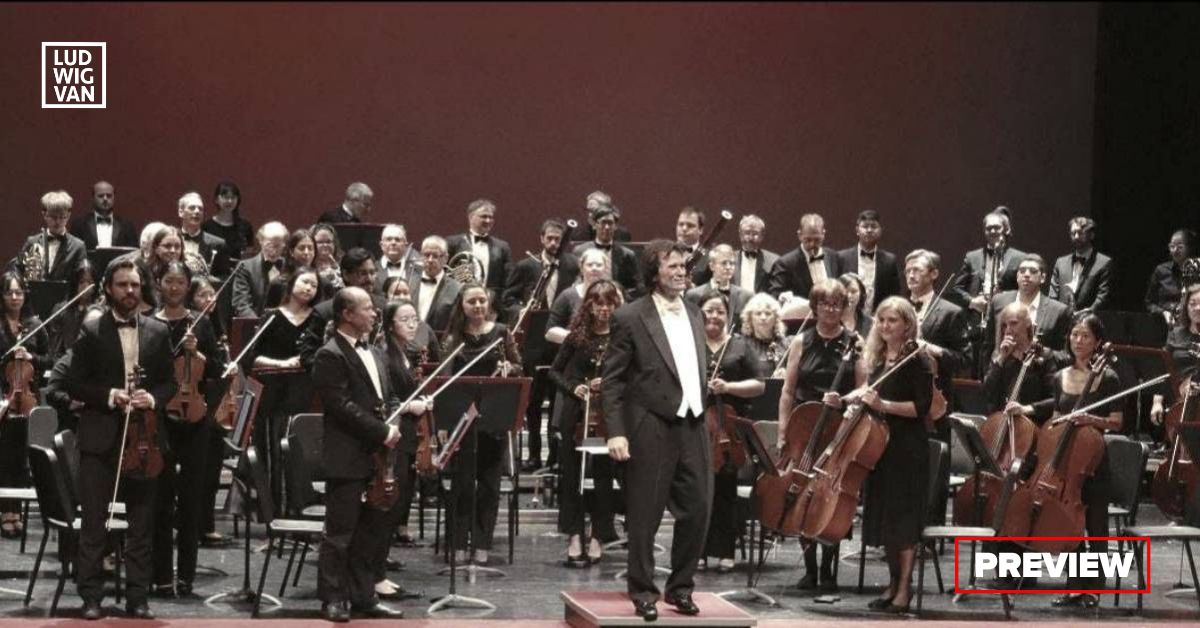
Operatic melodies and imaginative forms are the themes of the next concert by the Kindred Spirits Orchestra. Operatic Rhapsodies takes place on February 7, with conductor Kristian Alexander, pianist Dmitri Levkovich, and host Daniel Vnukowski of Classical 96.3 FM.
The program consists of:
- Ravel: Rhapsodie espagnole
- Debussy: Fantasie for piano and orchestra
- R. Strauss: Le Bourgeois gentilhomme
Ravel: Rhapsodie espagnole
Ravel’s Rhapsodie espagnole (or Rapsodie espagnole) was one of his first major orchestral works. It was composed between 1907 and 1908, and was premiered in Paris by Orchestre des Concerts Colonne in 1908. In the work, as he would in his opera L’heur espanole and Vocalise-Etude en forme de Habanera, M. 51, written the same year, Ravel uses elements drawn from his own Spanish ancestry.
The work began as a Habanero for two pianos that the composer created in 1895. He didn’t publish the Habanera on its own, however, and in 1907 he’d add three pieces to go with it. He completed the two piano version by October of that year, and by February 1908, had orchestrated the work.
The four-movement piece is orchestrated for strings, percussion, and harp, along with full bodied woodwind and brass sections. A prominent motif is established in the first movement used the pitches F-E-D-C#, and it returns throughout the four movements.
Debussy: Fantasie for piano and orchestra
Debussy’s Fantasie for piano and orchestra takes what is more typically a single movement form and expands it to three. As in Ravel’s work, Fantasie establishes two themes that are reiterated throughout the work. The title references its cyclical structure.
It is an early work of Debussy’s, composed between October 1889 and April 1890, however it didn’t receive its premiere until 1919, a year after his death. It’s an example of the composer’s developing voice, one that combines elements of Romanticism with the kind of harmonic experimentation that would become his trademark.
That blend of influences is also apparent in the structure of the piece. The first movement is sonata-like, and is followed by a slower, introspective and melodic second movement. The third and final movement is animated and strongly rhythmic, but avoids the bombast of Romanticism.
The piano part is both lyrical and virtuosic, and often plays into, rather than on top of, the orchestra. Though he was still a young composer at the time, he was already adept at using orchestral colours.
R. Strauss: Le Bourgeois gentilhomme
Strauss compiled Le bourgeois gentilhomme, Op. 60, from music he’d written between 1911 and 1917. It was a personal favourite of the composer’s that combined his Romanticism with his affection for the Baroque music of Jean-Baptiste Lully.
The piece has a complicated history. It was originally intended as incidental music for a much larger work that began its life as Der Bürger als Edelmann (Le bourgeois gentilhomme in French, after Moliere’s work of the same name). Der Bürger would consist of a revival of Moliere’s play, with an opera, Ariadne auf Naxos, at the end of the performance. The original lengthy production, which was intended to take place in 1912, would have included both ballet dancers and stage actors.
Strauss and his partner, writer Hugo von Hoffmansthal, eventually pared Ariadne down to the operatic version audiences know and love today. Le bourgeois gentilhomme, the orchestral suite, and became a separate work in its own right, consisting of nine movements that were culled from the incidental music of the grandiose, but not to be, production.


Dmitri Levkovich, pianist
Ukranian-born Canadian pianist and composer Dmitri Levkovich studied with Sergei Babayan for 11 years, and obtained Bachelor’s and Master’s degrees, as well as an Artist Diploma, from the Cleveland Institute of Music. He studied composition at the Curtis Institute of Music. He has won more than 20 international piano competitions, including the German Piano Award, and the Vendôme Prize.
His performance repertoire includes more than 30 piano concertos, and he has performed with a wide range of orchestras, including he Cleveland Orchestra, China National, Dresden Philharmonic, Gulbenkian, Frankfurt HR Radio, Mariinsky, Slovak Philharmonic, and Baden-Baden Symphony Orchestra, among others.
Dmitri is also a dedicated educator, and maintains a busy private studio in downtown Toronto.
The Concert
Along with the concert itself, audience members can enjoy talks and more to round out the evening.
- 7:10 p.m. Prélude: pre-concert recital
- 7:20 p.m. Pre-concert talk
- 8:00 p.m. Concert
- Intermission discussion and Q&A with Mary Kenedi and Daniel Vnukowski
- Post-concert reception
Find concert details and tickets [HERE].
Are you looking to promote an event? Have a news tip? Need to know the best events happening this weekend? Send us a note.
#LUDWIGVAN
Get the daily arts news straight to your inbox.