
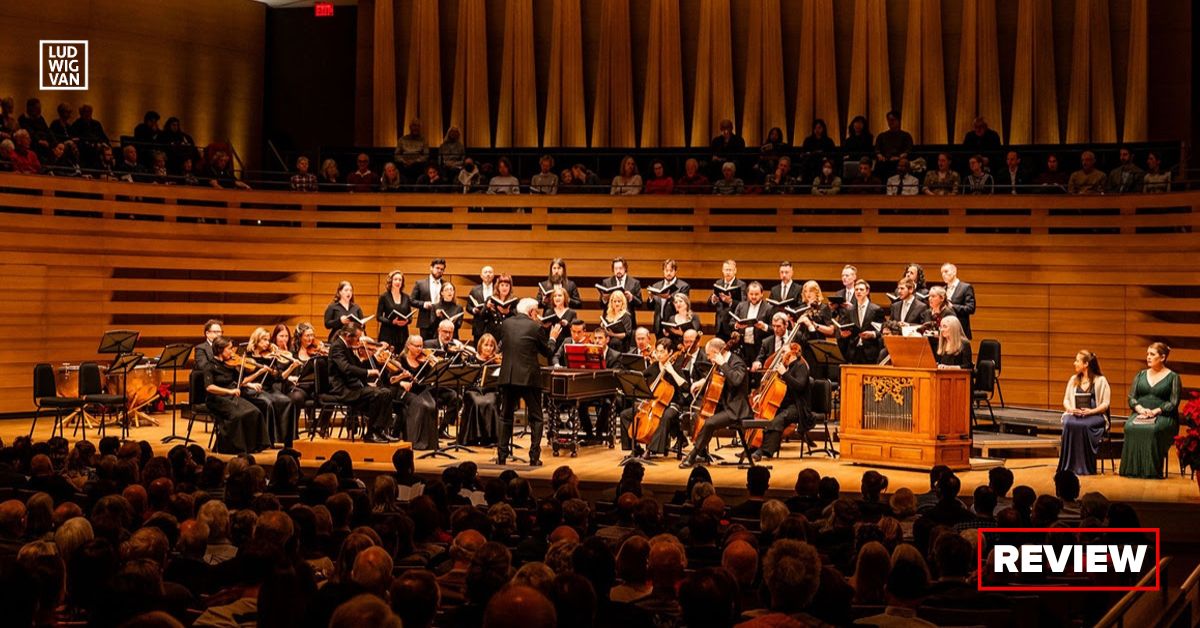
Tafelmusik: Handel’s Messiah. Tafelmusik Baroque Orchestra & Tafelmusik Chamber Choir, Directed by Ivars Taurin, with Stefanie True, soprano, Krisztina Szabó mezzo-soprano, Ben Done, tenor, Jonathan Woody, bass-baritone. Koerner Hall, December 18, 2025, continues December 19 & 20; tickets here.
There is always the risk with Messiah that tradition will do the heavy lifting — that grandeur will stand in for stylishness, reverence for insight. At the Koerner Hall, Tafelmusik provided the perfect antidote.
From the outset, this was Handel handled with care rather than with ceremony — alert, humane, and gently persuasive. Tempos breathed, textures stayed transparent, and the music’s message of consolation was sympathetically offered rather than vulgarly proclaimed.
Ivars Taurins
All this unfolded under the supremely musical but visually over-enthusiastic conducting of Ivars Taurins, who seemed determined to supply a parallel choreography rather than simply enabling the music.
Whether an orchestra of this calibre needs such florid physical input certainly crossed the mind during the opening Sinfonia. But, the question soon became irrelevant. Taurins’ grasp of architecture and structure as well as expressive detail quickly asserted itself. As a seasoned Messiah director, he has a clear vision of the work as a whole, yet manages to make each stage of the journey feel self-standing, immediate, and spontaneous.
Handel’s Genius
The long view was reinforced by the inclusion of several movements often excised. Rather than feeling indulgent, these numbers slotted naturally into the unfolding narrative, allowing the fullest appreciation of Handel’s genius for scoring and musical drama.
Messiah remains a masterclass in sustaining attention across three hours, its pacing, vocal and instrumental colouring all strategically planned. The off-stage trumpets — sounding from above the stage in Part One — served as a tantalising promise of greater things to come. When that promise was fulfilled in the Hallelujah chorus at the end of Part Two, it was only natural for the entire audience to rise — a matter of conviction as much as convention.
Dynamics throughout were meticulously managed in order to draw maximum impact from the small but mighty ensemble and chamber choir. If the shaping occasionally felt deliberate to the point of calculation, the resulting exaltation was undeniable — from For unto us a Child is Born in Part One to Worthy is the Lamb in Part Three.
The choir’s unanimity and razor-sharp diction were a constant joy, and whether in choruses or solo moments, accentuation was clear but never overdone. The music itself dictated the tempos, unfolding with a natural, unforced flow.
Vocalists
The evening demanded a degree of camaraderie when British tenor Nicholas Scott was indisposed. His numbers were taken by tenor Ben Done (from within the choir) and soprano Stefanie True. Done’s voice, bright and light, was in no way out-shone by his fellow soloists. In O death, where is thy sting, a brief lapse might have derailed the duet, but Taurins was there to discreetly gather the threads and guide him through.
The alto solos were taken by Canadian-Hungarian mezzo-soprano Krisztina Szabó, whose vocal expressiveness was evident, though support and power were less secure in the more incendiary passages such as For he is like a Refiner’s Fire. American bass-baritone Jonathan Woody brought a snarling, almost villainous edge to darker numbers such as Thus Saith the Lord, but sounded rather husky and less assured in The Trumpet shall Sound, where Kathryn James Adduci’s silky, warm-toned trumpet stole the scene.
By far the solo vocal highlight was Canadian soprano Stefanie True. Her voice — clear, agile, and sweetly lyrical — moved effortlessly between delicacy and projection. When stepping into the tenor territory of Behold, and See if There be any Sorrow, she subtly altered her timbre, offering not a substitution but a transformation.
Orchestra
The orchestra, subtle, stylish, and idiomatic throughout, underpinned everything with quiet authority. Special mention should go to concertmaster Christopher Verrette, whose leadership was refined, energetic and responsive, anchoring the ensemble’s unfailing clarity of intent.
It was in the final Amen that Taurins’ and Tafelmusik’s approach crystallised most poignantly. Taken more slowly than usual, shaped with extreme care, and expansively breathed, the fugue unfolded in a labyrinth of gentle accumulation rather than a triumphant blaze.
Its power lay not in volume or grandeur, but in patience and trust. In resisting pomp and preachery, the entire performance allowed Messiah to speak in a universal language — one capable of reaching beyond doctrine or tradition. What emerged was not a monument but a spiritual message — consolatory, spiritual, pacific, inclusive, and above all handled with care.
Are you looking to promote an event? Have a news tip? Need to know the best events happening this weekend? Send us a note.
#LUDWIGVAN
Get the daily arts news straight to your inbox.