
Crow’s Theatre: Rogers v. Rogers. Adapted for the stage by Michael Healey Based on Rogers v. Rogers: The Battle for Control of Canada’s Telecom Empire by Alexandra Posadzki. Directed by Chris Abraham, starring Tom Rooney. Guloien Theatre, December 10, 2025. Continues until January 17, 2026; tickets here.
“It will not be boring,” promises Tom Rooney in the character of Matthew Boswell, Canada’s Commissioner of Competition, in the opening monologue of Rogers v. Rogers by playwright Michael Healey.
It’s an apt statement for the funny, revealing play that unfolds.
Design
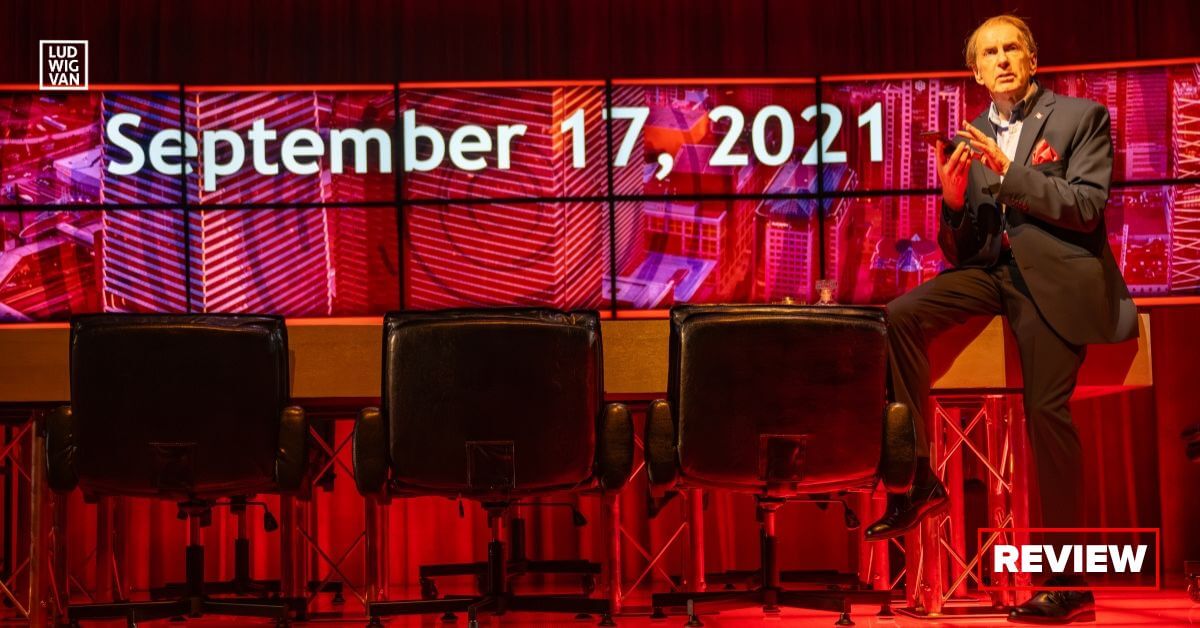
A long boardroom table with a gleaming top sits centre stage in front of a red curtain, and red lights. A long, narrow screen stretches behind the table, with images that change according to what’s transpiring on stage. That includes everything from a multiple windowed Zoom meeting to a park setting for a crucial meeting to the frumpy wallpaper of Loretta Rogers’ sick room.
Josh Quinlan’s design is an effective and economical setting for a play that relies on animated storytelling — by Tom Rooney in all of several roles — to make its point.


The Story
As the projection screen points out as the play begins, while based on the factual reporting of Alexandra Posadzki’s book Rogers v. Rogers: The Battle for Control of Canada’s Telecom Empire, the play itself is a work of fiction. Certainly, no one knows the private conversations that took place between parties, or their unexpressed thoughts on any of the events.
But… certain facts are in evidence.
The play unfolds in a series of stories, largely told as monologues to the audience by Matthew Boswell or Edward Rogers, interspersed with scenes involving other characters who flesh out the scenarios.
The play begins with Matthew Boswell, who lays out the framework of the story. The Rogers media empire looked to acquire Shaw Cable in 2021, and Boswell was opposed to the idea of turning a Canadian telecom industry made up of only four players into three. He points out the way that corporate Canada has created a vast network of companies that many consumers believe represent individual choices, when in fact, they’re collected into a very few conglomerates who ensure there is little competition.
That’s why Canadians among the highest rates for cell phone service in the world.
The other major character in the story is Edward Rogers, son of the late Ted Rogers. Buying Shaw became his pet project, as well as a way of making his mark in a company where he had long been sidelined by Ted Rogers himself, who publicly stated, towards the end of his life when he was looking to make succession plans, that Edward wasn’t ready to lead the company.
Edward’s clandestine behind the scenes machinations play out as he sabotages various company directors and officials, his own siblings and even his mother to win out. It contrasts neatly with Boswell’s very public attempts to halt the merger via the law.
The major problem for Boswell is that not a single company merger has ever been fully blocked in Canadian history.
The script is sharp and filled with zingers that drew laughs from the sold out audience. Of course, a story succeeds because of characters, however intriguing the ideas and issues may be. While Rooney portrays a dizzying array of characters from former Ontario Premier David Peterson to the family retainer who looked after the Rogers brood and kept the household running, it’s only Matthew and Edward who are fully fleshed out.
Edward emerges as a kind of pathetic family loser who’s bent on revenge — and gets it after decades of humiliation. The Rogers clan, let’s just say, doesn’t come off so well. Certainly, it gives Edward a classic villain’s backstory of neglect and emotional abuse.
Boswell is sharply contrasted as someone with a solid and loving family background and an unerring sense of justice, but also a taste for a good fight.
“This is the illusion of consumer choice,” Boswell says as he lays out the corporate monopoly shell game. Edward counters by calling the Rogers empire “a homegrown success.”
Characterization works best during the longer monologues. The supporting characters most often serve as fodder for humour. Some of the comedy wrote itself, so to speak, like the very public Tweets made by Edward’s sister Martha during the last and fateful meeting of the family board.


Tom Rooney
Rooney, a stage and screen veteran, is remarkable in all the roles. He uses a few simple props, like the jacket that Edward wears as opposed to the shirtsleeved Boswell, or the long glittery earrings he uses o portray Edward’s wife Sarah, and a variety of techniques to delineate between each of them.
As Boswell, he’s both passionate and profane, while Edward stutters slightly, his movements alternately self effacing and vainglorious. Rooney’s speech patterns change with each character, from the Italian-accented family butler to the Shaw executive’s Western drawl.
There are scenes where he plays two characters in dialogue with each other that are quick and played for laughs. In a climactic Zoom meeting, he plays Edward on stage, while the projection offers multiple windows filled with Melinda, Martha, and Loretta Rogers, Phil Lind, David Peterson, and Bonnie Brooks, each of whom offers their thoughts. Rooney’s particularly hilarious as Edward’s chain smoking, harsh spoken mother Loretta.
Final Thoughts
“Canadians accept too much,” Boswell says at one point.
But, the ending of the story shows that you can even provoke the complacent Canadian public to a breaking point. While Edward got his wish, and both control of the company and the Shaw merger, the Canadian public was so outraged by the merger’s easy approval that the Competition Act (Act) was actually amended via bill C-59 in 2024 — and according to the recommendations made by Boswell himself in a potentially career ending (albeit judiciously worded) rant that he posted to the government website. (We have this development to thank for the recent Breadgate settlement from George Weston Limited and its subsidiary Loblaw Companies Ltd., by the way).
“Hey, look at that,” Boswell says near the end. “We both won ugly.”
A rebuke against corporate monopolies and greed, a clash of personalities, and a story of generational family dysfunction combine in a thoroughly entertaining performance.
Are you looking to promote an event? Have a news tip? Need to know the best events happening this weekend? Send us a note.
#LUDWIGVAN
Get the daily arts news straight to your inbox.