
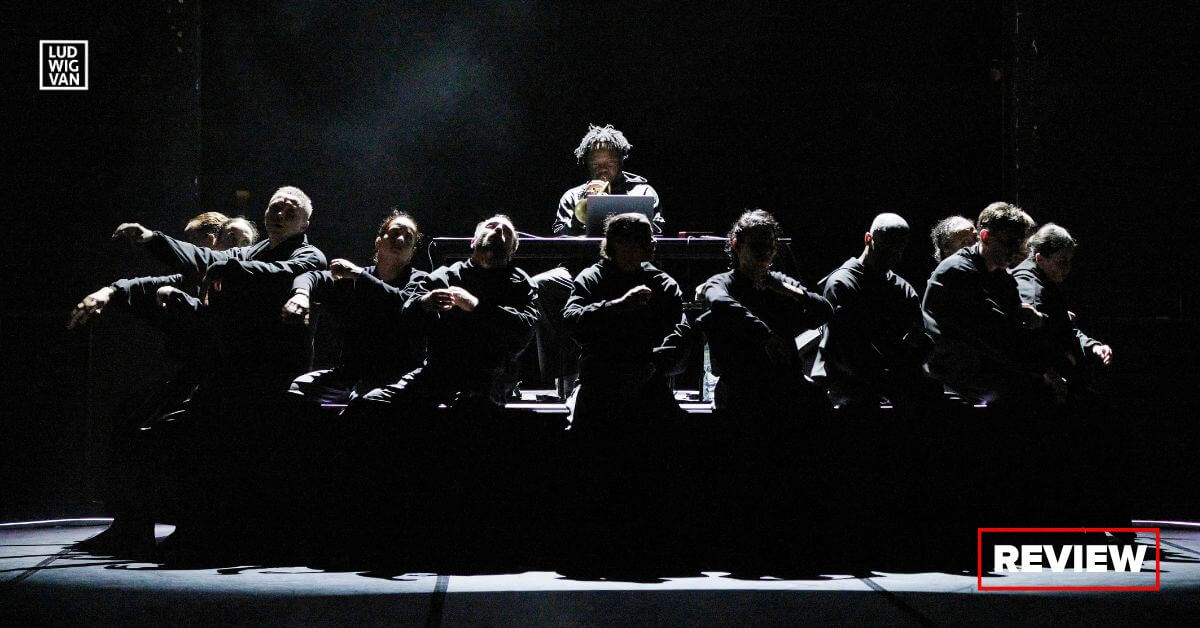
TO Live/A a | a B : B E N D, choregraphed by Aszure Barton, composed and live music by Ambrose Akinmusire, Bluma Appel Theatre, closes Dec. 6; tickets here.
Dance is in the eye of the beholder. Regardless of what the intent of the choreographer may be, it is how the work lands with the audience that ultimately counts.
A a | a B : B E N D, the joint creation of New York–based Canadian choreographer Aszure Barton and American composer and trumpeter Ambrose Akinmusire, is a daring piece that will mean a million different things to a million different people.
Barton and Akinmusire see it as an equal partnership between music and dance, each bending the other to create new, abstract, ethereal forms.
I see something more.

How BEND Presents Itself
On the surface, B E N D is a sound and light show, merging concert and dance.
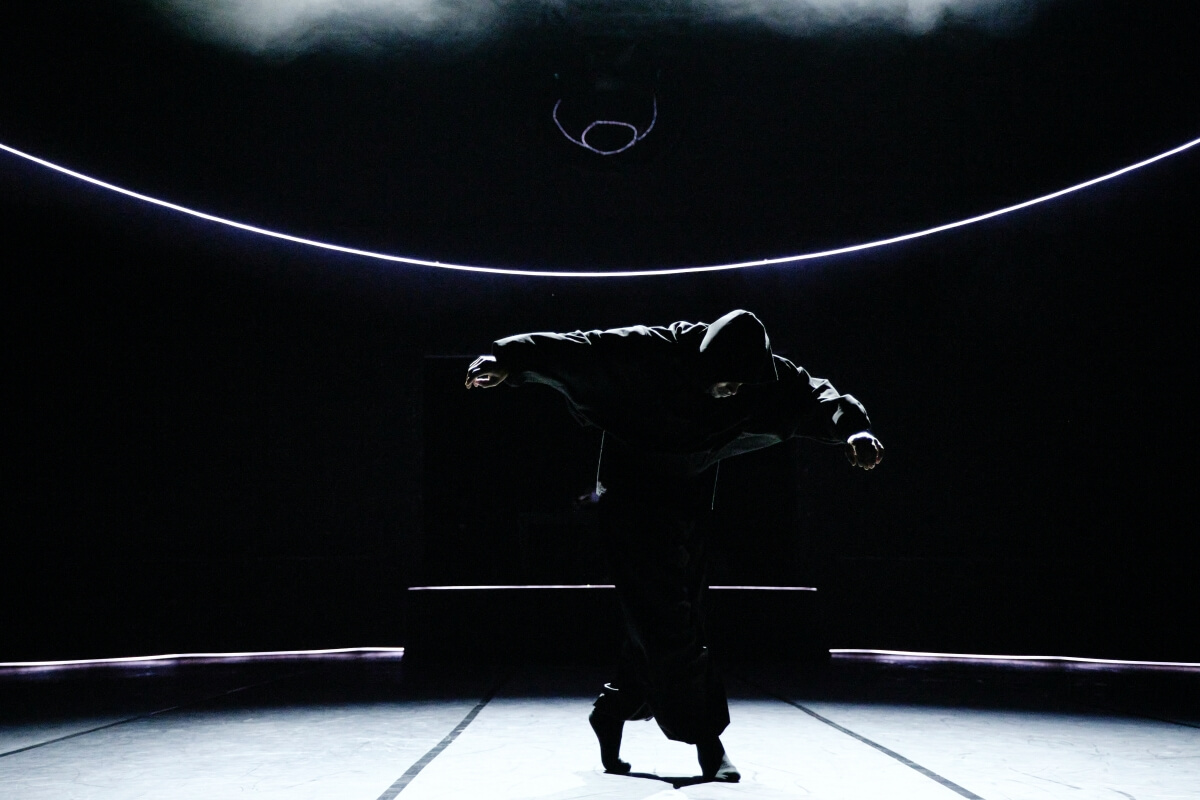
While Barton and Akinmusire intended B E N D as an equal creative sharing, a new way of presenting music and dance, I saw an apocalyptic world forged by the anonymity of the hoodies costumes and the relentless absorption of the individual into the collective that occurs throughout the dance.
The Stage Picture
The composer sits on a platform at the back of the stage. a desk in front of him. Akinmusire lays down a recorded driving rhythmic base over which he improvises on his trumpet. Around him, the dancers move through dazzling visual environments.
A mirror ball hangs above. Rings of light encircle both the top and bottom of the stage. Behind the musician is a bank of lights, and another ring surrounds him. Each set of lights moves at its own speed, creating a hypnotic world of shifting illumination. Technically it is remarkably complex, and visually it is stunning.
With the pounding beat reverberating through our bodies, and the moody jazz trumpet floating above us, the work becomes immersive, even invasive.
Credit must go to the creators and designers associated with BEND itself. Bonnie Beecher for lighting the Toronto stop. Tobin Del Cuore for video design. Rémi van Bochove for costumes. And especially Nicole Pearce for the original lighting and scenic concepts. Their contributions shape the environment in which the piece unfolds. The result is a true sound and light show.
The world premiere of BEND took place in 2023 at the Kampnagel International Summer Festival in Hamburg, Germany. This 2025 production is a made in Canada effort produced by Pomegranate Arts and TO Live with support from the National Creation Fund, the Banff Centre, The Charles and Joan Gross Family Foundation and the Canada Council.

The Dance Itself
The work reveals a world where individuality struggles and repeatedly fails to emerge. The 11 dancers begin in anonymous hoodies, indistinguishable from one another. Whenever an individual, duet, trio, or quartet attempts to break away, the group inevitably absorbs them again.
Individuality dies; the group triumphs.
Movements range from simple, almost childlike gestures to highly complex patterning. At times there are ritualistic passages, as if the dancers are sacrificing each other or offering themselves to a higher force, perhaps even to the musician himself.
Yet, the choreography is extraordinarily complex.
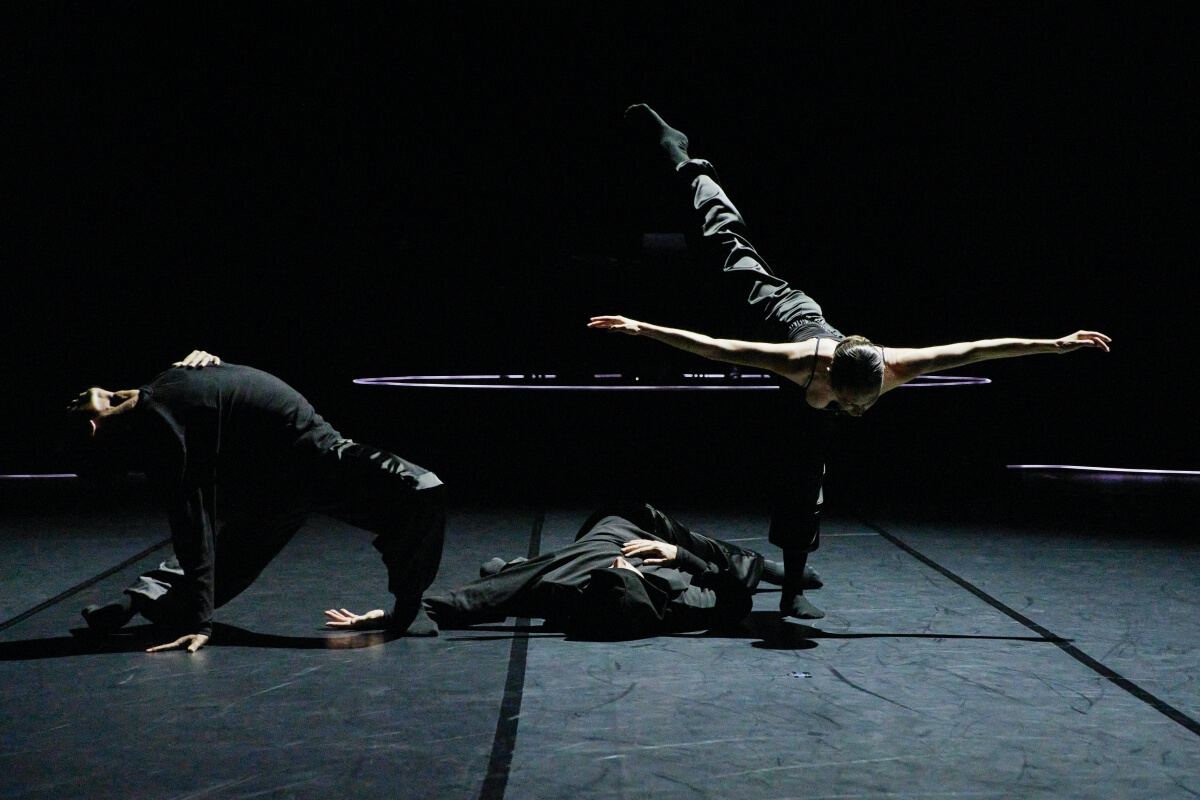
Barton deconstructs ballet and contemporary movement and reconstructs them with street dance, voguing, jazz dance, and intricate group formations. Much of the choreography involves bending the body individually and manipulating the bodies of others resulting in tortuous shapes and configurations, adding to the alien nature of piece.
The Ode to Freedom
A striking figure emerges early on, a woman (Nora Brown) who reveals herself with sultry, sensuous movement in stark contrast to the hooded anonymity around her.
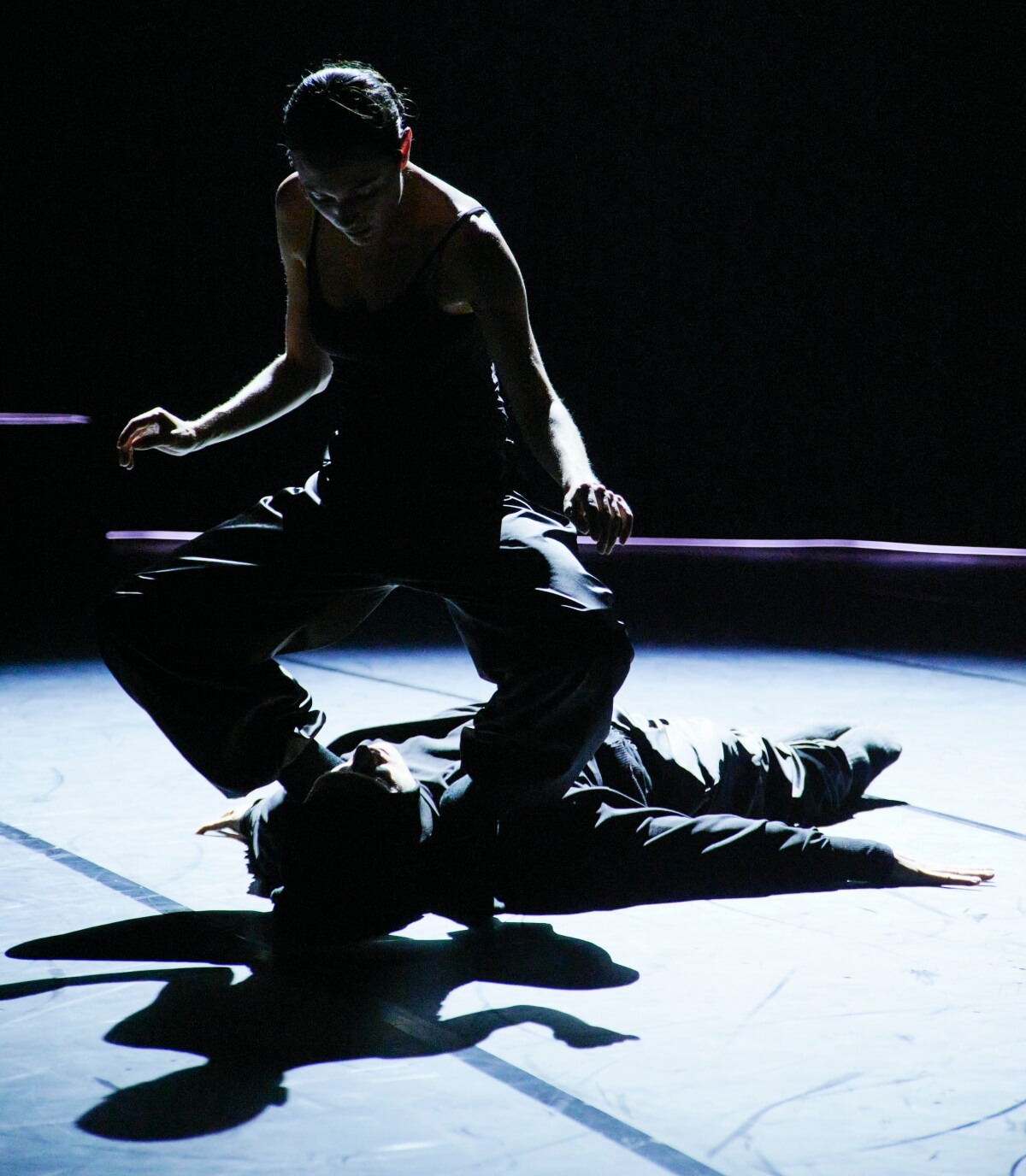
Later comes the extraordinary pas de deux in which she is fully visible while her partner remains entirely hidden in a hoodie. She seems to float in air, manipulated by an unseen force.
A third dancer mirrors the woman beside him, creating a remarkable pas de trois that is slow, agonisingly deliberate, and utterly singular because it celebrates individuality. This sequence stands as the emotional and structural centre of the piece. Then a fourth figure comes, then a fifth mirroring the woman — this is the ode to freedom, only once again to be swallowed up by the mob.
The woman is also the figure who is offered to the shrine of the musician, either the priestess or sacrificial lamb. The manipulated woman’s break out at the beginning takes on a greater significance after this pas de deux.
The Improvised Trumpet and the Endings
The trumpet improvisation is responsive to the dancers, and the dancers respond in turn.
Although the choreography is set, the piece is never the same twice. The shifting musical landscape influences the quality and intention of the movement in real time. This contributes to the work’s apocalyptic tone, its sense of a world where anonymity triumphs and personal identity is erased.
Layered over this is the recurring device of false endings. Again and again the piece appears to conclude, only to surge back to life. After several such moments, the true ending comes as a surprise — the dancers stand in a large still circle at the sides of the stage while the musician alone finishes the work, his trumpet sounding the final notes.
It is an unexpected and powerful conclusion because it is a sputtering trumpet and not the clear mournful sound we have been hearing throughout. It is a final dying breath.
An Important Final Word
With the collapse of Harbourfront’s finances and the loss of the International Dance Series, Toronto has been starved for the kind of international work that has nourished our dance community for decades.
Clyde Wagner, CEO of TO Live, has stepped into the breach with a five performance International Dance Series, of which B E N D is a part. For a dance hungry city, this commitment matters.
Are you looking to promote an event? Have a news tip? Need to know the best events happening this weekend? Send us a note.
#LUDWIGVAN
Get the daily arts news straight to your inbox.