
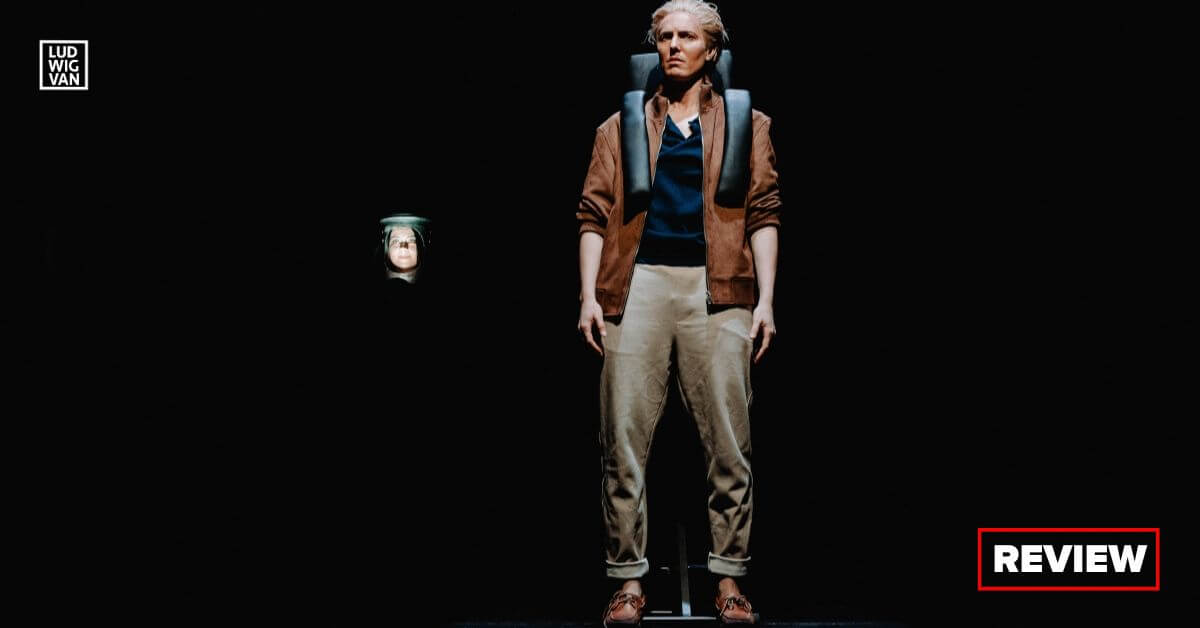
Lester Trips (Theatre), presented by Factory Theatre: Public Consumption, created by Lauren Gillis and Alaine Hutton as performers/writiers/directors/designers. Factory Theatre, November 29, 2025. Continues until December 7; tickets here.
Fame and power go hand in hand, like criminals and the law.
The key to understanding Lester Trips (Theatre)’s cheekily titled Public Consumption — created, performed and designed by Lauren Gillis and Alaine Hutton and presented by Factory Theatre — is that it is inspired by the downfall of the American actor Armie Hammer, who, in 2021, was accused by multiple women of sexual assault, including expressing an interest in cannibalism.
“I want to eat you,” he infamously wrote to one of his victims.
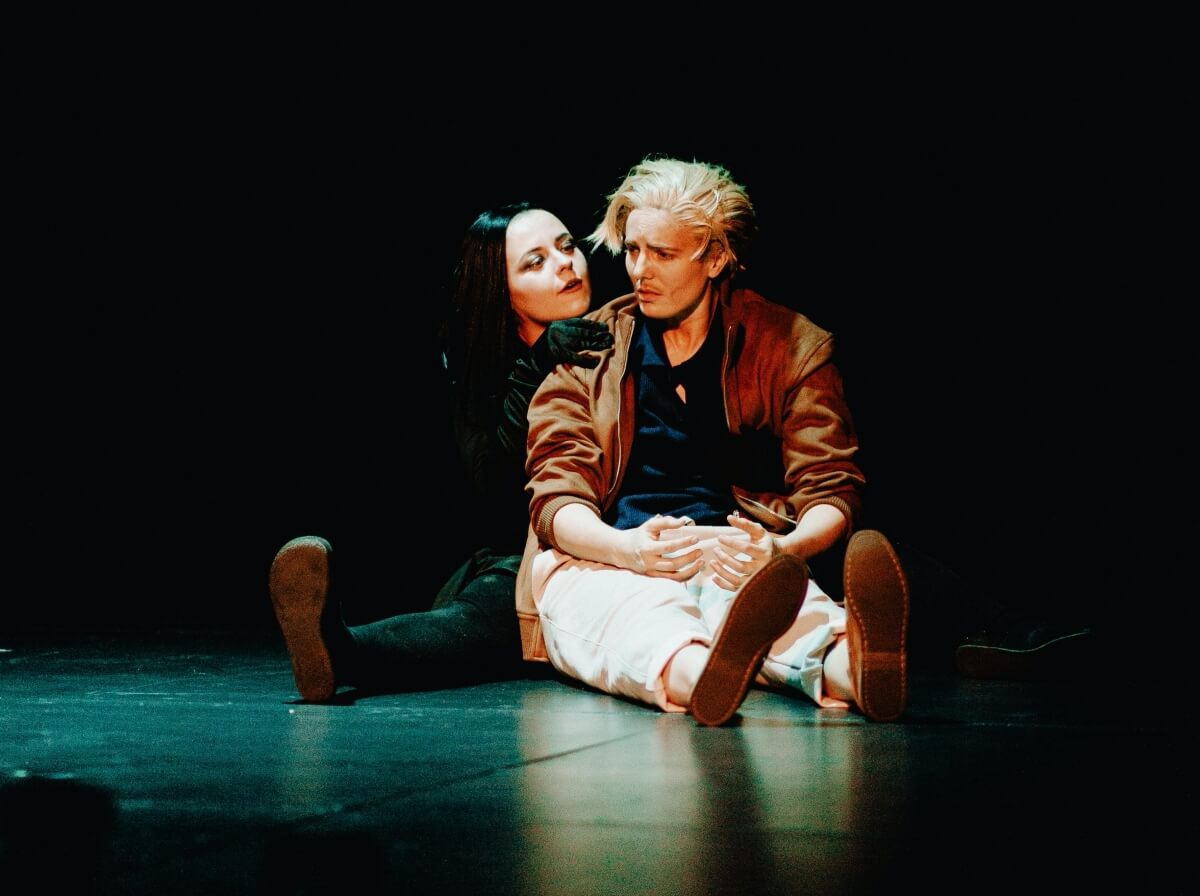
At 65 minutes, Public Consumption follows a similarly disgraced actor, Navy (Hutton), who is convicted of one of four charges of sexual assault. After pleading with his lawyer (Gillis), whose image is projected onto a screen downstage, he opts into an experimental work program by a “redacted” corporate entity in exchange of serving the 120-day sentence of house arrest.

The Story
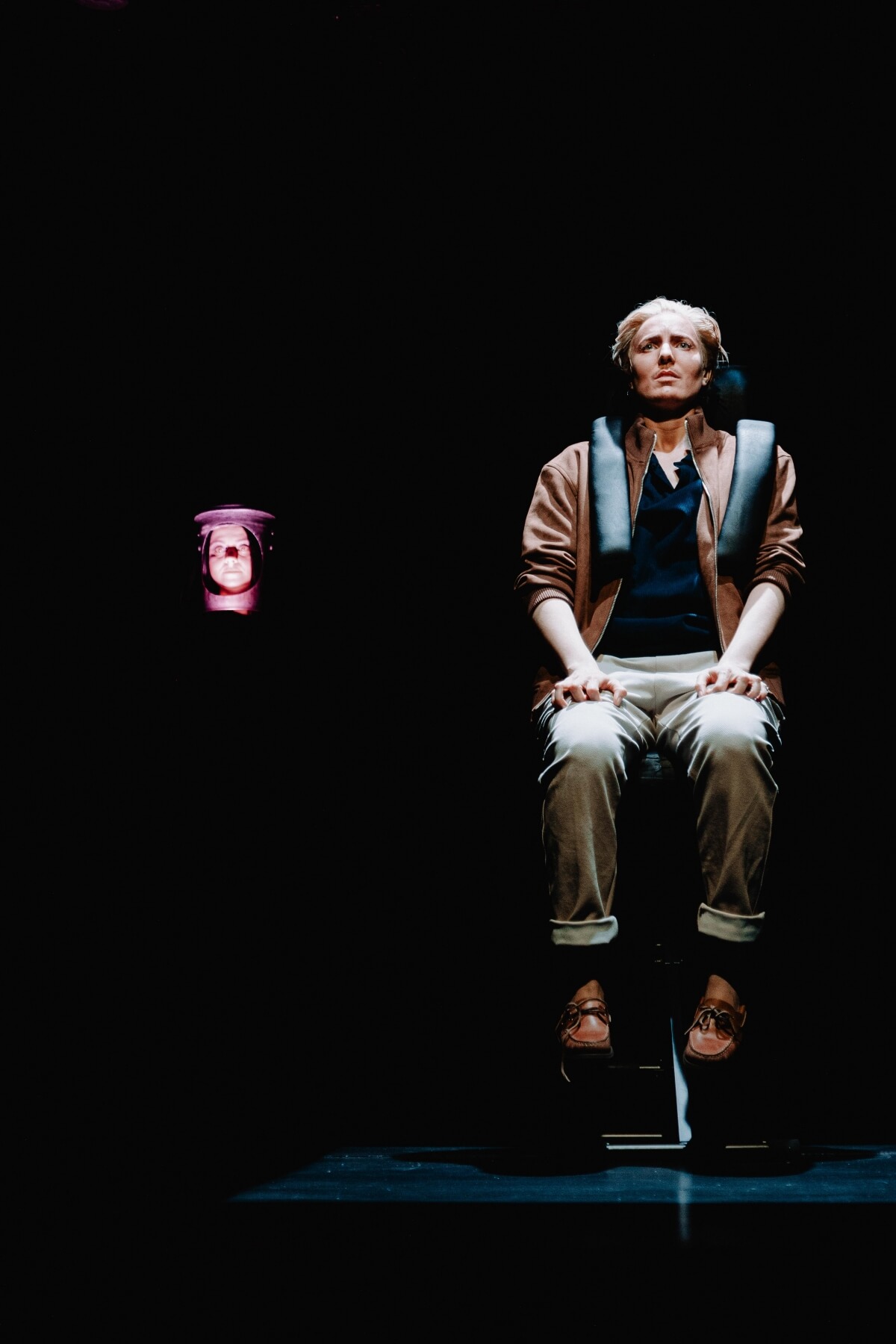
On his first day of work, Navy — sporting short hair, a faux moustache and holding a stylus — is greeted by the floating head of an AI content moderator, Ducky (also Gillis), who kindly yet robotically explains his job for the next 30 days: to parse through content on the internet and identifying any obscenity, such as acts of violence and vivid descriptions of sexual activity.
This conceit of having an ignorant participant encounter increasingly lewd material allows for humorous moments to accumulate, as well as a slew of pop culture references, ranging from Marvel and Harry Potter characters, as he learns of the realm of erotic fan fiction.
But, a line is drawn when Navy suddenly encounters himself in the content as a character.
Even if he wishes to run away from his problems, to find a short cut through facing his punishments, he cannot seem to escape; there’s no easy way out of this mess he’s created for himself.
After re-convening with his lawyer, he enters another program, one that sees Navy combing through video content instead, but the suggestion of the sexual assault of a child, and the appearance of his private videos testifying to his cannibalistic tendencies, causes him, once again, to abandon the program, despite the fact that it resets his progress towards legal freedom.
Punctuating each section are “commissions,” video projections shot and edited by Nico Stagias and starring Kerrie Hutton and Peter Demas, that observe a couple who engages in power plays, from pouring a glass of water to putting on a blindfold to suffering verbal abuse, but the purpose, or intended meaning, behind these acts remains obscure, left up to the audience to interpret.
The Play: Why Does It Feel So Real?
In the first two sections, as Navy and Ducky go back-and-forth with their conflicting tone and opinions, Gillis and Hutton explore the ways that language and images can be carriers of abhorrent messages, and the limits of technology’s ability to discern it. They also evoke a sense of unease whenever Navy wishes to go to the bathroom and a timer instantly begins, pointing towards the imprisoning nature of labour, capitalism and the prison industrial complex.
The third program, which naturally takes another step in intensity, sees Navy being immersed in simulations that people pay to interact with him in any way they wish — violent, morbid, exploitative — until he begins to lose all sense of reality, and, of course, himself.
“Why does it feel so real,” he asks, staring at his hands in a recurring motif.
The production features a musical number performed by Ducky, which allows Gillis to shine in her expressiveness, and a final, outlandish sequence, where both performers appear dressed as maidens who eat off the corpse of a man lying on a table. For all the laughs this scene provoked at the oftentimes ridiculousness of AI, the moment that felt earned, felt real, was Navy breaking from the act to stare at his hands for a brief moment, uncertain whether it is a fantasy or not.

Design
With André Du Toit’s crisp lighting design, complimented by S. Quinn Hoodless’ well-timed sound design, moving things along at an even pace, Public Consumption is never not an interesting, well-produced work that, notably, comes with several content warnings.
Depending on your tolerance for such things — I have read, heard and seen much worse — it is not as transgressive as the longline suggests. Should it have expanded on the content sections, the nuances of obscenity and labour could emerge rather than cease when a point is made.
Additionally, a monologue by Ducky at the end, proceeded by a mélange of comments from the internet, attempts to neatly summarizes its intentions, but it takes away from the fact the show is most engrossing in the moments when its ideas are dramatized rather than directly explained.
Final Thoughts
What it does best is re-create the sensation of falling down a rabbit hole, of suddenly finding oneself far from the origin point, indicative of their promising, thoughtful, outsized imagination.
Public Consumption is a multi-media trip chock-full of fresh concepts, transforming a tabloid event to investigate the threat AI poses to eat not only the rich and the famous, but all of us.
By Nirris Nagendrarajah for Ludwig-Van.
Are you looking to promote an event? Have a news tip? Need to know the best events happening this weekend? Send us a note.
#LUDWIGVAN
Get the daily arts news straight to your inbox.