
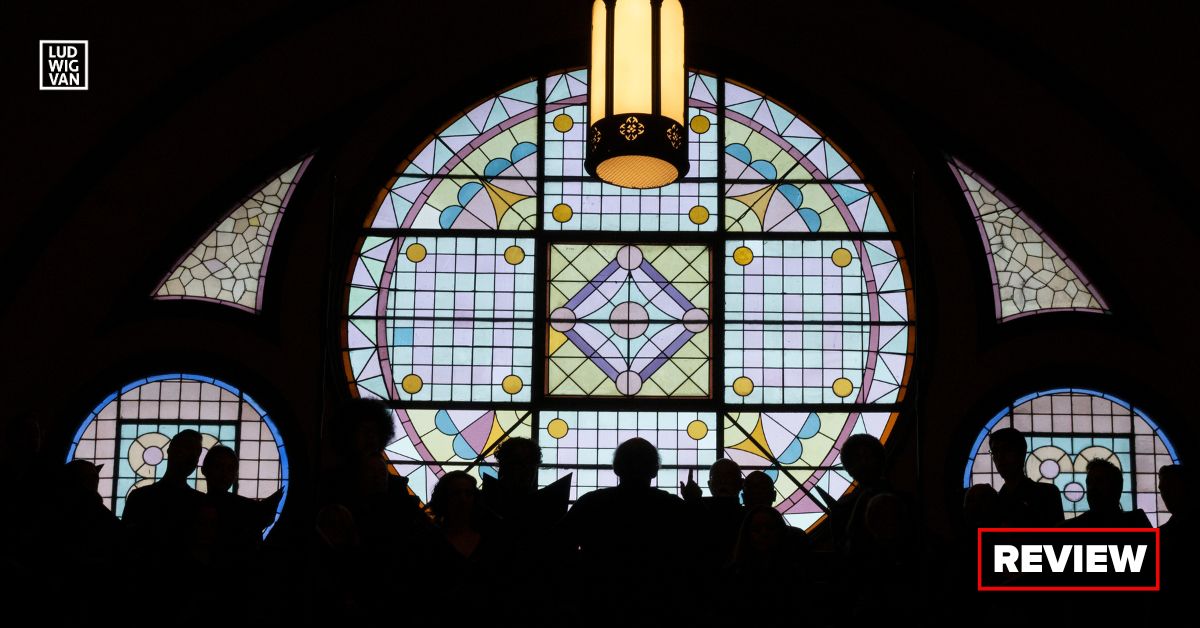
Soundstreams: Mass for the Endangered. David Fallis, Conductor; Louise Bessette, piano soloist; Judy Loman, harp; Erika Raum, violin; Soundstreams Choir 21; Ensemble Soundstreams. Trinity-St Paul’s Centre, November 22, 2025.
Come, attendants of creation, to this stream of ecclesiastical resonances.
Saturday night, at the Jeanne Lamon Hall in Trinity-St. Paul’s Centre, Soundstreams — the music presenter lead by artistic director Lawrence Cherney — opened its 43rd season in birdsong.
With its reverent choir and ensemble, the two-act concert parsed through the works of Avro Pärt, Andrew Balfour and Chris Hutchings before landing on the acclaimed perch of its centrepiece — Sarah Kirkland Snider’s Mass For the Endangered, featuring a libretto by Nathaniel Bellows.
At the pre-talk, Cherney, accompanied by music director and conductor David Fallis and Michael Mesure — the executive director of Fatal Light Awareness Program (FLAP) Canada — shared their intentions behind their curatorial decisions and prompted the audience to consider the irreversible damage human existence has left on the natural world.
Intended to be performed in 2021, before COVID put a wrench in it, Snider’s Mass For the Endangered, a 47-minute, 6-part choral work, originally commissioned by Trinity Church Wall Street, is a bleak plea for mercy, but also, in “Credo,” Fallis noted, a glint of reclamatory hope.
Fallis, erudite, provided background about the French composer Olivier Messiaen, whose piano solos, taken from the 13-piece Catalogue d’oiseaux (1958), structure the first act. A fervent, obsessive birder, Messiaen had named each of solos not only after the bird that inspired, but by the rooted impressions of environment surrounding them too, so that one can “feel the warmth.”
Mesure came in to inform us that, according a study from Cornell, three billion birds have been lost since 1970 due to a variety of factors ranging from windows, pesticides and plastic waste.
“We’re all endangered in this world today,” Cherney said of the ethos, solemn yet stern. “The story we are trying to tell tonight is about what we’ve lost, and what we might reclaim.”
First Half
The night began with pianist Louise Bessette, clad in a blue, floor-length silk dress with lace short-sleeves, committedly bringing Messiaen’s musical ornithology to life with “L’alouette calandrelle” (Mediterranean short-toed lark) and “Le courlis cendré” (Eurasian curlew).
The first saw her going back and forth from the middle of piano to the highest octave so two voices were in conversation, an abstract, discordant piece that felt like a palette cleanser.
At one point, towards its conclusion, hand hovering above the keys, one was not certain whether Bessette was done, evoking the sort of silence when one tunes into nature, which made the return into its portrait even more satisfying. The narratives in these pieces, if there were any, were difficult to identify and seemed to encourage a break from interpretation to passively experience.
The second solo, less high-pitched, moved at a more rapid pace, made up of a run of trills and a melange of voices. In comparison, it was more erratic, disorganized, and chaotic, a mild contrast.
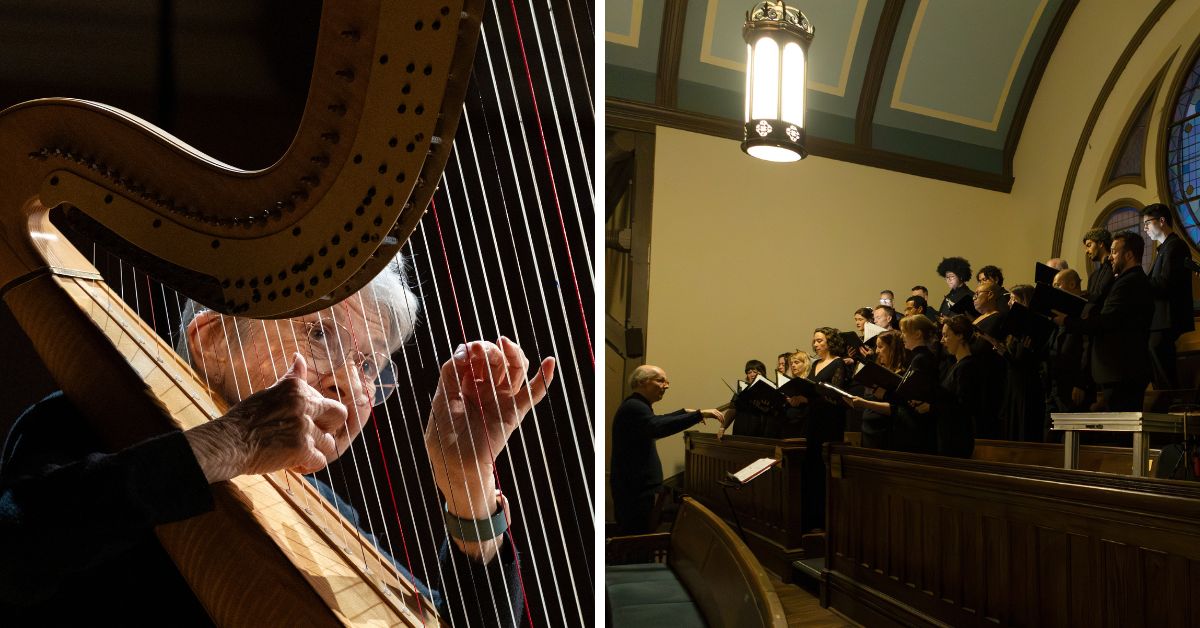
Sandwiched between these two birds was R. Murray Schafer’s “Wild Bird,” from 1998, a duo concertante played by violinist Erika Raum and harpist Judy Loman, who, Cherney had previously noted, originally performed in its world premiere.
True to its title, “Wild Bird” allowed for the stringency of the violin to be buffeted by the jewel-like embraces of the harp, a sentiment amplified by Loman’s seated and Raum’s standing positions. Their unrelenting dialogue demonstrated how interpretations of birdsong can produce a variety of sentiments — drama, violence, fortitude, wit, and the sensation of swirling ascendency.
When the stage went dark and the house lights went up, we turned our attention to the balcony’s gallery, where Soundstreams Choir 21, dressed all in black, rose from the pews, scores in hand.
Under Fallis’ graceful, unostentatious command, they performed a trio of choral octavos.
In Balfour’s “Gaze Upon The Trees,” they patiently unfurled Duke Redbird’s text, colouring words like “love,” “melted,” “leaves,” and repeating words like “sea” to create a soaring transcendence that was to be immediately contrasted with the indignant, scolding tone of Hutchings’s “Let Them Not Say,” with words by Jane Hirshfield. More than the beauty — for isn’t that the word we always reach for, is easiest to reach for, more often than not seems to suffice — it was the anger and fear that was palpable in their performance.
Finally, they turned to Pärt, whose 90th birthday Soundstreams will celebrate in February 2026, and his music for the traditional hymn “Veni Creator Spiritus,” which evoked the possibility of being absolved for our collective sins and a desire to be revitalized by grace.
“Ignite the light of our senses,” they sang, in Latin: “Pour love into our hearts.”
This, they were able to achieve, making the effort to crane our necks around worthwhile, but when our attention returned to the stage, where Bessette played yet another piece from Messiaen’s catalogue (“Le traquet rieur,” the black wheatear), which was overlong and not distinct enough from the second, I felt robbed from the sense of heights the choir had achieved.
But, as often occurs with mixed programs, one is often met with obscure, forgotten pieces that can help understand, prepare us for what is to come, the traces of the past that linger behind the present.
It does not have to do with Bessette’s consummate performance; after some time, even discordance establishes it’s own conventionality. I realized Messiaen does not speak to my soul, a sentiment which seemed to be shared with the man seated behind me, who let out a big long sigh.

Second Half
After intermission, it was time to experience the night’s highly-anticipated namesake.
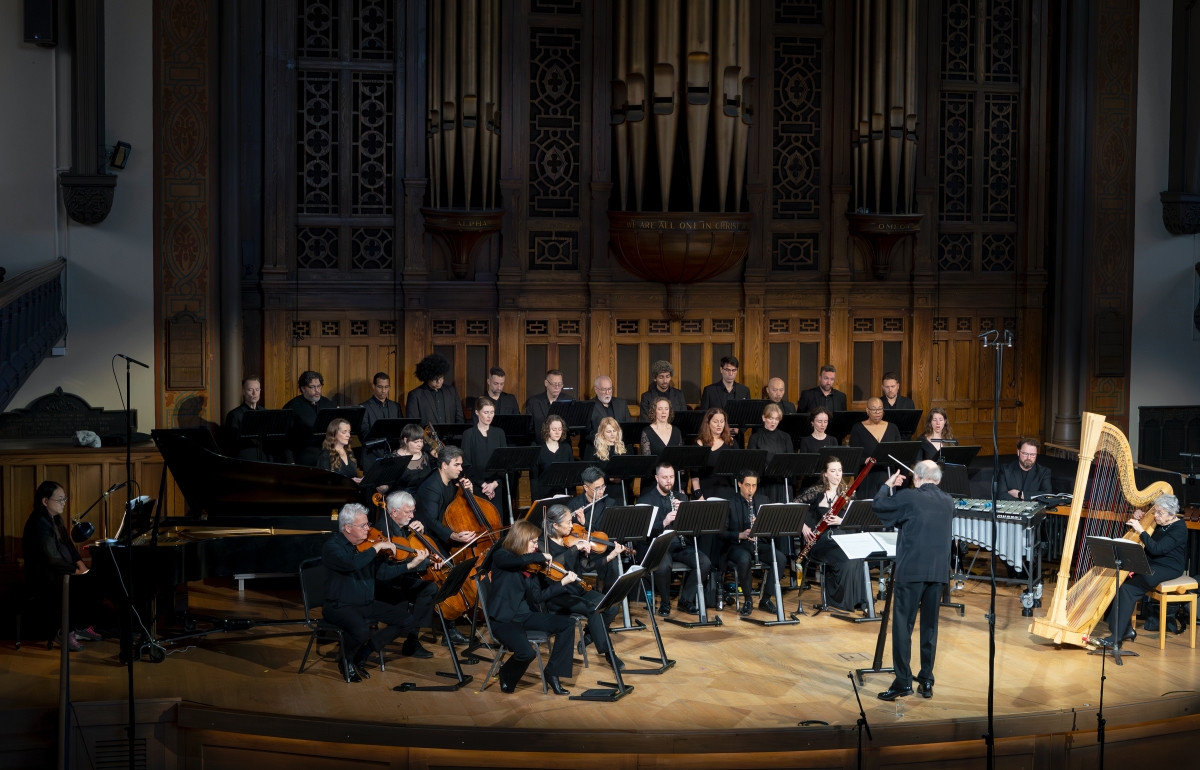
Written for a choir and 12 instruments, Mass For The Endangered — by turns divine, mystical and sumptuous — is a prayer for the animals of our world on the brink of extinction that provides ample opportunities for the talents of its artists to shine.
Keyboardist Gregory Oh, for instance, whose delicate piano refrain opens “Kyrie” and returns in “Agnus Dei” framed and thus grounded its wide and baroque scope.
Loman, who skipped over a section at the top of “Gloria” and requested it be re-started again, brought a sense of finality to her notes that wonderfully complimented the swooning vocal arrangement that sopranos Meghan Moore and particularly Sinéad White pristinely delivered.
In “Credo,” which incorporates a five-note ostinato by Caroline Shaw, clarinetist Anthony Thompson, flautist Stephen Tam, bassoonist Zsofia Veronica Stefan, and Ryan Scott’s percussion took turns conjuring up vivid images — as if moving through the woods; encountering species along the way — that aligned with the alliterativeness of the text that climaxes with a series of pronouncements.
“We believe in all who are voiceless,” they sang en masse. “We believe all who are silenced.”
Elsewhere, soprano Lesley Bouza and tenor Jean Paul Feo coloured their brief instances of spotlight with an individuality that gave the totality of emotion the necessary force to propel it.
“Agnus Dei,” the sixth and final movement, at one point, activated every instrument and voice on stage, once again freed the audience, and the critic, from analysis in order to submit to its stirring vortex of spiritual feeling colliding with ecological grief and a deep need for forgiveness.
It was as if everything were leading to this moment, whence our eardrums were fully dilated.
“Lamb of God,” they sang in conclusion. “Give wonder, wish, give kindness back.”
With Soundstreams, the wonders of creation are returned to us in abundance.
By Nirris Nagendrarajah for Ludwig-Van.
Are you looking to promote an event? Have a news tip? Need to know the best events happening this weekend? Send us a note.
#LUDWIGVAN
Get the daily arts news straight to your inbox.