
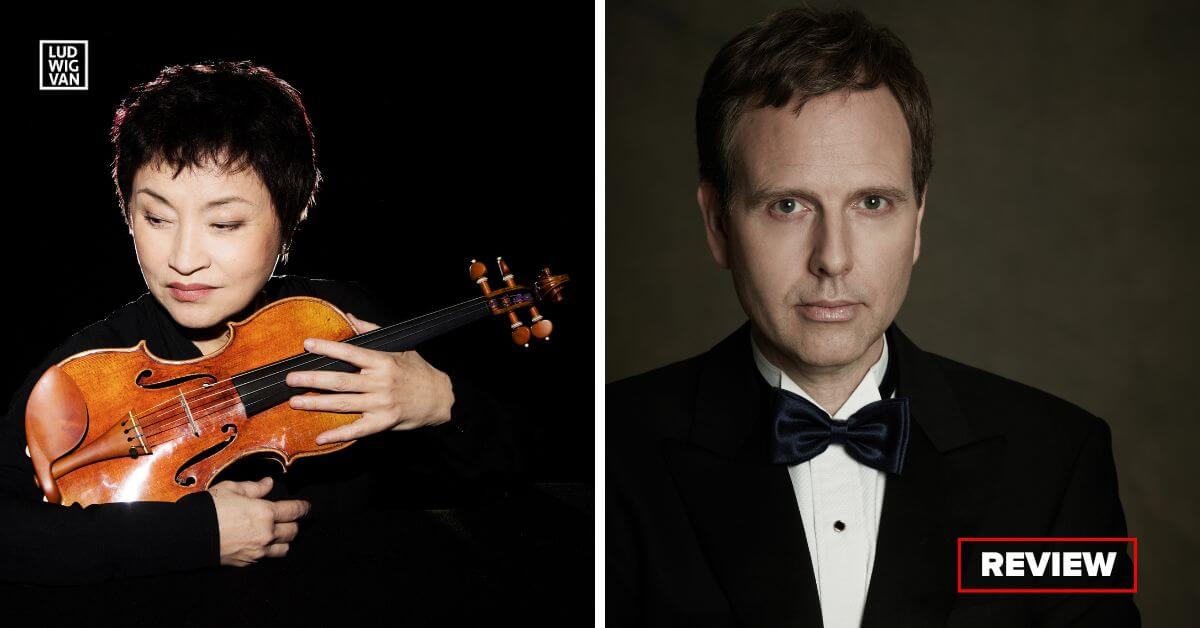
Royal Conservatory of Music: Kyung Wha Chung, violin, with Kevin Kenner, piano. Robert Schumann: Violin Sonata No. 1 in A Minor, op. 105; Edvard Grieg: Violin Sonata No. 3 in C Minor, op. 45; César Franck: Sonata for Violin and Piano in A Major. Koerner Hall, November 9, 2025.
On Sunday, November 9, two illustrious musicians, Kyung Wha Chung, and Kevin Kenner, in their full-glorious maturity, took over the Koerner Hall with refreshingly generous interpretation, spontaneity and trust.
Kyung Wha Chung & Kevin Kenner
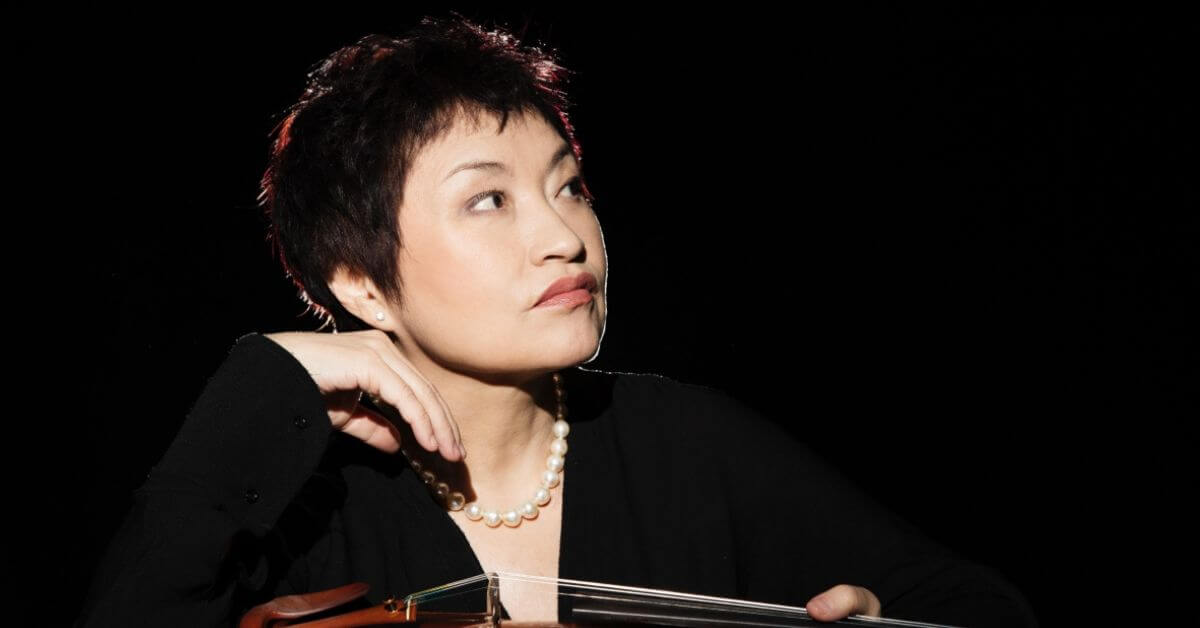
As one of the early Asian classical music stars, Kyung Wha Chung shot to fame by co-winning the 1967 Edgar Leventritt competition with Pinchas Zukerman.
A dominating figure in the 1970s and 80s, performing all over the world, Chung unfortunately had to step away from the stage, as illness, family life, and injury made heavy demands. Since then, Chung has performed sporadically, focusing on educating the next generation, but many took her fiery mastery of the violin to heart, and on the last day of this rare eight-city tour, Koerner Hall was full of lifetime admirers of this living legend.
Kevin Kenner, a gentle, supportive pianist with infinite colours on the piano, is not a mere accompanist. At age 17, he was an international Chopin competition finalist, and went on to win the second prize ten years later — there was no first prize that year. Along with 3rd prize at the Tchaikovsky, Best Performance of Chamber Music at the Van Cliburn, Kenner’s mastery of the piano is undeniable.
As the hall filled with a mature audience, along with a few young ones who came to witness the legend in flesh, there was an inevitable contemplation about age. We often say that with age comes experience. And with experience comes the space to take time, and be centred, and to become who we meant to be, and who we could be. But how many of us actually get there — and would we know when someone gets there?
Chung, making waves as a first-generation Asian classical superstar, along with Mitsuko Uchida, Yo-Yo Ma, and Đặng Thái Sơn, must have faced so many obstacles. Even today, or especially today, musicians and everyone else are faced with societal pressure to conform to a chosen prototype. The flood of edutainment and attention-grabbing reels, envy-inducing status chasing, and the current adaptation of capitalist culture into all things appropriate and inappropriate make it quite difficult for all to simply be.
How often have people, especially women, been criticized for their concert attire, their musical and personal mannerisms, and lack of professionalism? Are all Asian musicians technical with no sense of musicality? Are women not capable of conducting? Is one’s clothing too revealing, or too non-distinctive — are your performance and programming absolutely focused on maximizing business impact? Isn’t it true that music now mostly runs as a music business: are you playing too many old hits, or are your new music choices too pretentiously avant-garde?
With countless studio edits, meticulous preparation, and tight execution, from the way one enters the stage, to which direction the performers bow out, to encore choices that may rock the boat by their political association (determined by who?), current classical music, as glorious as it is, has lost some crucial humanist aspects. The young generations are trained to keep an eye on their popularity growth and media relevance. How many reels are you putting out, and whose interpretation should you modulate? How do you make yourself instantaneously distinctive, yet relatable to the largest mass possible — and contrary to all of that, are you being true to yourself?
The Program
With such a busy backdrop, Chung-Kenner’s program, featuring three well-loved works — Schumann’s first Violin Sonata, Grieg’s 3rd violin sonata, and Franck Sonata — was a provocative performance of Romantic style, where the pair stayed disciplined and beautifully constrained, allowing the few climactic soarings to become spectacularly special.
These works, often seen as a part of a student curriculum, pose a shared challenge regarding pacing. The tumultuous compound six meter of Schumann, impetuous offbeats and glacially slow, yet huge buildups in the Greig, and large scale drama of Franck, often takes the players into an irreversible maelstrom, where music spins out of control, and the musicians become tragedy themselves, as they struggle to reestablish time, space, and phrasing — tumbling down the stairs, head first, arms flailing. And the current interpretations often leave us gasping, as all dramatic turns stay hyper-intense, exaggerated to maximum effect, at all times, just like cinemas where all sounds are turned up to 11.
Performance
Chung’s sound wasn’t thundering big, nor was it aggressive. Rather than pushing through time and grinding against the decibel challenge, Chung, though sometimes sounding a bit faint for ears that have been trained by screaming media, kept her own pace. The contrast to this luxuriantly unhurried pacing was her feline flexibility; her judicious use of spacing and sharp, distinctive articulation that contrasted with her large-scaled phrasings, kept the audience on the edge of their seats.
Kenner, who was clearly challenged with capricious surprises from Chung at times, responded with grace and charm. His incredible dynamic range was not about decibels or loudness. A proper dynamic range creates a whole dimension of movements and gestures, creating an added dimension of psychoacoustics — it’s not the volume level, but the way he creates motions that do not overpower, which is wonderful.
To support Chung’s sound, Kenner tamed the piano to exist in a smaller dimension, but with additional definitions to make both their sounds audible, conversational, and beautiful.
This particular quality about the Chung-Kenner symbiosis is nearly impossible to describe. How do you tell when two persons are still reactive to one another, while performing these canonic works that we are all so familiar with? What do we mean when we say the work feels fresh, organic? It is impossible to sense these feelings from a recording. It is becoming incredibly rare to witness on stage as well. Even in rock concerts, where rowdiness and spontaneity once ruled with ease, performances are becoming more and more set in stone, especially with heavy multimedia incorporation. When your backscreen video runs at 3:44, you cannot simply play for 3:34, nor 3:54. And we all lose something when we become inflexible, no longer reactive; it’s simply not human.
While attending this concert, being in the presence of this 77-year-old legend and her soulmate musical partner, we got generous phrasing, with true spontaneity, instead of brutality and violence, neck-breaking turns, and compression that makes your ears pop.
Final Thoughts
The most beautiful contrast of the program was between the opening of the Schumann, the very first thing on the program, and the first encore: Debussy’s Bon Soir. The melancholia and endless yearning from a young, yet dying Schumann, matched with the incredibly long breadth and endless yearning for eternal beauty set in Paul Bourget’s poem, looking at death from the opposite perspective, was brilliant.
…Un conseil de goûter le charme d’être au monde
Cependant qu’on est jeune et que le soir est beau,
Car nous nous en allons, comme s’en va cette onde:
Elle à la mer — nous au tombeau!
The impact of these two musicians at the peak of their maturity, simply playing the music they love, and witnessing Chung taking whatever fancy she wanted, was a welcome change in the highly polished, no-surprises-allowed world of current classical ideals. How wonderful it is to be human and to have friends, to be together, to exist, and to play together.
Are you looking to promote an event? Have a news tip? Need to know the best events happening this weekend? Send us a note.
#LUDWIGVAN
Get the daily arts news straight to your inbox.