
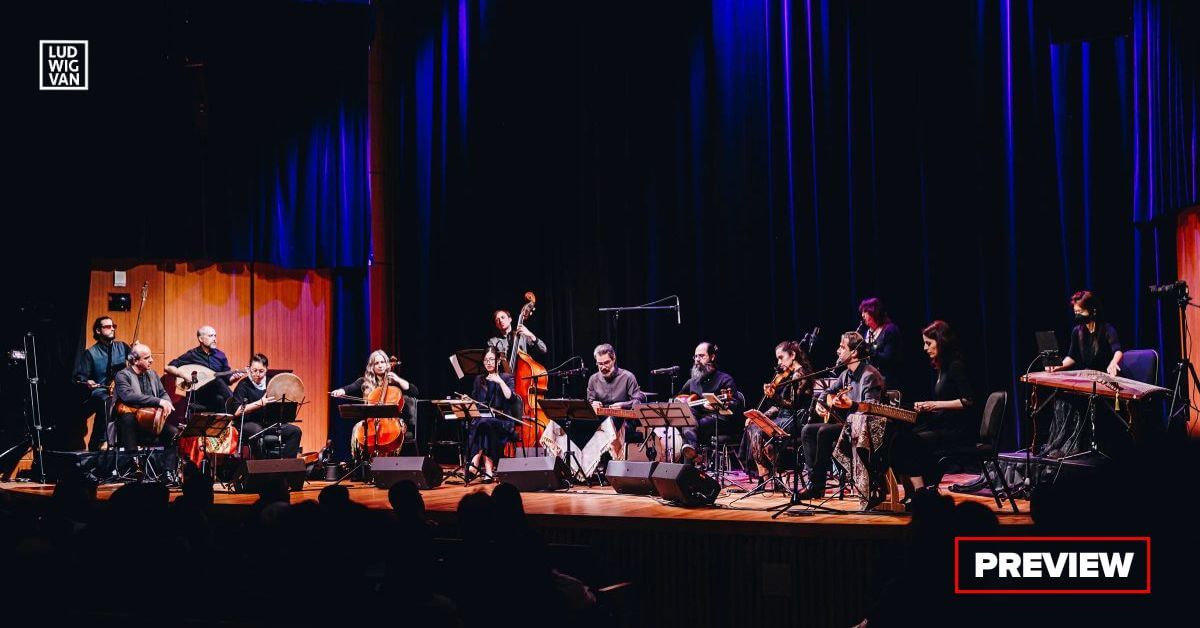
The Labyrinth Ensemble is kicking off a tour of Southern Ontario this weekend, including seven stops between November 8 and 21. The tour starts with a concert at Toronto’s Aga Khan Museum, and makes stops in Bancroft, Midland, Peterborough, and Ottawa, before winding up with two dates in Mississauga.
The 12 musicians of The Labyrinth Ensemble come from a variety of musical backgrounds, and they’ve spent four years developing their sound, experimenting with and promoting the modal musical traditions of Central, West, and South Asia, and the Mediterranean.
The touring members of the Labyrinth Ensemble are Sadaf Amini, Julian Anderson-Bowes, Yang Chen, Burak Ekmekçi, Michael K. Harrist, Roa Lee, Naomi McCarroll-Butler, Sasan Salaseli, Araz Salek, Marta Solek, Tev Stevig, Aysel Taghi-Zada, and Amely Zhou. They perform on a wide range of instruments from santur to gayageum to lyra.
The tour essentially marks the graduation of this cohort of musicians, and highlights the founder of the original Labyrinth in Crete: Ross Daly and longtime collaborator Kelly Thoma, who will be joining them on the tour. A new cohort will be announced at the Labyrinth Ontario 2026 Fundraiser.
Labyrinth Ontario
Labyrinth Ontario was created to promote the modal music traditions of Central, West, and South Asia, along with the Mediterranean region, and to training artists who work in those traditions in the Greater Toronto Area. The end goal is to create a global hub for performance and training in modal music in Southern Ontario.
The organization was formed as a non-profit in 2017, and they work to program concerts, hold workshops, and share videos of the modal music tradition. The Toronto organization was inspired by the Labyrinth Musical Workshop in Crete, Greece

Modal Music: In a Nutshell
In tonal music, the root note and chords related to the major or minor scale become the tonal centre of the music, by and large, with harmonic progressions based on a specific root pitch. Modal music, in contrast, is based on scales and static harmony, often using a drone, i.e. a tone, note, or cluster of notes that is sustained throughout a section or an entire piece.
Up until about 1600, Western classical music was also modal — including Gregorian chants, for example, and Renaissance madrigals, which blend both modal and tonal elements. Around the mid-20th century, modern jazz also largely shifted to a modal rather than tonal approach, emphasizing improvisation over modes rather than chord progressions.
Modes include the major and minor scales of traditional Western music theory, but also include several other scale sequences using different patterns of tones and half-tones.
- The C major scale, for example, is C D E F G A B C
- The D Dorian mode is D E F G A B C D
It’s more than a difference of notes. Like modern jazz, traditional modal music also involves improvised melodies performed over the modal framework.
Outside the Western sphere, much of the traditional music from around the world uses a modal framework.
The Labyrinth Ensemble with Âriâ Mohâfez in a workshop at the Aga Khan Museum earlier this year:

Labyrinth Ensemble Tour
The Labyrinth Ensemble Tour includes seven concerts across Southern Ontario; details below.
- November 8 at the Aga Khan Museum – Toronto; details here
- November 9 at the Bancroft Village Playhouse in Bancroft with Tweed & Co; details here
- November 12 at the Midland Cultural Center in Midland with Brookside Music Association; details here
- November 14 at Sadleir House in Peterborough; tickets available at the door, or at Blue Streak Records (394 George St N) in advance; details here
- November 15 at Glebe-St. James United Church in Ottawa with Debaser; details here
- November 19 at Hazel McCallion Library in Mississauga – Labyrinth Quartet with Chamber Music Society of Mississauga; details here
- November 21 at Erin Mills United Church in Mississauga with Chamber Music Society of Mississauga; details here
Are you looking to promote an event? Have a news tip? Need to know the best events happening this weekend? Send us a note.
#LUDWIGVAN
Get the daily arts news straight to your inbox.